

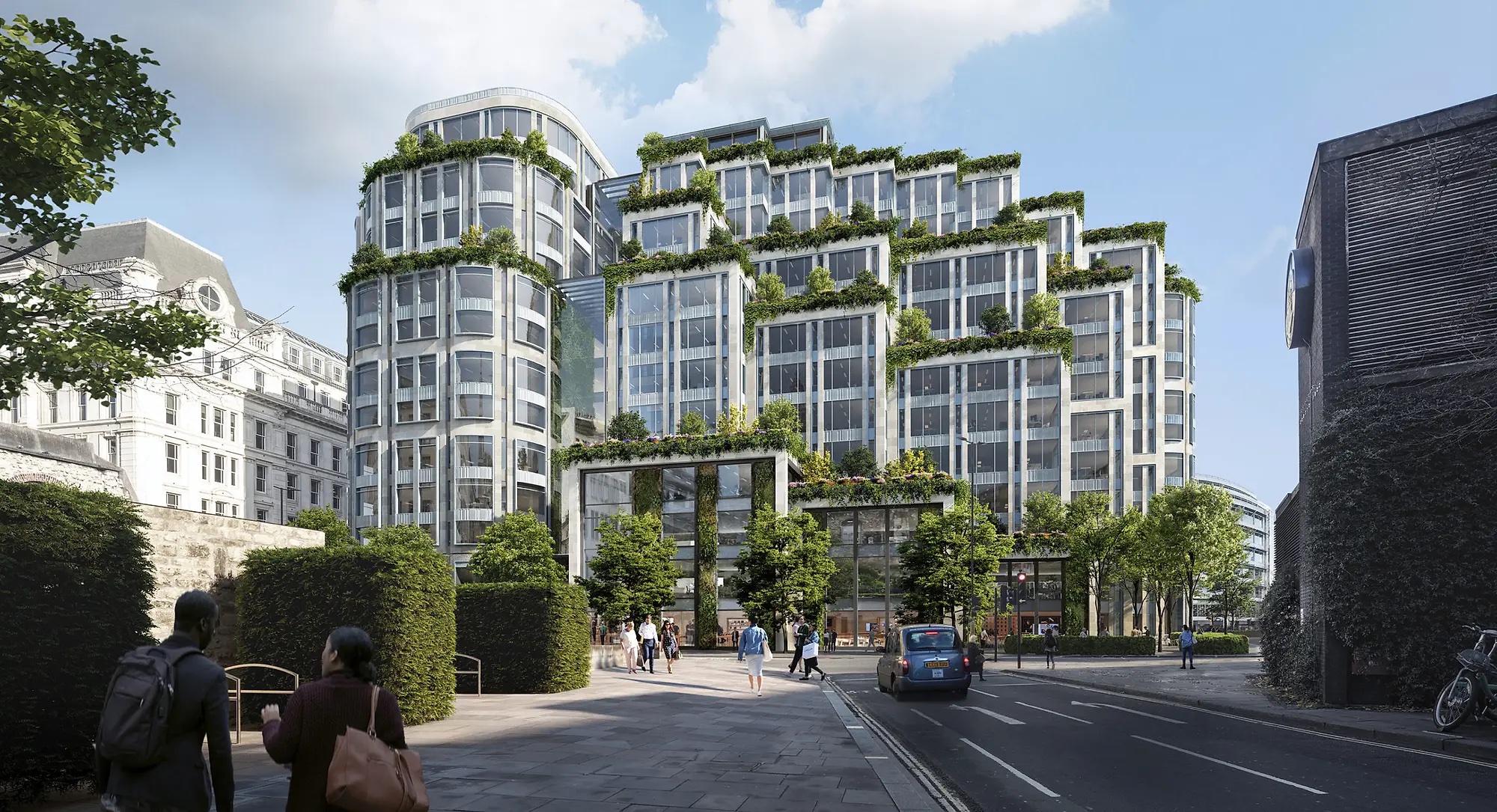
Panorama St Paul's is an ambitious adaptive reuse project developed by Orion, transforming a substantial office building in the heart of London. Before visiting, I had heard a bit about the project from the architects, and chat in the market – particularly around HSBC’s pre-let – so was wondering what the fuss was all about.

Upon arrival at the site, there was a long walk along safe routes to the site meeting rooms, which allowed a cheeky preview of the types of interventions that the building has seen, hinting at the extensive work being done. After a presentation from Paul Simovic (Principal at architects KPF) and Louis Harrison (Project Director at Mace), and now fully clad in PPE, I was eager to see the changes up close.
The existing building – 81 Newgate – dates from the early 1980s, and was designed by the government’s Property Services Agency for BT. The existing cores were in the ‘wrong place’ for modern office use, leading to short core-to-glass distances. During the tour, we saw how new cores had been formed within previous atrium space, creating deeper floor plates and enhancing future flexibility. Through extensive reuse of structural and façade materials, the up-front carbon of the scheme has been estimated to be less than half that of the equivalent new-build.
As well as designing alterations to the concrete frame, structural engineers AKT II have designed a new steel frame with composite slabs to infill the south-west quadrant of the building. By demolishing several storeys of heavier reinforced concrete flat slabs and rebuilding using a lighter construction, four additional floors could be added whilst avoiding changes to the foundations. We observed how these new elements connected with the existing frame, using a range of some ingeniously elegant and some awkwardly industrial connections, depending on how the constraints of levels and existing reinforcement density at these interfaces have conspired to help or hinder the design.
One of the most impressive aspects of the project is the reuse of stone. The previous building was clad in hand-set stone, of which 95% has been successfully recovered, cleaned and reused in the new precast façade. This includes 388m3 of Portland stone and 37m3 of granite, with a new panel arrangement optimised to achieve such a high level of reuse.

The project is nearing completion as a shell and core, allowing for HSBC’s fit-out team to complete the new office product. However, the new roof terraces are being completed in the base-build, with finishes and landscaping in progress during our visit. These private terraces are the standout feature of the building from a future occupant’s point-of-view, with the main roof offering stunning views of St Paul's Cathedral and the skyline beyond.
During construction, the client team instructed a significant change to improve the floor plate, by combining two grids of relatively closely-spaced columns into one. This has resulted in the creation of a enjoyably striking steelwork detail, with large shear heads cantilevered from the new columns to support the existing concrete slabs. I really hope that HSBC and their fit-out team retain some of the visibility of these details and the various interfaces between new and old, so generations of bankers to come can appreciate the history of the building and the clever technical solutions the construction industry has devised to grant 81 Newgate another life.