


Rebranding retrofit as ‘FutureFit’ to generate a more positive, forward-looking image and removing or reducing VAT on refurb projects, with developers incentivised to pursue retrofit first through a reward based planning approach, were suggestions at CAF’s Retrofit at Scale event, hosted by architect and design firm Gensler.
Gensler’s Co-Managing Director Richard Harrison welcomed members and guests to the firm’s London office overlooking the City skyline, and where Gensler has been carrying out its own ‘FutureFit’ recycling of the firm’s offices, he said.
Harry Cliffe Roberts, Principal and Global Building Transformation Leader, introduced the industry guide Retrofit at Scale, produced in partnership with Opportunity London and launched last year, with a view to unlocking commercial opportunity and capital investment.
His presentation framed retrofit not as a niche sustainability agenda, but as a mainstream, investable solution driving long-term value. He shared how Gensler and Opportunity London convened a cross-disciplinary working group to ask a fundamental question: what’s holding retrofit back, and how do we move from ambition to implementation?
‘Wholesale demolition has to be a thing of the past’, he argued, when ‘an era of unbounded authorship’ for architects had come to an end. ‘Why isn’t retrofit the default response?’ he said. There was an issue around ‘behaviours and attitudes, with ‘retrofit’ being regarded as ‘a second-hand product,’ he argued. ‘We have to challenge that. Retro-fit is the wrong term. We need a rebrand.’
Harry introduced his concept of ‘FutureFit’ – a reframing of retrofit as something inherently forward-looking. ‘Why is something so critical to our future branded as rear-facing? While retrofit is one of the most progressive and resilient design strategies available to us, positioning it as FutureFit shifts the mindset – designing with the existing, for the future – but also designing with future changes in mind.’
He explained the guide’s five essential pillars – Design & Delivery, Education, Policy, Behaviour & Attitudes, and Value & Demand – each addressing critical blockers that limit retrofit adoption. From embracing digital tools and shared material hubs, to strengthening industry–academia collaboration, aligning policy frameworks, and redefining how value is measured, the presentation made clear retrofit at scale requires systemic change as much as technical innovation and cultural shift.
The guide doesn’t stop at diagnosis. Attendees heard a snapshot of proposed actions to shift the needle. The guide doesn’t have all the answers, but aims to hold space for the conversation – creating a shared framework that enables the industry to tackle these challenges collectively, in tandem and in a common direction. A new model is needed for the industry to operate effectively, and it’s clear that the current frustrations and barriers to adopting reuse stem largely from ambitions clashing with an outdated model.
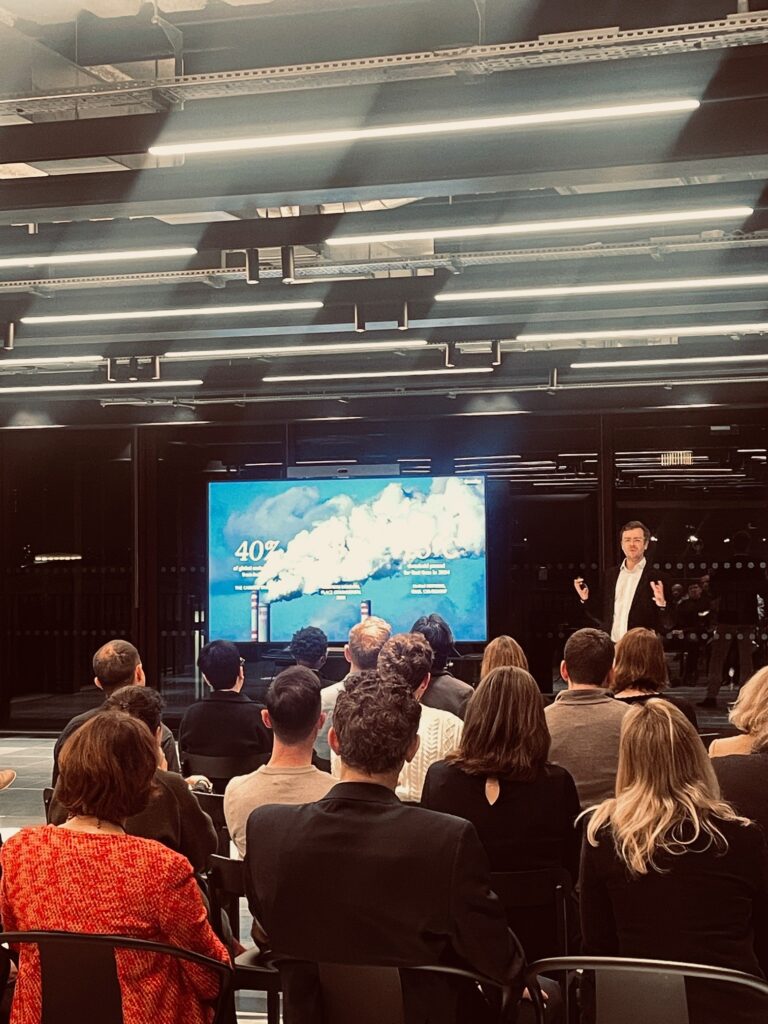
The Q&A was lively, reflecting a shared recognition that while challenges are complex, there is appetite and momentum for change. There was a collective passion to make retrofit happen.
Rob McNicol, Assistant Director of Policy and Strategy and Kerstin Kane, Principal Planning Officer (Sustainability) from the City Corporation attending, invited Harry and the audience to consider what future policy incentives could make retrofit a more attractive development pathway and to submit representations on the City’s draft SPD Planning for Sustainability (adopted in February 2025 but to be updated for the new City Plan 2040 due to be adopted this year).
This sparked discussion on removing taxation barriers and exploring a credit‑based system – similar to New York’s Local Law 97 – to stimulate innovation and reward more ambitious ‘FutureFit’ schemes.
Other points raised were that the new draft NPPF seems to say ‘less about retro-fit than the previous version’. Also, should the RIBA’s Plan of Work, a widely used model for the design and construction process, be changed to include a requirement to consider retrofit?
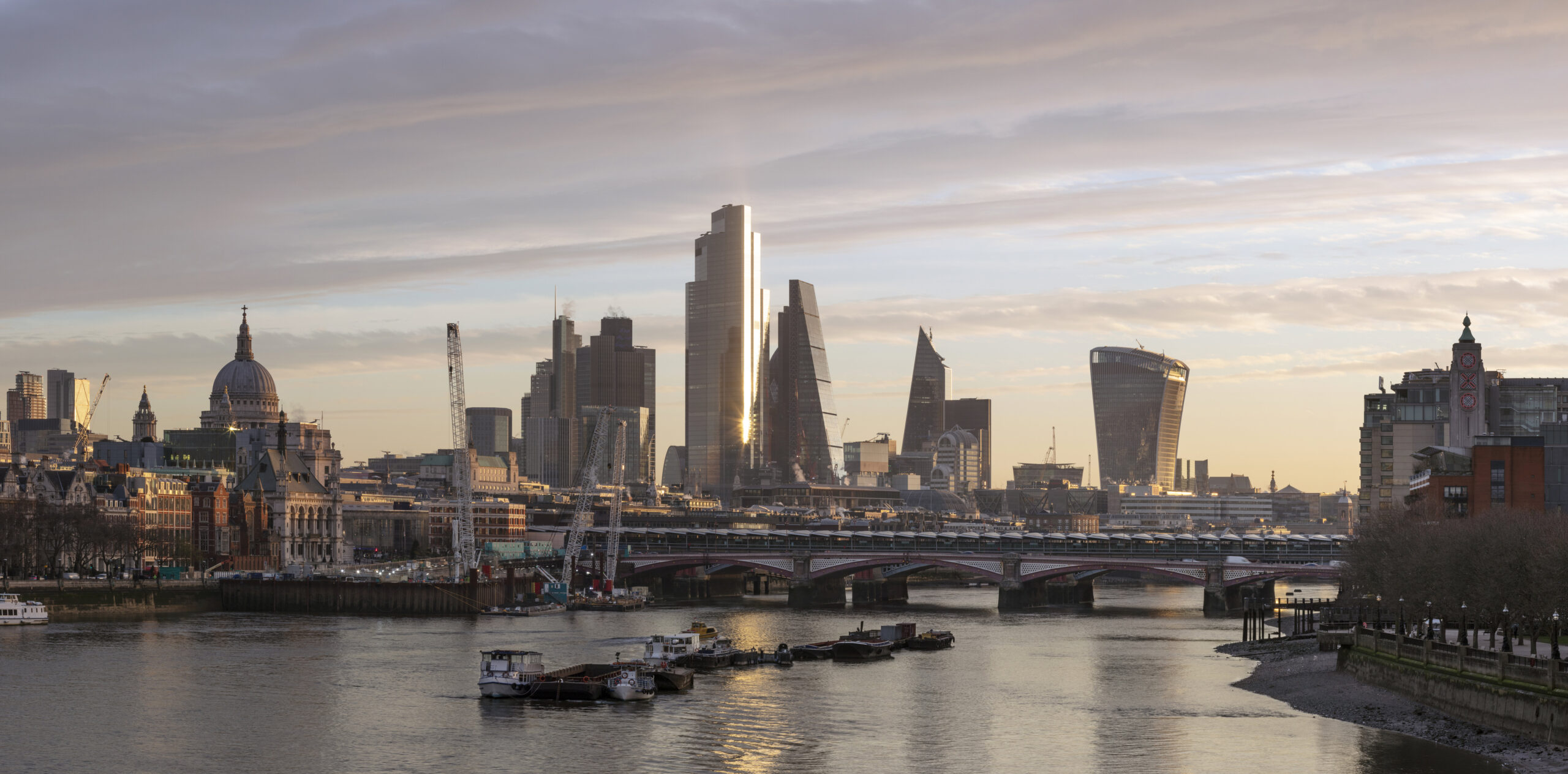
The evening concluded with continued conversations as guests connected across disciplines and perspectives. With the London skyline as a backdrop, the event felt symbolic, overlooking a city full of existing buildings, and an industry increasingly aligned around the opportunity to reimagine them.
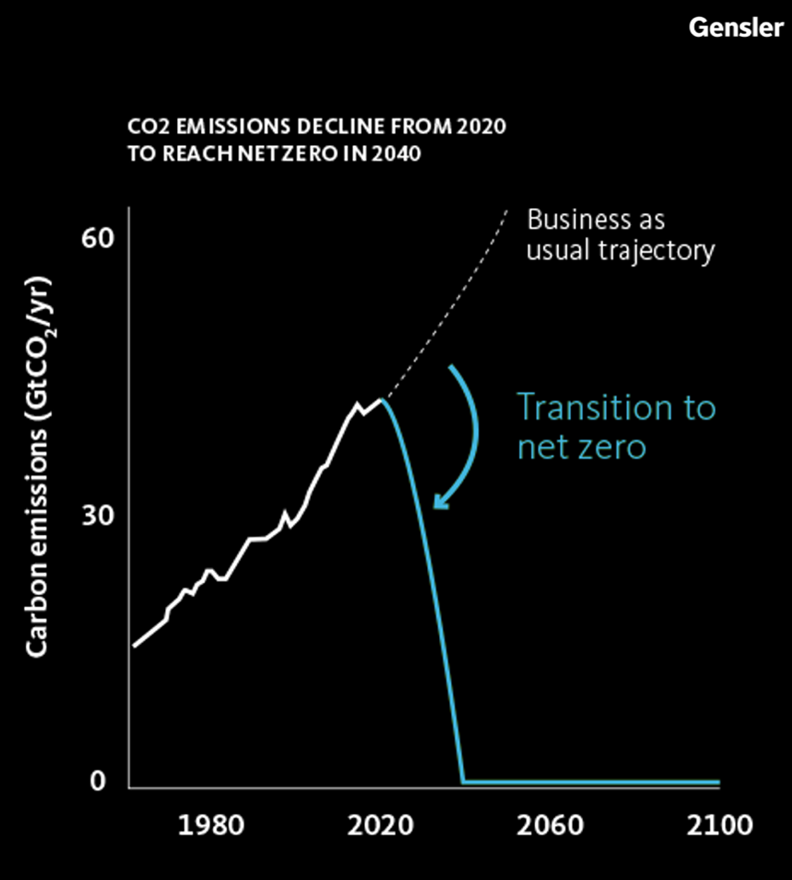
The blue line shows the decline in emissions required to meet net zero in 2040
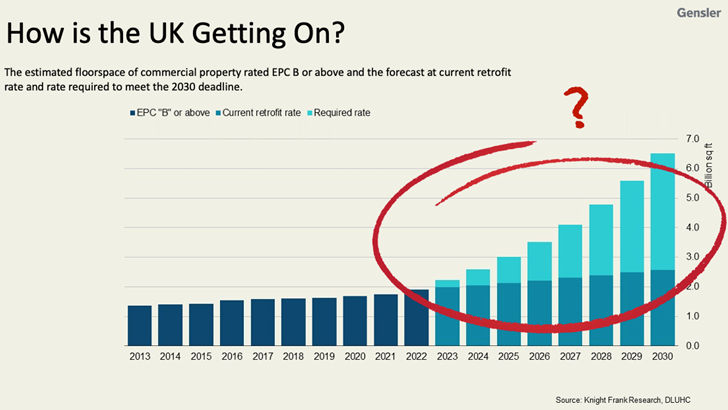
Estimated floorspace rated EPC B or above, showing the current rate of retrofit to the target date of 2030 in mid-blue, and the required rate of retrofit to meet EPC B or above