


‘CAF 2.0’ forges ahead
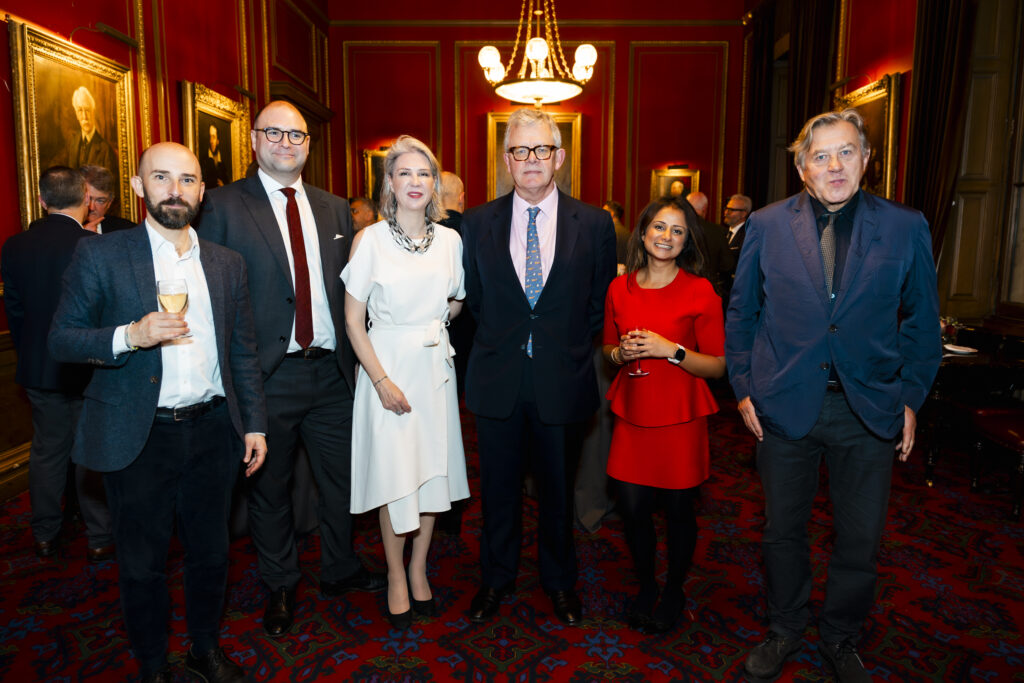
2025 was the first year of ‘CAF 2.0’ – an evolution of the Forum responding to the new era opening up in the City of London, and to look ahead to 2026, our 35th anniversary since we were founded in 1991. So, what has changed? Our new Operations Director Jenny Adler-Potts joined us in late 2024, who you will all have met by now. Jenny has quietly and efficiently been able to action the Forum Committee’s ambitions to up our game and build our profile through the year. We have also, with Jenny’s help launched this new website – one that is fully functional and easy to navigate. It is packed with information on forthcoming events and reports on previous site visits and building tours and you can easily book events online and renew subscriptions. Usefully for members wanting to reach out, you can also create and update your own professional profiles – so, if you haven’t already, please take advantage of this new facility. We’ve been able to significantly expand our events programme because of this improvement in operational efficiency. By the year end we delivered an unmatched 19 events, with a mix of talks, building tours and site visits. The year’s programme concluded with the final part of the very successful Gracechurch Series, brilliantly conceived and hosted by JJ Sarralde of The Townscape Consultancy and, another first, a joint drinks party with The London Society at the Reform Club. Highlight of the year was another sold-out highly enjoyable annual dinner in November at The Mercer restaurant with two fantastic speakers demonstrating the Forum’s continuing relevance and reach – Tom Sleigh, chairman of the Planning & Transportation Committee, and, on his first public outing, Robin Dobson, the new chief executive of Platform4, Network Rail’s new property company. A lively Q&A ensued. Your committee will build on this change in momentum in 2026. We plan a mixed programme of site and building visits across the City including further talks at Temple Bar and a number of events already secured for the first part of the year – including on 15th January a tour of the Grade-1 listed Custom House overlooking the Thames. And of course we will be marking our 35th anniversary with a party – further details in due course. Thank you for your support throughout the year and I look forward to seeing you in the New Year. My best wishes for the festive season. Andrew
TBC . London: going for green and social impact
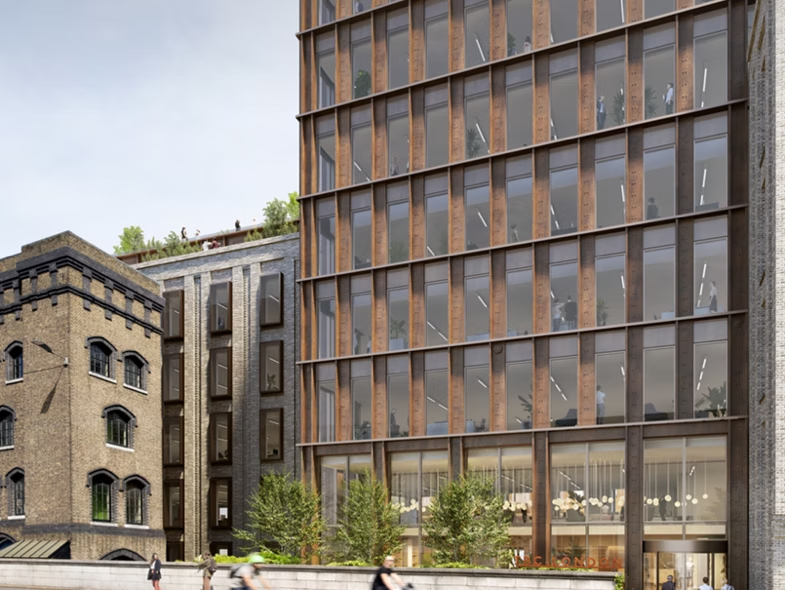
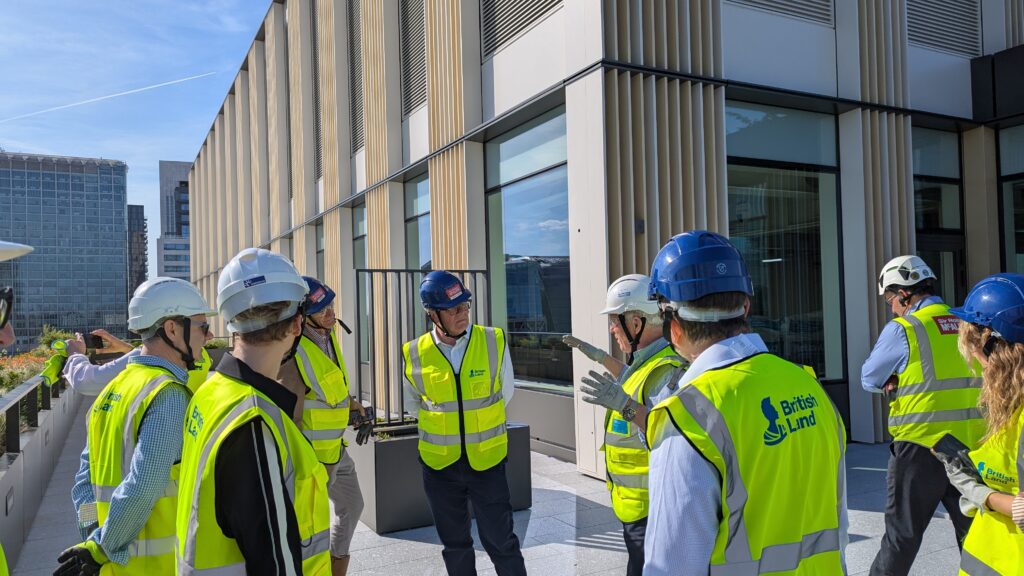
What is probably the best view of the City core’s cluster, CAF members agreed on their recent tour, is now available from the northern roof terrace of TBC.London – an environmentally and socially impactful remodelling of an unlovely 1980s building at 224-226 Tower Bridge Road, south-east of Tower Bridge that also fronts Shad Thames. Developed by FORE Partnership and designed by architects Stiff + Trevillion the original building was bought from an owner occupier in 2018 with development starting during the pandemic. FORE is an interesting developer operating in the UK and Europe, run by Managing Partner Basil Demeroutis. The company is one of a handful of property B-Corps, describing itself as “a purpose-driven, real estate investment firm with a holistic approach to carbon reduction, design, technology, and community”. These are comprehensively addressed in TBC.London, as the 110,386 sq ft (NIA), eight-storey scheme has been renamed (it was formerly Tower Bridge Court). It is 100%-electric in use, so no fossil fuels are required and will be net zero carbon in operation. Each of the two million items used in the building’s refurbishment and re-use were measured using a piece of AI-driven tech to obtain accurate carbon measurement, Demeroutis told CAF members. Much of the existing building’s frame was reused, and where the new double height reception has been created and existing floors extended, 20 tonnes of 1930s steel beams were salvaged from the former House of Fraser store on Oxford Street and re-used in TBC, saving an estimated 48 tonnes of CO2 compared with using new steelwork. The cost of doing this – salvaging, storing, cleaning, re-engineering, transporting, installing, etc – was roughly equivalent to using new steels. The carbon saving equated to the annual carbon absorbed by 20 acres of trees. Steel re-used made up 10% of the building. The building achieves NABERS 5.0*, BREEAM Outstanding, WELL and Wired Score Platinum ratings. ‘It will be in the top handful of buildings in Europe,’ boasts the TBC.London website. TBC.London has been confirmed as operating at 31.5 kWh/m2 EUI, or at least 30% better than the UKGBC (UK Green Building Council) 2025 target, using 71% less energy than a typical office building, and 78% less than Part L regulations require. Fore promise more precise measurements when the building is fully let and operational. Four floors of office space are already pre-let, prior to the scheme’s recent practical completion, to wealth management advisor Allfunds and accounting software company Sage. There is 40,000 sq ft available to let, across part first, second, fifth and the smaller eighth floor. Food retailer Blend has taken the 16,000 sq ft food hall space at the lower level, enjoying a corner frontage to Shad Thames. That total project went from 68,000 sq ft to 110,000 sq ft – a substantial 60% uplift on the previous lettable space in the building. And the whole development should make a substantial contribution to boosting activity in Shad Thames and on the Thames waterfront. Focusing on the ‘S’ for social impact, the building also includes a 3,300 ft ‘urban village hall’, a communal space for local charities and social groups to use for whatever purpose they want. A feature that Fore tries to include in all its schemes, for use also by the occupiers of the building. There are 159 basement cycle parking spaces, including a bike shower and repair space, and showers/wc’s/lockers for changing. The reception takes up a further 3,012 sq ft and there is an 1,860 sq ft clubroom on the 7th floor which features the spectacular terrace overlooking Tower Bridge and the City across the river. Stiff and Trevillion’s design is an enhancement to the Tower Bridge Conservation Area, feeling much more in keeping with its environs. The lower brick clad element to the north establishes a successful and very close relationship with the brick engine rooms for the bridge, while the curved corner between Shad Thames and Horseleydown Lane that sits above the foodhall manages to give this junction a feeling of more space. The ground floor treatment with heavy steel beams and warehouse style columns adds to the Shad Thames feel. The taller office element fronting Tower Bridge Road is set back nicely also adding a more spacious feel to this part of the busy road and helps frame the taller part of the scheme. The elevation treatment provides a much more ordered workspace elevation than its Po-Mo predecessor. TBC . London has 159 bike spaces, a bike wash and repair space Thanks to FORE Partnership and the team at Stiff + Trevillion for enabling the tour.
‘Destination in the sky’ – One Undershaft
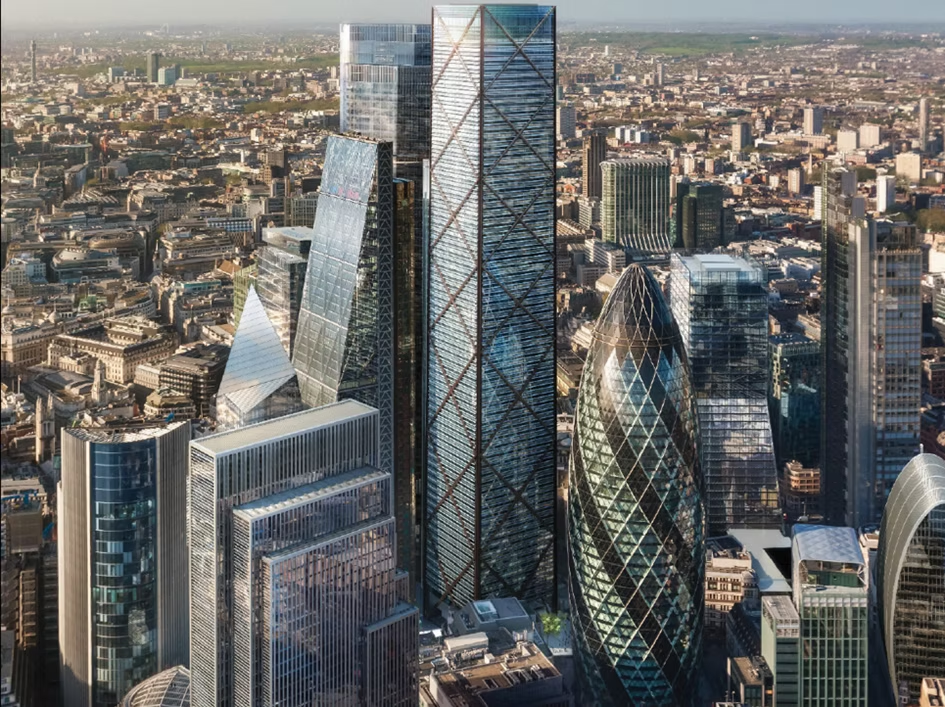
The sudden emptying of streets in the Pandemic meant ‘we started to think harder about the human elements of the City in that pause’, said Eric Parry, newly minted CBE in this year’s Birthday Honours, introducing One Undershaft to Forum members and guests at his practice’s Old Street offices. Having won planning committee approval last December, the revised 1.26m sq ft scheme is now on site. Unlike most of Eric Parry Architects’ previous work across many building types, however, the revised design of One Undershaft failed to please the architectural critics when unveiled last August. Typically, there were no complaints or comments about this in his presentation. The practice’s previous design, approved in 2016 for Singaporean developer Aroland, was a slender square-plan tower, tapering as it rose to a similar height as the new design and was nicknamed The Trellis for the structure’s criss-cross expression on its facades. Parry’s new design does its utmost to deliver the City Corporation’s ambition of ‘Destination City’, now engraved as the core policy of its City Plan 2040 and soon to conclude its Examination in Public. It increases office floorspace in a reducing series of stratified office elements that sandwich or support several two-storey public and occupier-shared amenity layers. The topmost element of the design replicates the height and square plan of the previous design, and also retains the classical ‘entasis’, a visually-pleasing tapering effect (also used by Lutyens on the Cenotaph). One Undershaft replaces the demolished Commercial Union Tower, guardian since 1969 of St Helen’s Square which it overlooked. A well-crafted relic of mid 20th Century Modernism designed by Gollins Melvin Ward, it was a fine Miesian tribute, if rather severe. But neither it, nor the earlier 2016 scheme, offered so much ‘human’ or public amenity, other than their presence and appearance as refined sculptural ‘objects’ within the City cluster, providing almost solely offices. One Undershaft is a more complex urban response to the City’s new planning agenda and post-Covid cultural drivers in how we live and work. All major schemes have to evolve during their long gestation – time being the old enemy to any developer’s equation. Schemes usually need to get bigger to restore viability and deliver enhanced amenity. And if it isn’t appropriate or viable to go taller, then something needs to happen in the mid-section to improve viability and fund amenity. What helps manage this evolutionary process in the City, said Parry, are the many, many ‘conversations’ enabled between all parties to hone a project captured by radical changes in circumstances. These ensure future need is addressed when required and opportunity knocks. Parry observed such intense and productive creative exchanges were not customary in other European cities. That is traditionally how the City remakes itself and keeps it alive. The new scheme will provide 1.26m sq ft of all-electric offices, possibly by 2031 – equivalent to 10% of the new office space that is required, estimated by City planners. The market is currently favourable. Expanded mid-section elements of office space extend over St Helen’s Square, and as recompense a new upper public podium garden has been introduced on Level 11, projecting out over the remodelled square. The podium garden features a central glazed oculus that can be walked upon, for those of an adventurous disposition. Its tongue-like form also attracted much comment. A 35% uplift in total public realm for ground level improvements and the podium garden is claimed. The two top floors, finished in red, London’s traditional colour, will signal to the whole city, and are reserved for a viewing gallery combined with an outpost of the London Museum. ‘London kids will be able to get a glimpse of Margate on a clear day,’ quipped Parry. Structure, colour and materiality of the new scheme should distinguish it strongly from nearby buildings. ‘It is a white building,’ said Parry, pointing to a sample of the proposed brise-soleil and spandrel cladding elements. ‘We didn’t want another all-glass building.’ The wrapped fractal ‘skin’ of the podium, also white, should prove usefully reflective. The cool colouring and dominant horizontality of the façade treatment will contrast strongly with the verticality and orange rust-finish of the nine exposed and enormous Corten steel ‘redwood trees’ that surround and support the whole edifice as it rises 74 floors to almost 300m. That’s similar in height to the Shard – and the Eiffel Tower – which, even on a clear day, you may still have to picture for yourselves. With thanks to Eric Parry Architects for hosting.
Mid Year Review 2025: Reading the heartbeat of the Square Mile
As I pondered possible themes and topics for this half year report, I cast an eye over the events we have held in the first six months of 2025 and began to think about what linked them, and how they characterise what the Forum aims to do. The roster – which has included events almost every month – covered a fascinating spectrum that provided us with an architectural ‘electrocardiogram’ of the City, and its ever-changing nature. Together, they describe the ‘heartbeat’ of the Square Mile*. What does that tell us about the health and future of the City? That there is much to be optimistic about in terms of its continued growth and relevance. Indeed, this is the tone of the draft City Plan 2040 – essentially the City of London Corporation’s development manifesto for the next 15 years – which speaks of how the City intends to respond to the evolving workplace, and the need to address issues of diversity, sustainability and opportunity. City Plan 2040 recognises that cities need to have a mixed and vibrant offering – with residential, arts and culture and community spaces alongside places of work – for them to not only to be desirable for those who work here but also a ‘destination’ for visitors and tourists alike. We are witnessing this change and shift taking place ‘live’ and, through our events, we give you access to and visibility of these developments. This, for me, is the great attraction of the City Architecture Forum – it stays close to ‘place’, it reads its ‘heartbeat’, and provides us with a continuous and compelling commentary on the constant evolution of the City and those that shape it. We are afforded privileged glimpses of the future and cherished views of the past. We are connected to this intriguing organism and our mission is to share this with you through our own particular melange of fireside chats, panel discussions, talks, and building tours and visits. We recognise the need to keep our organisation evolving, so the second half of the year will see us trialling a new programme of member-only dinners, featuring interviews and conversations with prominent industry figures, and a website refresh in Q3 – which we hope will provide better access to the Forum’s events and membership information. Much to look forward to over the next six months! David Magyar – Hon Sec Read our LinkedIn article for a full account of the events of the last 6 months. https://www.linkedin.com/feed/update/urn:li:activity:7333031724773249024
40 Leadenhall: More of the Metropolis
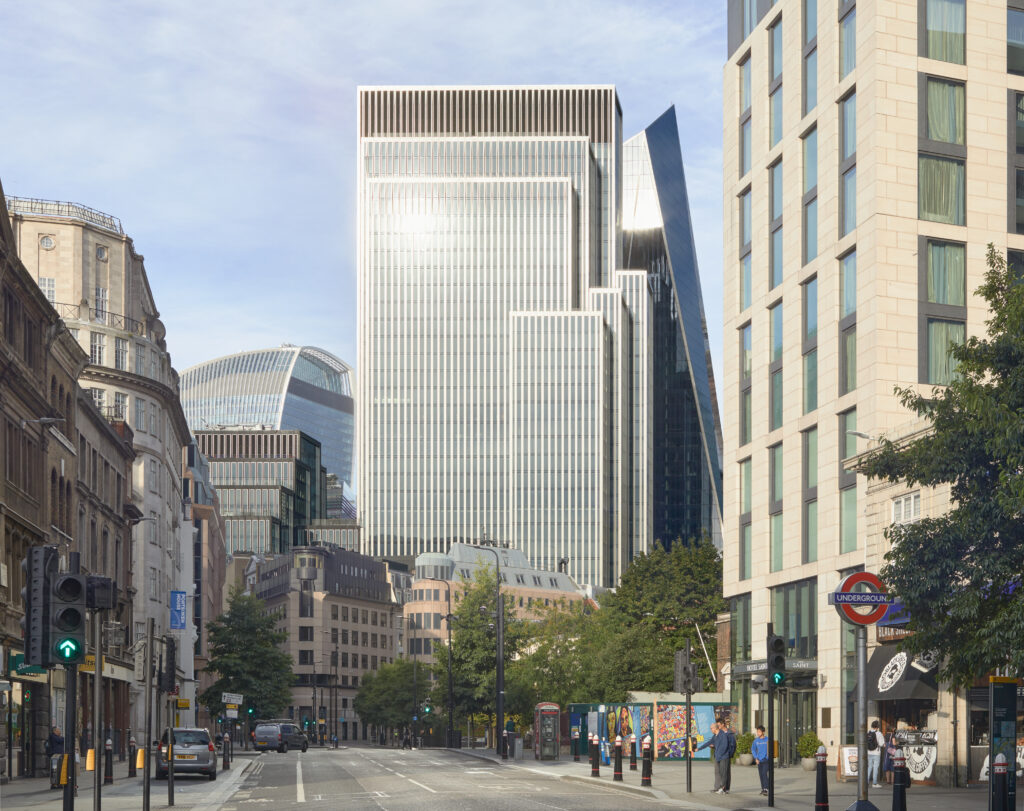
Image courtesy of Make Architects On a sun-drenched afternoon in early April, members of the City Architecture Forum filtered through the thirsty Leadenhall Market to arrive at an exclusive tour of 40 Leadenhall. A striking and unavoidable new presence on the City’s skyline and one of the most ambitious commercial developments to emerge in the Square Mile in recent years. Once dubbed ‘Gotham City’, 40 Leadenhall commands attention not with height alone, but through the boldness of its architectural language: a series of layered volumes stepping skyward with geometric poise; aptly bookending the cluster. Designed by Make Architects and developed by M&G Real Estate with Nuveen Real Estate, the scheme delivers over 900,000 sq ft net of high performing office space across a dynamic, and a tiered form providing many outdoor spaces (17 to be precise). The tour, guided by Cara Bamford of Make Architects and Andrew Todman of Gleeds (formerly Avison Young), presented a rare opportunity to step inside this landmark and gain an intimate insight into the project’s vision, complexity, and delivery. From the ground up The group gathered at the building’s generous north entrance where light danced off orthodox façades and crisp lines invited the eye upward. Already, the building makes a statement, not just as a feat of scale, but as a symbol of modernity rooted in context. The structure sits comfortably among the City’s evolving ensemble of towers, yet carves out its own identity through thoughtful massing, refined materiality, and intelligent urban response – almost naturally integrating with the history of the streets. Our hosts began the tour with an overview of the site’s history, the constraints and opportunities of its central location, and the conceptual principles that shaped the architectural form. It quickly became evident that this was not simply a tall building; it is the result of laborious design thinking, strategic collaboration, and confidence in the city, even with COVID-19 shutdowns looming upon breaking ground. Tall oaks from little acorns grow As we moved through the internal spaces, Cara described the design team’s ambition to create a new model for high density and high-quality workplace environments. The tiered form not only creates a dramatic external silhouette, it responds to light, views, and urban grain, preserving key sightlines while allowing natural daylight to permeate deep into the floorplates. Inside, the sense of volume is palpable, with the receptions boasting up to 8.5m of floor-to-ceiling height space. Consistent and expansive floorplates offer flexibility for a range of occupiers, while triple-height spaces and high-performance glazing create a feeling of openness rarely found at such a scale. The internal planning reflects contemporary demands for adaptability, wellness, and energy efficiency. Every decision, from materials to mechanical systems, has been approached with performance and longevity in mind. For instance, the floorplate had been designed to split into three, yet out of the 34 storeys, only two have taken this route – which is testament to the obsession of open-plan and the scale of tenancy. Principle project management Andrew then brought the conversation into the realm of project management and delivery. From what appears to be back-to-front procurement strategies to construction logistics, he shared the challenges of carrying a project of this magnitude in the heart of one of the world’s busiest business districts, and how the unique order of packages enabled a much tighter programme in the long-run. He spoke to the sheer complexity of the build, including the coordination of multiple work streams, the interface with neighbouring structures, and the need for constant collaboration between consultants, contractors, and stakeholders. He offered insight into how the team navigated programme pressures, supply chain dynamics, and technical innovations to maintain momentum and quality throughout. What shone through was a deep commitment to both precision and partnership on the foundation of a digitally native toolkit. The success of 40 Leadenhall is not just a story of architectural ambition, it is a triumph of orchestration, in a scale of bedlam that should not work on paper. Sustainability and the future workplace A core focus of the tour was the building’s sustainability credentials. In a landscape where the environmental performance of new developments is under increasing (and justified) scrutiny, 40 Leadenhall stands as a benchmark. The design prioritises operational energy efficiency, with high-performance façades, intelligent systems, and the ability to adapt to future technological advances. Cara and Andrew both emphasised the long-term thinking embedded in the project. Rather than designing for immediate occupancy alone, the scheme has been crafted to evolve with its tenants; flexibility in services, floor layouts, and building systems means the spaces can adapt as user needs change. This forward-thinking approach reflects a broader shift in how we conceive workplace buildings, not just as static shells, but as living frameworks capable of supporting diverse and sustainable modes of working. The power of perspective Perhaps most compelling was the chance to experience the building at multiple levels. From street to summit, the tour revealed a project in dialogue with its context at every scale. At ground level, generous public realm interventions create a welcoming threshold; mid-rise terraces and setbacks offer moments of pause and reflection; from upper floors, sweeping views across the City underscore the building’s place in the skyline. Not to mention, the beautiful restoration and integration with Grade-II listed heritage building, 19-21 Billiter Street, forming an intrinsic part of the overall development with a restaurant as well as wellness facilities for building users For many attending, the highlight was the chance to witness firsthand how each architectural gesture (each panel, joint, and junction) tells part of a broader story. These were not generic office floors, but carefully choreographed spaces, shaped by insight and shaped for impact. Closing comments The feedback from members was unanimous: this was a tour that offered true depth. The level of access, combined with the candour and clarity of our hosts, made for an enriching and memorable afternoon. Many remarked on the precision with which both Cara and Andrew articulated the journey from concept to completion, a rare […]
Bishopsgate Goodsyard: Where the buddleia reigns… for now
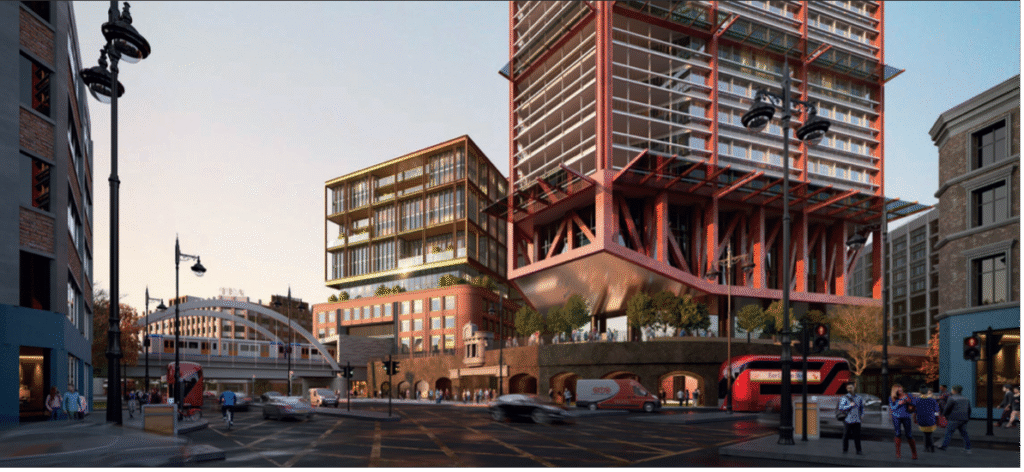
“East is best, the West is the rest” was a saying in Shoreditch’s artist-led renaissance back in the 1990s, affirmation that a new place was emerging. We’re talking pre-Tea Building and way before Shoreditch House opened in 2007 – when nearly all buildings in Hoxton Square were vacant. Times were tough and interest rates went over 10%, remember that? Shoreditch was fun – rapidly filling with “cultural migrants” – young people from elsewhere finding a place in the capital, a deserted canvas with affordable spaces for uneconomic, experimental activity. Most of the artists who moved in then have sold up and moved out, especially the YBAs who made it big. Now the coast is clear for developers to complete the job, times are tough again, but may be improving. Last June CAF visited Norton Folgate, now complete. In February we toured the nascent Truman Brewery development. And this month we visited the 4.5 hectare Bishopsgate Goodsyard, the largest of central London’s unregenerated sites. The tour was led by CAF member and local architect Chris Dyson and Hammerson’s development manager Tony Coughlan. Chris is working on the Goodsyard’s proposed new cultural building and retained buildings including a mission hall and Huguenot weavers’ houses on Sclater Street. Put Norton Folgate, Truman and the Goodsyard together, amid all the development round about, and perhaps it is time to think about what this transborder patch, once disparagingly referred to as “The City Fringe”, might eventually become. Three sites that will transform the trans-borough “City fringe (with Norton Folgate in red at centre left) Techies and affluent others have taken over Shoreditch and much of the City, reinventing banking and everything else. The Revenge of the Nerds is driving demand and increasing rents which will recast and reinvent much of the area, perhaps stretching from Farringdon in the west to beyond Brick Lane and up to London Fields and even unto Mare Street in Hackney. London is doing what it always has – reinventing itself, making new economies and remaking its places to suit. It begs the questions of how long and how far will this effect travel, and should you be building offices or homes to optimise cash flow? Hackney for one has been keen to see major offices on the business end of the site. Some local groups expressed a different view. For most Londoners the lower and upper worlds of Bishopsgate Goodsyard have been forbidden since 1964 when a fire wrecked station, depot and elevated goodsyard. The 1840 Victorian complex closed and became a forgotten citadel. Members walked up the steep cobbled ramp overlooking the mainline rail cutting running into Liverpool Street and over Bishopsgate, having emerged from the vast underbelly of the Goodsyard’s arches onto the “railway field” as it was called. This was where produce and goods arrived from East Anglia for sale before being distributed to Spitalfields vegetable market. Now the “developer’s friend” – wild buddleia reigns supreme, while surrounding new towers loom over. A start date for Hammerson and Ballymore’s main construction works mooted last year has now become “possibly” later this year, planning approval for the reserved matters application having been won for Building 1 (Gensler and Buckley Gray Yeoman) in November 2024 from Hackney and Tower Hamlets. Any hesitancy about pushing the button on this “Saturn 5” rocket of a scheme – up to 500 homes, 1.4m sq ft of offices, a 2.6 acre park, restaurants, retail and leisure, plus two culture spaces and a ten year delivery plan – in current circumstances is understandable. Ballymore and Hammerson are probably hoping a pre-let might turn up for one of the three major office buildings proposed for the western end of the schem1.4. And they might get lucky as the workspace market in the City and surrounds is looking increasingly healthy. Two phases are likely to commence to start with, one office plot and either one residential plot or the cultural building, designed by Chris Dyson Architects, along with some retail space, depending on how the market for these uses evolves in coming months. Four phases overall is current thinking. The Goodsyard will be one of the more unusual and intriguing schemes in London when built, as FaulknerBrowns’ masterplan shows. The scheme’s east-west linear “striations” dictated by the long site plan and retained Victorian infrastructure generating large differences in levels, and its “razor back” built form, quickly diminishing in height from Bishopsgate to Brick Lane in the east give it a unique form and a complex connectivity, especially from north to south across the level changes. A total of c. six acres of public realm is included. What will the elevated public green spaces, designed by Spacehub, feel like and how will the developers manage to fill and make attractive all of the large conserved arches underneath? Will a cohesive community composed of residents, with 50% of the c.500 homes being affordable, and employees working in the 1.4m sq ft of offices be formed, and will the scheme integrate with its rapidly morphing surrounds – a key goal of the masterplan. The growing shortage of major buildings to let in the City is surely a good omen that six decades of waiting for The Goodsyard’s second coming is nearly over and answers to those questions will soon be arriving at the former station.
Mixed outlook for Truman Brewery
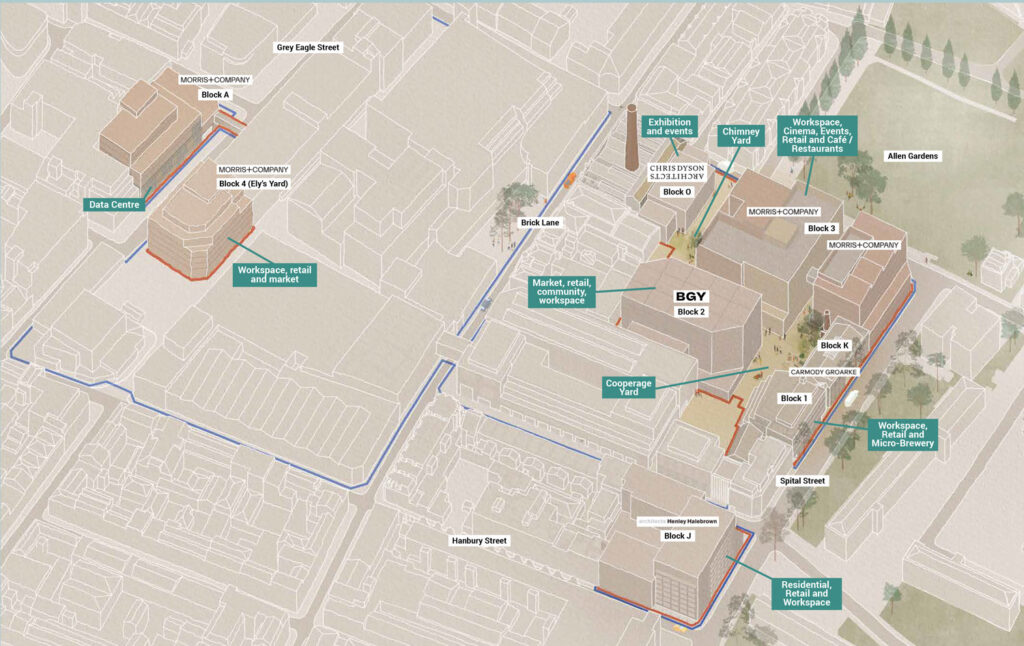
The 4 ha Truman Brewery site which members visited in February, courtesy of development manager Grow Places, like British Land’s nearby Norton Folgate site, has proved controversial and is the subject of three planning applications now in public consultation. Founded in 1666 and the world’s largest brewery by 1873 before its closure in 1989, the site lies at the heart of Spitalfields and the Brick Lane neighbourhood. A coalition of community groups established the Save Brick Lane Campaign to contest the site’s regeneration. Proposed new development will cover 1.2ha of the site, chiefly on the undeveloped parts to the east of Brick Lane. The scheme is being run under ‘The Truman Brewery’ brand. Numerous retained buildings occupy the rest of the site, some of historic value, like the boiler house with the famous landmark ‘Truman’ chimney. Above: The emerging masterplan The western part of the site now hosts creative businesses, independent shops, exhibition and event spaces, bars, cafes and restaurants and is a buzzy established part of the Brick Lane/Shoreditch scene. The eastern half remains more closed off by virtue of a perimeter wall to the north and east. Three detailed planning applications for the proposed new elements, west and east of Brick Lane, totalling 1.2ha, are now with Tower Hamlets’ planners who have been considering them since August 2024. Details are available on www.trumanbreweryconsultation.co.uk. The scheme is being managed by development manager Grow Places, led by Tom Larsson, formerly of Stanhope. Also presenting new proposals were Giles Charlton of landscape architects Spacehub and one of the architectural practices involved, Amr Assaad, director of Buckley Gray Yeoman (BGY). ‘Informal change and growth,’ has been the approach, creating new uses on the inactive parts of the estate, driven by the ‘clustering’ of users and visitors and the ‘network’ effect arising from new uses introduced. The bottom line of Grow Places’ approach seems to be: ‘How do we not fuck this place up?’ as Tom Larsson put it, somewhat earthily. Pick a team of local architects, seems to be the answer. The design team includes BGY as masterplanner and architect, Carmody Groarke, Morris + Company Chris Dyson Architects and Henley Halebrown. All are known for their ‘sensitive’ contemporary approach. The object from the start of the brewery’s new life has been to create a commercial and cultural hub, but large areas of the site have yet to realise their full potential and the benefits this could bring to area. Notably some of the large hard-standing areas, hidden from view for hundreds of years where barrels of beer were stored for national distribution. It’s here the majority of new buildings are proposed. New and retained/refurbed buildings are distributed around two new narrow ‘yards’. Chimney Yard to the east of the Truman chimney above the listed boiler house, and then further east, Cooperage Yard in front of the retained listed cooperage. New links from these spaces are created to Buxton Street to the north and Spital Street to the east, where the current Banglatown cash and carry warehouse, a distinctive local retailer, will be relocated in a new building. Above left: View looking south from Allen Park. Two workspace buildings by Morris + Company on Buxton Street Above right: View west with, left of pic, new residental building by Henley Halebrown, including new ground floor Banglatown store Images of each of the new buildings illustrate their relatively modest scale, in keeping with existing retained buildings and the site’s surrounds, and a materiality that is sensitive in terms of colour and form to that of the site and the neighbourhood’s industrial heritage. Brick predominates in a range of hues. Buildings are robust, orthogonal , softened by detailing, and their chamfered shapes, generating a familial resemblance. The overall effect should make it harder to judge where the neighbourhood stops and the Brewery begins, knitting the site back into its Brick Lane fabric. Above left: Cooperage Yard, with buildings by BGY and Carmody Groarke Above right: Spital Street on the site’s eastern edge, with new public entrance to Cooperage Yard Proposed uses are very mixed and distributed around buildings and spaces. Affordable housing, affordable workspace, retail and community spaces are included. Cinema, exhibition, events, and market spaces are also proposed, with cafés and restaurants (although locals were keen to limit new competition for Brick Lane’s famous eateries). On the western extremity of the site two new blocks designed by Morris + Company will include workspace and a date centre. Some of the smaller buildings on the eastern part, by Carmody Groarke, and other elements will be timber-framed, or concrete-timber hybrids. All are designed with flexibility in mind, and the delivery of services and buildings in phases. The Truman chimney will still dominate. Cheers!
A Visit to Panorama St Paul’s
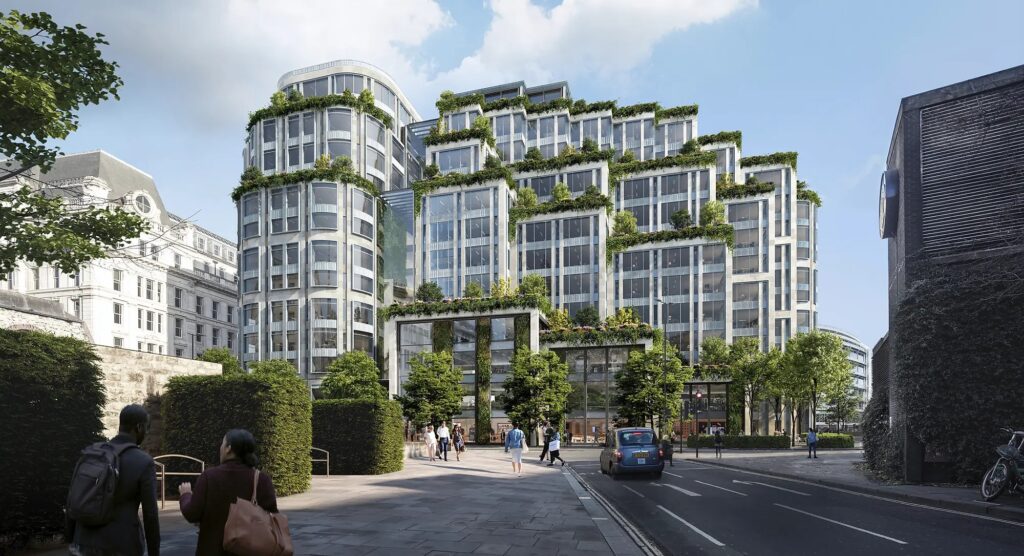
Panorama St Paul’s is an ambitious adaptive reuse project developed by Orion, transforming a substantial office building in the heart of London. Before visiting, I had heard a bit about the project from the architects, and chat in the market – particularly around HSBC’s pre-let – so was wondering what the fuss was all about. Upon arrival at the site, there was a long walk along safe routes to the site meeting rooms, which allowed a cheeky preview of the types of interventions that the building has seen, hinting at the extensive work being done. After a presentation from Paul Simovic (Principal at architects KPF) and Louis Harrison (Project Director at Mace), and now fully clad in PPE, I was eager to see the changes up close. The existing building – 81 Newgate – dates from the early 1980s, and was designed by the government’s Property Services Agency for BT. The existing cores were in the ‘wrong place’ for modern office use, leading to short core-to-glass distances. During the tour, we saw how new cores had been formed within previous atrium space, creating deeper floor plates and enhancing future flexibility. Through extensive reuse of structural and façade materials, the up-front carbon of the scheme has been estimated to be less than half that of the equivalent new-build. As well as designing alterations to the concrete frame, structural engineers AKT II have designed a new steel frame with composite slabs to infill the south-west quadrant of the building. By demolishing several storeys of heavier reinforced concrete flat slabs and rebuilding using a lighter construction, four additional floors could be added whilst avoiding changes to the foundations. We observed how these new elements connected with the existing frame, using a range of some ingeniously elegant and some awkwardly industrial connections, depending on how the constraints of levels and existing reinforcement density at these interfaces have conspired to help or hinder the design. One of the most impressive aspects of the project is the reuse of stone. The previous building was clad in hand-set stone, of which 95% has been successfully recovered, cleaned and reused in the new precast façade. This includes 388m3 of Portland stone and 37m3 of granite, with a new panel arrangement optimised to achieve such a high level of reuse. The project is nearing completion as a shell and core, allowing for HSBC’s fit-out team to complete the new office product. However, the new roof terraces are being completed in the base-build, with finishes and landscaping in progress during our visit. These private terraces are the standout feature of the building from a future occupant’s point-of-view, with the main roof offering stunning views of St Paul’s Cathedral and the skyline beyond. During construction, the client team instructed a significant change to improve the floor plate, by combining two grids of relatively closely-spaced columns into one. This has resulted in the creation of a enjoyably striking steelwork detail, with large shear heads cantilevered from the new columns to support the existing concrete slabs. I really hope that HSBC and their fit-out team retain some of the visibility of these details and the various interfaces between new and old, so generations of bankers to come can appreciate the history of the building and the clever technical solutions the construction industry has devised to grant 81 Newgate another life.
A turning point – a personal view

The draft City Plan 2040 is at its Examination in Public. The Corporation has abandoned plans to move Billingsgate and Smithfield fish and meat markets to Barking and to close them, with traders to be compensated and presumably freed to fend for themselves. Michael Cassidy, an ‘architect’ of today’s Square Mile and a founder of this Forum at an earlier turning point, has retired after 44 years as a leading City politician. These and other signs tell us the City has embarked on a new era. The City Plan 2040 seeks to accommodate a changed post-Covid world, to make the Square Mile a ‘destination’ for visitors, and much more desirable for employees and therefore businesses. Underneath the optimism lies a permafrost of existential concern and debate. Firstly in financial terms, the ability of the City’s principal public expression, the Stock Exchange, to compete effectively with global rivals. This is a problem for all stock markets when compared to Wall Street and its sustained bull market driven by tech and its dominance in the US economy. Perhaps a more protectionist US will prompt investors to revalue London’s and the European exchanges. And secondly, expressed by what former Mayor of London Ken Livingstone rudely used to refer to as ‘the Heritage Taliban’, the fear that adding 1.2m sq m of office space in the next 16 years, the chief policy of the new City Plan, will damage the historic built environment. A debate expressed in the battle between Bevis Marks Synagogue and proposals for 1 Undershaft, and more general debate around new-build versus re-use. See the Examination in Public for how it plays out. We had a similar debate in the mid 1980s, over a different set of threats, for similar reasons. It’s always been like this, as Michael Cassidy would testify. Hard fought-over turf with blows exchanged between old and new in an undersized ring (with plenty of underused corners). The City remains an engine of growth, as the refashioning of Broadgate and the vertical thrust of the Cluster testify. The new plan seeks to re-import more desirable urbane qualities neglected in Big Bang’s dash to globalisation, and essential attractors in the unending war for talent. New schemes pay for that. Recent criticism in the FT of proposals for Smithfield meat market, that the new Museum of London and whatever happens to the, er, rump of the market and its surrounds, will in some way be ‘sham urbanism’ are understandable. It is a shame the market is going (even 30 years after traders embarrassed the Corporation by packing not only meat but also their local ward). Such criticism is however ‘nostalgie de la boue’ as the French put it. We are unlikely to persuade woolly mammoths to reinhabit northern England, no matter how much that might appeal to conservation, or indeed conservative, instincts. A ‘Saved’ Smithfield meat market would end up equally sham, unrealistically financially privileged, and markets generally do not thrive in aspic. CAF events in the second half of the year exemplified the changes the City is experiencing. We visited Fletcher Priest’s refurbishment of One Exchange Place on the north east flank of Broadgate now underway for La Salle Investment and a Malaysian pension fund. This behemoth was one of SOM’s larger experiments in Post-Modernism when completed in the early 90s, contrasting with the robust modernism of Exchange House which bridges the rail tracks. New cladding, extra floor space, reduced atria, the introduction of a much more generous public link, with retail, penetrating through the scheme will create vital connections between Exchange Square and Bishopsgate, omitted from the original design, and vastly improve what this very large building has to offer, crucially avoiding redevelopment. A fruitful combo’ of good architecture and more powerful urbanism. A joint presentation from Fleet Street Quarter Business Improvement District and the City’s Built Environment team at Temple Bar later in the autumn proved popular and revealed how the area will be transformed. The Corporation however now has no less than five BIDs competing to transform their respective areas and this caused some concerns to be raised by members at a meeting of the Policy and Resources Committee in November, not least around the Corporation’s capacity to deliver the public realm improvements the BIDs are promoting and the one-size-fits-all model for BID management which has rapidly evolved. To cap the second half, CAF’s annual dinner in November was a sell-out. The Corporation’s New Built Environment director Katie Stewart confirmed she is a breath of fresh air, promising collaboration between public and private to achieve the City Plan’s aims. She paid tribute to Michael Cassidy who had announced his resignation on the same day. Her co-speaker, 20th Century Society Chair, Hugh Pearman, had a pragmatic proposal. Why not treat City office buildings as the temporary structures they appear to be, as the planning system treats large industrial plants, and by-pass all that agonising about whether and how they should be redeveloped? They could be cheaper and more adventurous…and there goes another squadron of flying pigs. He also gave a sneak preview of City buildings now sufficiently ancient (more than 30 years old) for the Society to be receiving petitions for their listing. The Gothic PoMo cathedral Minster Court, for example. You have been warned. With revived energy and waxing influence, the Forum will continue to offer an enjoyable space for debate, learning, and observation of the new momentum in the City’s long life – the new schemes emerging, the market and social forces and policies shaping its future. Membership of the City Architecture Forum is one of the best places to acquire and augment knowledge of what the City and its built environment is all about. Essential, in fact. With seasonal felicitations, Lee Mallett, CAF Committee member
Art & Architecture in the City
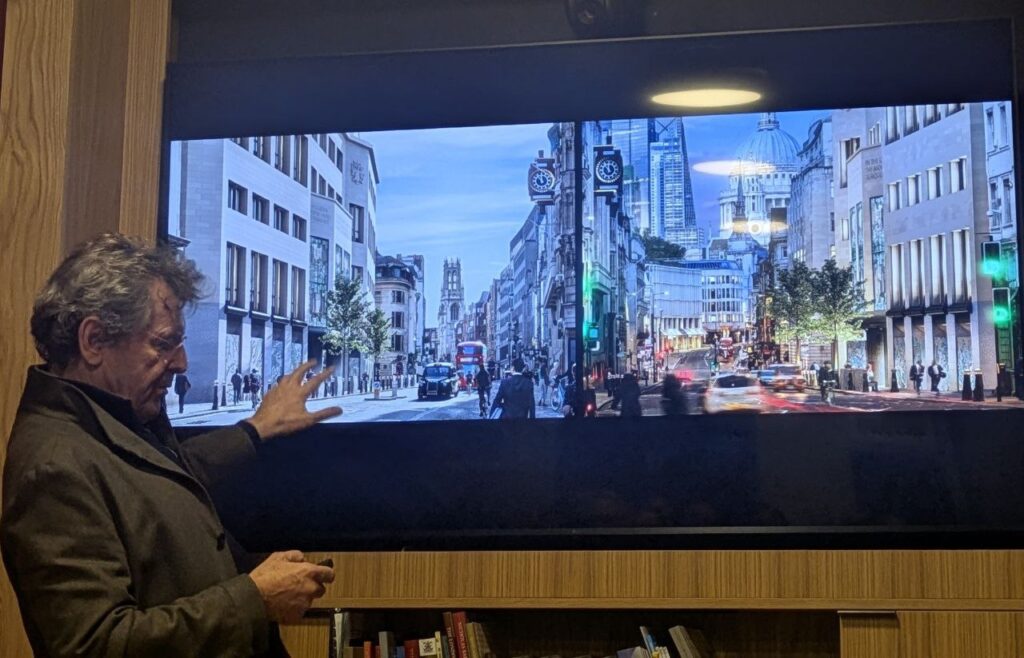
Artworks taking root within architectural and urban surroundings inspire us and challenge our thinking. Any doubts you may have had about their importance in our daily lives would have been lifted during last week’s talk on “Art and Architecture in the City”. Their production and their influence make for fascinating stories, from the structural prowess needed to hold up a sculpture, to public art events uplifting children’s lives as they become candid art critics. Successfully combining art and architecture takes a certain level of risk, and it’s well worth it. We heard different approaches through inspiring presentations interspersed with a lively and thoughtful discussion, wonderfully chaired by Michael Cassidy, in a packed lecture theatre at Temple Bar. Art and architecture come together in two different ways: by juxtaposition or being interwoven. A “sculpture at the entrance” type of juxtaposition, where the two form a dialogue and remain independent from each other, is exactly what happens at 23 Savile Row. Eric Parry presented the prominent sculpture by American sculptor Joel Shapiro which announces the building’s entrance, hovering above it as an abstract giant bird, as tall as two storeys high. On the other hand the Salisbury Square development integrates an entire façade of glass panels with colourful artwork by Shirazeh Houshiary, celebrating nature, to enliven what would have been the very hermetic street level frontage of the new Law courts – security taking over from transparency, for obvious reasons. To successfully embed an artwork into architecture, Eric Parry considers that architects cannot view their building to be the work of art. It is perhaps more nuanced. It takes confidence as well as boldness from everyone involved: the client, the artist and the architect, who need to work as a team towards one goal. And neither the architect nor the artist can be too precious either. When an artist’s work is so intertwined with the architect’s design, the boundary is blurred between the two: the artist’s work does not exist without the architecture, and the architect’s work is not complete without the artwork. As one of the largest employers in the City, Deutsche Bank are giving their staff visual wonders and food for thought, using walls of their new headquarters building at 21 Moorfields as a gallery displaying works from their collection. These are almost exclusively paper or photography, for practical reasons, they can be framed and protected. People lean on them. “The collection is there for people who work at the bank to engage in debates”, explains Mary Findlay, International Art Curator at the bank. Themes include post-colonialism, identity, climate crisis. The collection is now so vast it is stored in a separate facility outside London. But as part of the new building, the bank has also commissioned pieces from three contemporary artists on the themes of inclusion, Simeon Barclay, Claire Hopper and Rene Matić, for large pieces works integrated on some of the plain walls. “Art is a powerful tool, used to bridge cultural divides”, confirms Stella Ioannou of Lacuna, who presented the impressive 14-year-old Sculpture in the City programme which has supported some 137 artists, showing contemporary art in relation to contemporary architecture. Around themes such as Architecture as canvas, Street encounters, Looking up, Superscale, Civic engagement and Emerging artists are grafted a series of activations: dance workshops, tours, cocktail & create sessions, and perhaps the most impactful: “Little Art Critics “. Children are the art critics; you can trust them for speaking the truth. Stella told us the most moving story about one boy who gets bullied at school. His mother told her that whenever that happens, he watches the video of him speaking on the programme Little Art Critic, and that makes him feel better about himself. There are poetic works like the Kissing Gate by Maya Rose Edwards, to stop people in their steps; gigantic ones like The Good, The Bad, The Ugly by Jake and Dinos Chapman, that look minute in front of the Gherkin; intriguing ones like the translucent cube Pacific Red by Larry Bell. Public art cannot be precious: people will touch it, climb it, hug it, kick it, even lick it. Stella is certain some children must have licked the Pacific Red cube, it looks too much like a lollipop. All these works are temporary. This means you can take additional risks you wouldn’t be able to take if they were permanent. Risk in technique, such as Bridging Home by Do-Ho Suh’s, a house on a bridge, hanging over a TfL route and 4 lanes of traffic, atop a bridge which acts as a fire escape. And risk in content. When asked “what constitutes a successful art piece”, Stella becomes very thoughtful, takes a while to answer. Eventually, she tells the anecdote of how Martin Creed’s Work No. 2814, made of 48 plastic bags “blossoming” in a tree, became the subject of a furore. “How could you call this art ?” she was asked by one furious viewer who hated it, but eventually came to understand it and love it, walking past it for 10 months. We heard a lot from the curators and the architects during this talk. Next time, it would be wonderful to hear it all from the artists.
CAF Annual Dinner 2024: Delivering Destination City
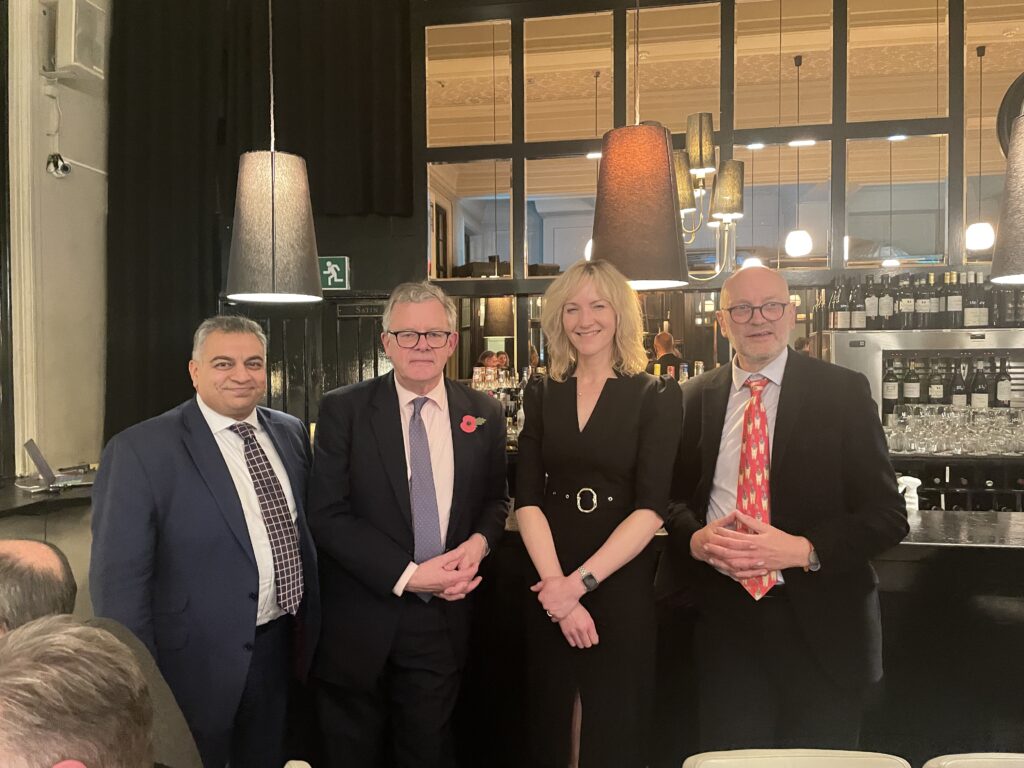
The City Corporation will work “collaboratively and transparently” with developers, architects and their teams alongside businesses to deliver “Destination City”, the object of City Plan 2040, the new Director of Environment, Katie Stewart (below, middle right), told a packed City Architecture Forum annual dinner. 88 CAF members and guests filled the Mercer restaurant with a senior cohort of City politicians and officers including Planning and Transportation chair Shravan Joshi (above left), his deputy Graham Packham, and Planning and Development director Gwyn Richards. “It is about delivering a world leading business and leisure destination and a seven-day-a-week Square Mile. The tricky bit is how you deliver that on the ground,” she said, speaking alongside architecture critic and 20th Century Society chair, Hugh Pearman (above right). “We cannot be prescriptive about how we get there and it’s critical for this next era of the City’s development it is done in the same way as previous moments in its history – by the private and public sectors coming together.” She thought current issues were perhaps more challenging than previous crises. The City has to get a grasp on its emissions, on bio-diversity, on the impact of new AI technology, and not least the changes imposed by post-Covid working. We are still “frankly, working out what life and work post-Covid actually is”. “Destination City – although it [the City Plan 2040] doesn’t say it explicitly – is all about making the City fit for the future, resilient and sustainable – and not just environmentally. Activating the public realm at ground floor and at height, making all those spaces more inclusive, more exciting.” It was not a task the Corporation could deliver on its own, or without controversy given the historic built environment. “This is tough stuff” but the City will welcome “creative tensions” and is prepared to take “collective risks” because “without taking risks, we will not succeed”. The City’s team, politicians and officers, will work “collaboratively and transparently” with developers, she promised. With flexibility around policies such as change of use and locating tall buildings and how these impact the City’s built environment. The City would also seek a more “open and frank relationships” with its eight Business Improvement Districts (raised at a recent Policy and Resources Committee). And “we are working to understand what businesses really want out of the City,” she said. The Corporation wanted to build Team City of London – a working partnership between the Corporation, developers and businesses to help achieve Destination City. She concluded with a tribute to CAF’s co-founder Michael Cassidy CBE, who will not seek re-election in the City’s elections in March and who helped establish and champion the Forum with incredible energy and enthusiasm, providing a place for discussion. The Forum she said was “a lasting legacy of his vision” which had “helped shape this fantastic city”. “I’m sure everyone here tonight is grateful for the contribution he’s made to the City.” “Temporary” solution for City offices Architecture critic, trustee and chair of the 20th Century Society, Hugh Pearman, provided a more “oblique” take on the City’s built environment, past and future including a list of buildings that, he said, were in the society’s sights for future listing. “The City is not that old a place really is it?” he teased. “St Albans, Colchester and Canterbury have longer histories, despite impudent makeovers by the Romans. And like ancient Rome itself, this new town we’re in, is in a perpetual state of demolition and new building.” The best fun to be had when starting out as an “architectural hack” he said, was scouring planning applications to see what “hopeful monsters” were evolving. He found London Wall was often where developers and architect “let rip” and Terry Farrell’s Alban Gate development, he discovered, was only one of several proposals to bridge “that canyon” – “and I think luckily the only one. It should be listed but isn’t.” If London is a “city state” then the Square Mile can be regarded as “state within a state” – but what are its rules? Steeped in tradition, the paradox is it is “so unsentimental” about its buildings. And it is the toughest place to get a recent building listed, he said, or even a not-so-recent building. Visit Broadgate for example he suggested, described by Simon Bradley editor of Pevsner, as “far and away the best office precinct in London”, where there are now “only architectural fragments” of the original Arup and Peter Foggo-designed elements. “Turns out it just wasn’t good enough!” joked Pearman. One Finsbury Avenue, the remnant, he suggested should be upgraded from its Grade II listing to Grade II*. It was built in a time when it didn’t seem especially necessary to build tall, but today even James Stirling’s No 1 Poultry seems “positively modest” while Richard Rogers’ Lloyds of London even though it is quite tall, merely comes across as “big”. And the Gherkin is reduced to “a tiddler” he said. The City has always reinvented itself. And today “you don’t even need the excuse of a fire”. There are some “real peaches” of buildings now under threat he said: “There’s Farrell’s Alban Gate. There’s Denys Lasdun’s only surviving unlisted building – the extraordinary faceted emerald Milton Gate. And..the ultimate B-movie building, GMW’s Minster Court, of which architect Piers Gough was moved to remark “they do Gothic better than vampires”. “No one does quality kitsch like that anymore, and yes the 20th Century Society is being pressed to ask for it to be listed.” Perhaps the City had a special dispensation under planning law, considering its amazing churn in buildings. Like parts of a petro-chemical refinery that can change their structures within a curtilage without needing planning permission. But this isn’t the case, so Pearman had a proposal for the City. “Why don’t we stop pretending and declare all speculative office buildings in the City to be temporary structures? After all that’s what they seem to be. Instead make them lightweight, smaller, more sustainable, with recycled materials, […]
Hold the front page for Fleet Street’s renaissance
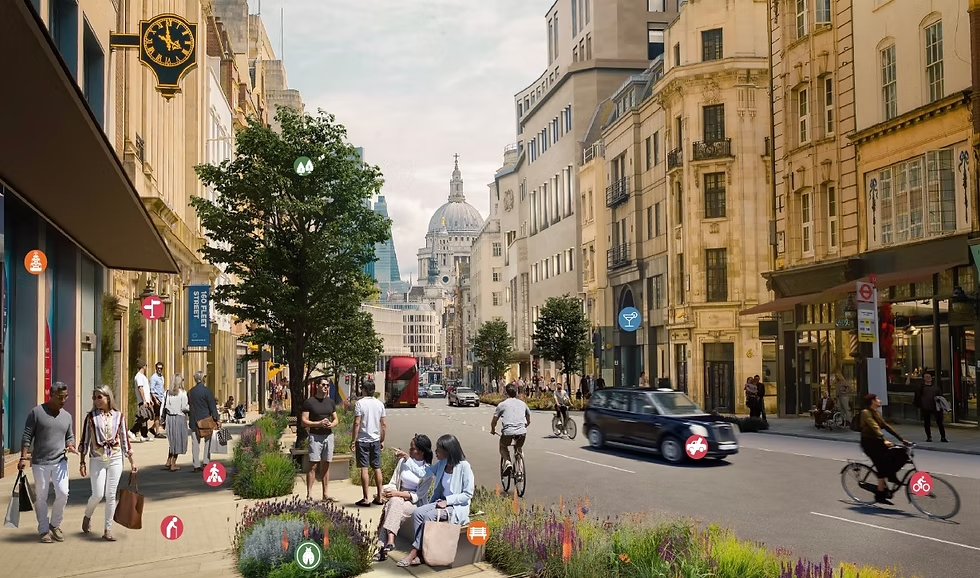
So the City Corporation sponsored the establishment of a fourth BID in the City, the Fleet Street Quarter Business Improvement District, which opened for business in 2022.
Two years on, Mike Fairmaner, former Westminster planner, now head of placemaking for the BID, Introduced an update for CAF members (ironically in the relocated, but possibly mislocated, Temple Bar) made it clear any diminution in vibrancy has not dimmed enthusiasm for major new development.
2024 Mid-Year Review
The City of London and its architecture is never static. The City is a location steeped in history and architectural heritage but this has rarely held it back from being forward-looking, ever changing and willing to address new challenges. It captivates and fascinates with its ability to reinvent itself and push new boundaries, and its ability to work equally well with the old and the new. This dynamic inspired the foundation of the City Architecture Forum and it continues to drive us forward. Our programme of events for this year has focused on capturing some of the latest thinking and current examples of this activity, as well as engaging our members and guests in debate and prognostication on the future. Thanks to the membership and our network, we are lucky enough to be able to gain access to buildings where others can’t, and our talks and debates are chosen for their relevance to our industry, with the speakers and participants we invite usually ensuring these are very quickly sold out! In 2024, we have covered a very broad range of topics and projects already. The year began with an early viewing of progress – a ‘sneak peek’ – at the Museum of London, a major arts and culture project which cleverly and thoughtfully repurposes part of the old Smithfield Market, and followed this with a complete contrast in architectural terms – a tour of the bold, new and hugely impressive 20 Ropemaker Street, the latest in the line of tall office buildings emerging around the City core developed by OPLM and CO-RE. As we moved into the spring months, it was time to promote some lively discussion with debates on Retrofit and Reuse First and the City’s journey towards net zero, and the City Plan 2040. The City of London Corporations’ active participation in these events, involving key individuals such as Kerstin Kane, Rob Nichol, and Shravan Joshri, demonstrates the level of commitment we have enjoyed from the membership and the high regard in which the Forum is held. In May, we were treated to examples of intricate urban design and the expert architectural ‘stitching’ together of old and new on our tour of British Land’s Norton Folgate site, in the Elder Street Conservation Area between the City of London and Shoreditch. After this – in June – came a presentation from 3XN, GXN and British Land describing how research-based design thinking has informed the architecture of 2 Finsbury Avenue, a striking new office scheme and one of the latest buildings in a new wave of large development projects at Broadgate. The excellent attendances and positive responses we have had to these events has established a momentum we hope to be able to sustain in the latter half of the year, so please watch this space for how the rest of the programme will unfold! In case you have missed what has gone before, our website carries reports of all our 2024 events to date, so you can readily catch up on the details. Our Forum Chair, Andrew Reynolds, and the Committee, are also hard at work preparing for this year’s Annual Dinner in November and confirming the guest speakers. Last year we invited Sharon Ament and Tom Nancollas, who were of the highest calibre, and we are keen to ensure we maintain these high standards for this year.We very much look forward to seeing members old and new, and their guests, at future events and welcome all suggestions for next year’s programme and how we can make the Forum more relevant for you. Best wishes, David David Magyar Hon. Secretary
2 Finsbury Avenue – Research based design thinking in the pursuit of innovation
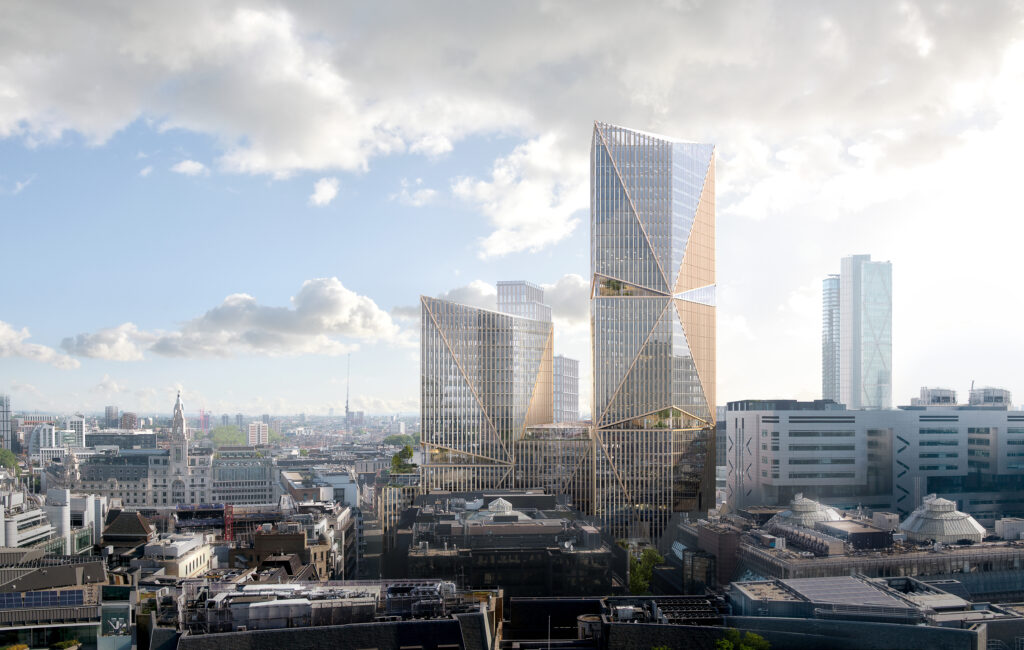
The business of attracting visitors to hotels and restaurants, customers into shops to buy retail products, and tenants into offices has, in recent times, become hugely challenging – and the competition is fierce. Leasing agents would have us believe we are in an ‘arms race’ to persuade people back into offices, where workplaces must now be part of an overall ‘experience’, offering amenities of all kinds to attract and differentiate themselves from the next if they are to succeed commercially. Looking at it another way, though, we could argue this is a ‘golden age’ for offices. Why? Because the finest office buildings are not only consistently surpassing themselves in terms of their design, quality and style, they are simultaneously showing care and consideration for the environment and our well-being. 2 Finsbury Avenue is promising to take all this to another level. The architects for the project, 3XN from Denmark, are exceptional designers, and British Land, the client and developer, chose them after staging a limited competition to find the ‘best of the best’ for their flagship Broadgate development. 3XN’s task has been no less than to re-define what makes a great building, to re-think the genre, and set new and exemplary standards for the workplace. How have 3XN gone about this? For 2 Finsbury Avenue, they have delved deep into their locker of creativity and drawn on research, proposing a design driven by sustainability, circularity and behavioural science, and not simply fad or fashion. Working closely with collaborators and sister company, GXN, they have explored how culture and behaviours shape the spaces we are drawn to. The behavioural brief they have conceived is to create a human centred design, which examines the sensorial as well as the spatial qualities of a building. The aim of this project is not simply to design a workplace, it is (to paraphrase) to create an experience that includes a workplace. GXN – an independent design led research studio – are an unusual and intriguing addition to the project team. They pioneer what they call strategic sustainability, which focusses on an architecture that is better for the planet and better for the people using the building. They synthesise science and research into design guidance, which in turn informs an architectural concept and its development. Human experience is placed at the centre of design and is critical for the evaluation of/engagement with the built environment. Circular design is another primary focus, where their aim is to make buildings ‘part of the solution and not the problem’. The collaboration with 3XN is a powerful mix, resulting in a project that is highly relevant and infused with purpose, direction and innovation. The combination of ideas about architecture, the environment, social and behavioural science is not new, of course. Students of architecture will have encountered books covering these areas of thought during the period 1960’s through to the 1980’s – a time of significant social and political change – by writers such as Reyner Banham, Steen Eiler Rasmussen, Oscar Newman and Anthony King, among many others, as well as architects such as Frank Duffy and John Worthington, who wrote about these themes specifically in relation to the office. Indeed, Duffy and his colleagues at architectural firm, DEGW, initiated ORBIT (Office Research: Buildings and Information Technology) looking at the impact of information technology on office design, which had a substantial impact on major office developments such as Broadgate and Stockley Park. It is interesting how research driven design is once again to be found at the forefront of a leading workplace project at 2 Finsbury Avenue. The City Architecture Forum invited 3XN and GXN, and their client and developer, British Land, to expand on all this, hosting a sell-out event earlier this month held at 100 Liverpool Street (another impressive Broadgate development in the British Land portfolio). Matt Secker of British Land opened up by describing the Company’s involvement in the re-invention of Broadgate (a fascinating study in the evolution of the City and office design in itself), and their aim to create a world-class mixed use destination. A part of this vision – a vision of the future of offices – is 2 Finsbury Avenue, and they are to be applauded for the bold and innovative approach they have taken here. They have encouraged and fostered the development of fresh thinking, creating a project team environment that actively promotes and supports this. Juan Ramirez and Jessica Barton of 3XN, and Susan Thams Carruth of GXN, followed to tell us more about the design. The building consists of a12 storey podium linking two towers – one at 21 storeys and the other at 36 storeys – described as ‘vertical campuses’ with a public and community offering, which interact with the public realm at street level, providing amenity spaces – terraces, winter garden, social lobby, etc – and mixed-use offerings. The architectural form has been derived partly by the constraints of the LVMF and townscape, and partly by parametric design. Extensive research and design work has gone into future proofing, sustainable design, the choice of materials, circularity and human centred design. The spaces will respond to different needs and different moods, provide for neurodiversity (extroverted and introverted spaces), and create micro zones and environments, spatial archetypes and hierarchies. This is a sophisticated approach which, stated simply, will provide a sustainable office building that is flexible and adaptable and will accommodate future needs. Its great attraction lies in how the design proposes to respond to users’ needs for the new workplace, and how that narrative is focussed on well-being and humanised space. The story of the design for 2 Finsbury Avenue is refreshingly different and engaging. The project will, no doubt, set new standards for the post Covid office and, at the very least, provide a cogent and thoughtful commentary on it. British Land, and the team they have chosen, are setting us all a challenge to try to match these standards, and it will be interesting to see how their […]
Beyond the fringe at Norton Folgate
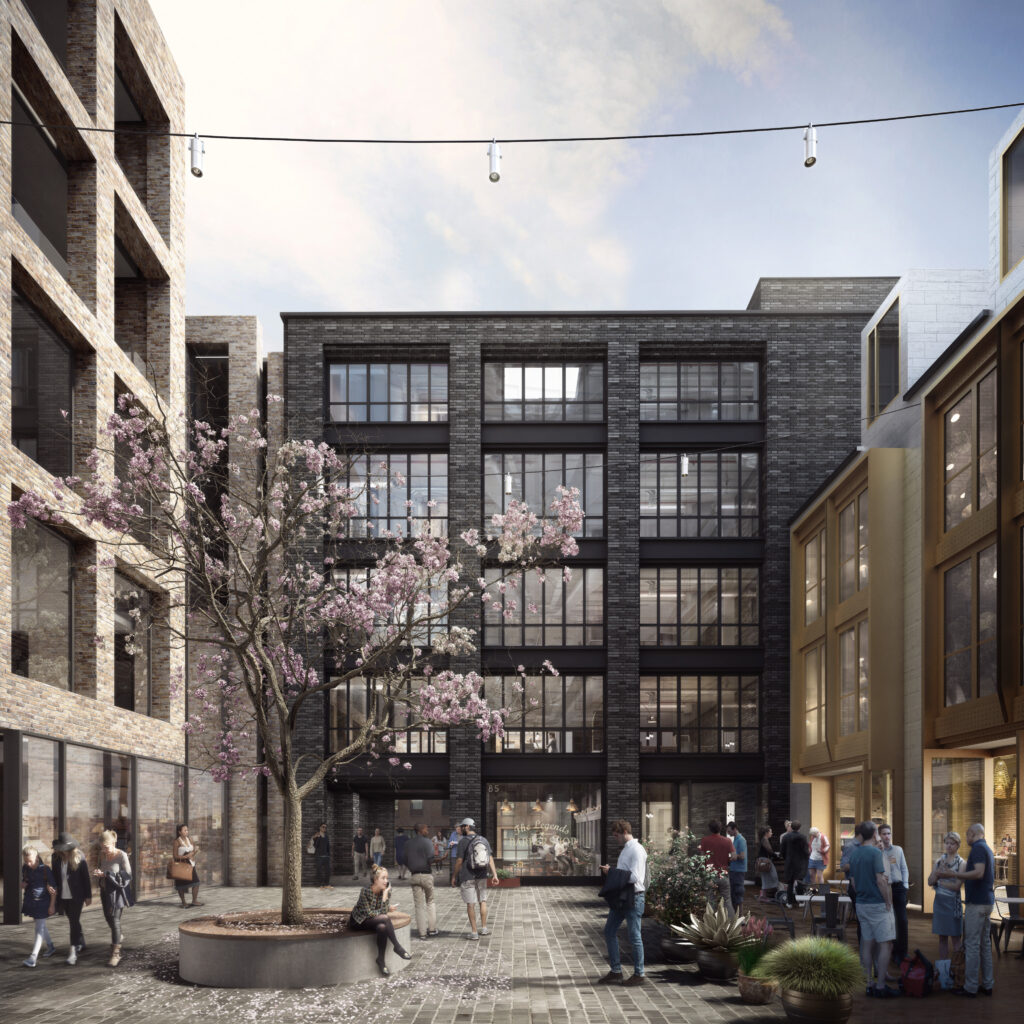
A world away from the city’ promises one of the headings on British Land’s website for its £225m, 330,000 sq ft office-led mixed-use reincarnation of the Norton Folgate site in Spitalfields that was so controversial in its nascent stages back in 2013 when AHMM prepared their first feasibility study for the developer. Planning skirmishes dated back to 1977, however, when earlier plans stirred resistance from local residents. Yet CAF members on their recent ‘Behind the Scenes’ tour of the development, whose cobbled streets and compact elements of public realm are about to open to the public, might be heard muttering ‘so what was all the fuss about?’ Maybe the ‘fuss’ influenced this sensitive outcome which appears capable of allowing new wine to be put into a handsome mix of old and new bottles in a way that will sooth local opinion. This was certainly the positive response of CAF members at first viewing of the development, which might be regarded as atypical of British Land and its varied portfolio in which historic or heritage elements have not featured prominently, other than Plantation House perhaps, now known as 30 Fenchurch Street. Norton Folgate is indeed a ‘world away’ from British Land’s neighbouring Broadgate, now being very boldly redeveloped. And although the two schemes are vastly different in scale, typology, materiality, massing, context – there are some echoes between the two. Broadgate’s success was to draw in the City’s higher economic values using a new spacious public realm to create an architecturally-branded enclave of value, replete with public art on the former Broad Street station site. Norton Folgate does something similar on a much more intimate scale, weaving revitalised and restored public realm between its six buildings. Some of this new space is semi-public and pedestrian, some is restored historic and public cobbled street. Norton Folgate slips you back into an historic series of alleys, places and streets, their interest intensified by the mix of refurbished historical and characterful new elements, mostly minimal, some more ornate. All new building components, pay homage to local scales and materialities to build a coherent overall character. The scheme applies a building-by-building approach, using restoration, refurbishment, extension, remodelling and façade retention. AHMM were masterplanners and designed three of the six buildings – Blossom Yard and Studios, Nicholls and Clarke’s new building, and Loom Court which includes a secluded internal courtyard space for office workers and restaurants. Stanton Williams, Morris + Company, and DSDHA designed Elder Yard and Studios, 15 Norton Folgate, and 16 Blossom Street respectively, with East leading the public realm strategy. DSDHA’s southern elevation to Blossom Yard features light stone cladding that catches northern light while large golden window units add elegant and unexpected opulence. Almost everwhere else, a variety of brick types and hues, is used for robustness, quality and its suitability for the Conservation Area’s character. Embedded between the new ‘tech-city’ hub of Shoreditch, about to be extended by the development of Bishopsgate Goodsyard, Norton Folgate hints at the Boho-hotel character desired by the post-Covid occupiers. Not ‘financial’ but creative professional, with hints of ‘loft’ and a clubby feel. Internally the main Blossom Yard’s building’s entrance ‘lounge’, for example, is wide, low and long, with wide composite floorboards that have a sawn timber finish (think Tate Gallery, but wider), revealed brickwork walls and a bare concrete soffit with tidy minimal services suspended. There are lots of plants and red leather perimeter benches. Very comfy, not too corporate, nor wasteful of space. Much effort and patient experimentation has clearly gone into maximising the presence of retained elements and their transformation into fully functioning spaces capable of modern occupation. Elements of facades, floors, beams, soffits, where they offer desirable character have been retained and upgraded to meet modern regulations, but keeping the ‘look’ occupiers will appreciate – and presumably pay for. A range of office types is on offer, with retail at the ground floor, and should appeal to a wide range of tenants from start-ups and SMEs to more mature organisations, including local tech and creative industries. And the very healthy pre-letting of 126,800 sq ft to law firm Reed Smith in Blossom Yard & Studios, taking a third of the space, is proof of the pudding. More natural ventilation and less sealed windows in some of the spaces would perhaps be more appropriate for today’s market, but this was not high on the agenda when the scheme was conceived pre-Covid. And some of the fantastic high-ceilinged restaurant units in the historic retained buildings will probably prefer opening windows onto those cobbled streets in warmer days, rather than the large sealed units now installed. These are minor niggles that British Land or occupiers will be able to adjust. What the team have achieved is a welcome, highly sensitive resuscitation of a site in need of renewal for many decades. Which is not to say local protestors were wrong-headed, or to deny that British Land or the entire property industry for that matter, might well have produced something of less character and value if the site had been tackled in earlier eras. It’s tempting to think Spitalfields pioneers, now affluent property owners rather than the squatters they once were, or possibly even an original Huguenot refugee, might admire the new mix of uses and spaces created that can continue Spitalfields’ traditions of a culturally diverse and industrious community pursuing a variety of enterprises – hopefully for decades to come. Lee Mallett Forum Committee Member With thanks to Peter Mayhew, Paul de Hoxar and Alireza Iravani of AHMM, and David Hills of DSDHA, for hosting CAF’s Behind the Scenes visit.
The City 2040: perspiration outweighs inspiration
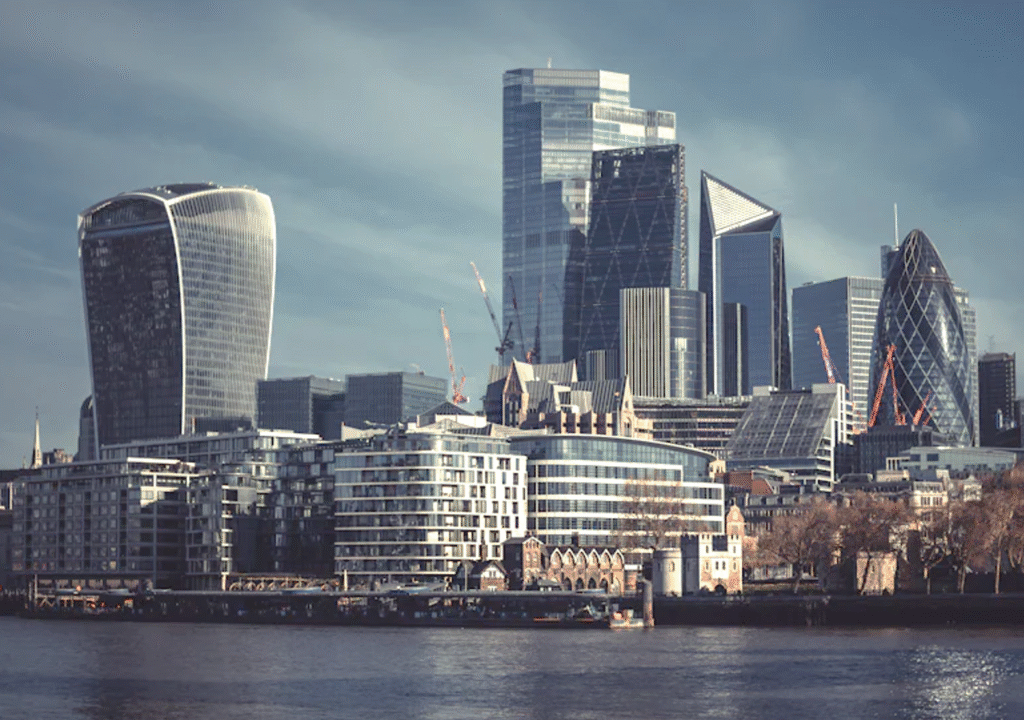
The draft City of London local plan, at 44,000 words, is a prodigious effort, suggesting future development can be directed or fine-tuned to suit a very decent set of strategies reaching 2040. The product of a process which began in 2016, which has been subject to five public consultations so far, the latest version of the draft is still open to addition or amendment if you get your comments in quickly. So the CAF event at Temple Bar on 14 May, chaired by Lee Mallett, was a timely opportunity to hear about the plan from the horse’s mouth, as it were. Or rather two horses, the first of whom was Shravan Joshi, Chair of the City’s Planning and Transportation Committee, who stressed the importance of metrics and data in the planning process. This showed that while footfall in the City had risen to about 80% of pre-Covid levels, the people in the Square Mile now are very different to the previous world of traditional business office-workers. More tourists, more digital tech start-up types, more media-tech folk. Having said that, legal and insurance sectors were still critical to City activity – with no sign that demand for office space would evaporate. In fact quite the opposite. Joshi noted that predicted demand for additional office space suggested a minimum of 1.2m sq m of space would be required, with that sum increasing to a potential maximum of 1.9m. These figures take into account hybrid working and are partly based on current activity, with 0.5m sq m of space under construction currently – 18 Gherkins, as Joshi noted. The City may be changing, but the assumption is that it will continue to be an engine for growth, the first priority of the City plan, which is intended to enable and encourage rather than prescribe (though there is proscription too, for example, a ban on any automatic conversion to residential use of redundant office space). But along with growth comes policies aimed at whole-life carbon ‘optioneering’, with a retrofit first test applied to new development; protection of heritage given greater priority, perhaps, than has been evident in the recent past; taking into account the visitor implications of the Elizabeth Line; and not least the opening up of the planning process, providing ‘more security for stakeholders’. A confident and coherent overview was supplemented by the second ‘horse’ in the person of Rob McNichol, Assistant Director (Policy and Strategy) at the City, who put some flesh on the bones of the overview, talking about the suite of policies which would achieve the vision that had been set, which apart from economic growth included the importance of making the City ‘vibrant’, which everywhere wants to be these days, and welcoming to all, irrespective of gender, ethnicity and all the other wokescript definitions of people making up what used to be called the general public. Some refreshing pointers to new ways of thinking included the idea of fast-tracking retrofit projects through the planning process, and the importance of educational and cultural facilities forming part of major development proposals. All this would be combined with clear guidance on the location of tall buildings in respect of views and heritage, without any instruction as to style or appropriate height. We were invited to think of the policy on height contours as being like a ‘trellis’ with, as it were, different sorts of plants with different dimensions. We also heard that sustainability should mean designs showing the possibility of dismantling buildings which had outlived their usefulness, in order for building elements to be re-used or recycled in the line with circular economy principles, though there is little in the document showing exactly how 50-storey towers would be made in such a manner, or indeed what longevity might be expected of the contemporary City office. Thoughtful responses came from a handful of invited contributors, and then the audience as a whole. Taking the positives first, the development growth strategy was warmly welcomed by David Ainsworth of CO-RE London, who noted the incredible demand that still existed for space in what is London’s Central Business District, including companies migrating back from Docklands like HSBC – what a change from the era when some thought the City would ‘be the Latin Quarter of Canary Wharf’. It was the creation of Lloyd’s of London which had changed all that. His plea to the planners was not to become too prescriptive about height, style and precise location – he didn’t want to be blocked or boxed (he might have cited Bing Crosby’s yesteryear hit, ‘Don’t fence me in’, particularly in relation to a trellis . . .) The other developer speaker was Jay Ahluwalia of Dominus, who welcomed the diversity of development envisaged in the plan, not surprisingly given his company’s successful activities in the hotel and student housing sectors. He welcomed the 2040 plan approach of identifying key change areas and urged the City not to underestimate the importance of the non-office market. Urbanist Kathryn Firth of Arup liked the retrofit-first approach, the concept of the provision of ‘affordable offices, and the way the plans addresses diversity, edges and delivery. She had some warnings, however, including what she thought were inadequate additional housing numbers (though in good locations), given the City’s ambition to be a seven-days-a-week hub. This in turn would have implication for the location and nature of the retail offer envisaged. She also worried about the dependency on big developments to supply cultural facilities which might result from ground-plane voids, and the too-heavy reliance on the private sector to deliver public realm benefits. What happens if there is an economic downturn? Would it result in a rash of ‘stranded assets’? Townscape consultant Peter Stewart had a more fundamental criticism of the plan, which referenced a point made by Lee Mallett in his introduction about the architectural relationship between plan and section: ‘If the plan is prose, the section is poetry’. Stewart was concerned that the enormous quantity of words in the plan […]
Retrofit and Re-use First : The City’s journey to net-zero
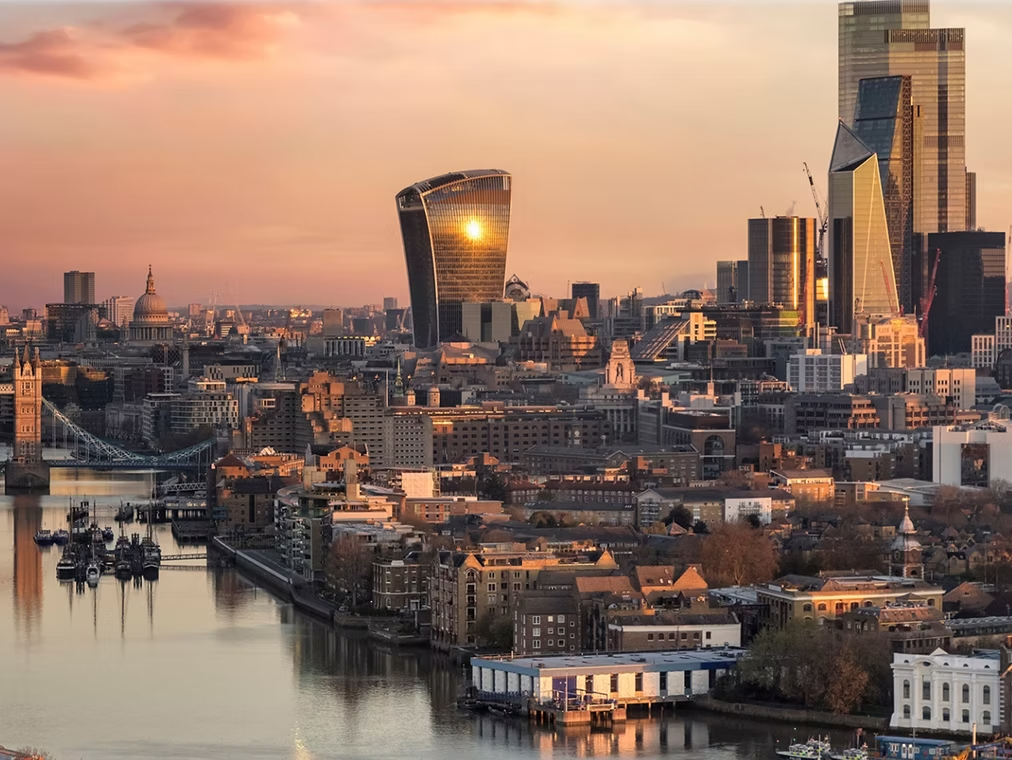
In the world of sustainable architecture and design, the conversation for the built environment is evolving rapidly, challenging industry norms and pushing for innovative solutions. With the Draft 2040 City Plan focusing on a ‘retrofit first’ approach there is a need to prioritise retention and retrofit of existing building in the journey to achieve net-zero carbon. At the City Architecture Forum event, Retrofit & Re-use First, the City’s journey to net-zero held at the beautiful Temple Bar with time spent in the exceptional Sir Christopher Wren’s working room, the audience had the pleasure of hearing from three of this industry leading experts. Kerstin Kane, Principal Planning Officer (sustainability), City of London Corporation; Tina Paillet, President of RICS and co-founder of Circotrade; and Dr Barbara Marino, Strategic Development & Compliance Director, Keltbray. These esteemed speakers shared valuable insights that shed light on the current challenges faced and the opportunity for change. Michelle McDowell as event Chair emphasised the importance of retrofitting and reusing existing structures, highlighting the need for smart design and collaboration. With a focus on achieving the highest sustainability targets, retrofit first approach advocates for optioneering and considering the environmental, social, and economic impacts of design choices. This approach aligns with the growing trend towards circular economy practices, where materials are reused and repurposed to minimise waste and maximise efficiency.Kerstin brought a fresh perspective to the table, emphasising the need for flexibility in design and a shift towards more sustainable building practices. By singing and dancing to the tune of highest sustainability targets, Kerstin challenges the industry to think beyond traditional norms and define aspirations clearly, then encouraging all to look at optioneering at the initial stage of any project. Collaboration and consultation are key, as stakeholders should work together to define aspirations and create a workshop-style environment that fosters innovation and creativity. 62% of all waste from the UK is from the construction industry which in 2021 equates to 1.5M tonnes and only 1% of materials are reused across the UK & Europe. Tina highlighted that the industry is not changing as we think it should with lots of talk and less doing. The insights into waste statistics were depressing, noting the need for material savings, and the importance of checking plans for opportunities further demonstrate a requirement for a holistic approach to sustainable design. With pressure from EPC regulations and a staggering amount of waste generated by the industry, Tina advocates for action over mere talk, pushing for tangible results and measurable impact. By rethinking procurement routes and engaging with stakeholders early on, Tina believes that real change can be achieved. As Barbara aptly put it, “anything is possible – everything is achievable.” With a focus on repurposing existing structures and embracing new technologies, Barbara challenges the industry to adapt and evolve. By understanding the challenges of retrofitting and deconstructing steel structures, Barbara highlighted the importance of warranty and the need for continuous improvement in building practices.In conclusion, the future of sustainable architecture lies in collaboration, innovation, and a commitment to change. By embracing the insights shared by the City Architecture Forum, Kerstin, Tina, and Barbara, the industry can move towards a more sustainable and efficient built environment. With a focus on circular economy practices, flexible design solutions, and proactive engagement with stakeholders, the possibilities for transformation are endless. It’s time to dance to a new tune and create a built environment that not only meets our needs today but also ensures a sustainable future for generations to come. Kara Thompson
A New Museum for London pt II
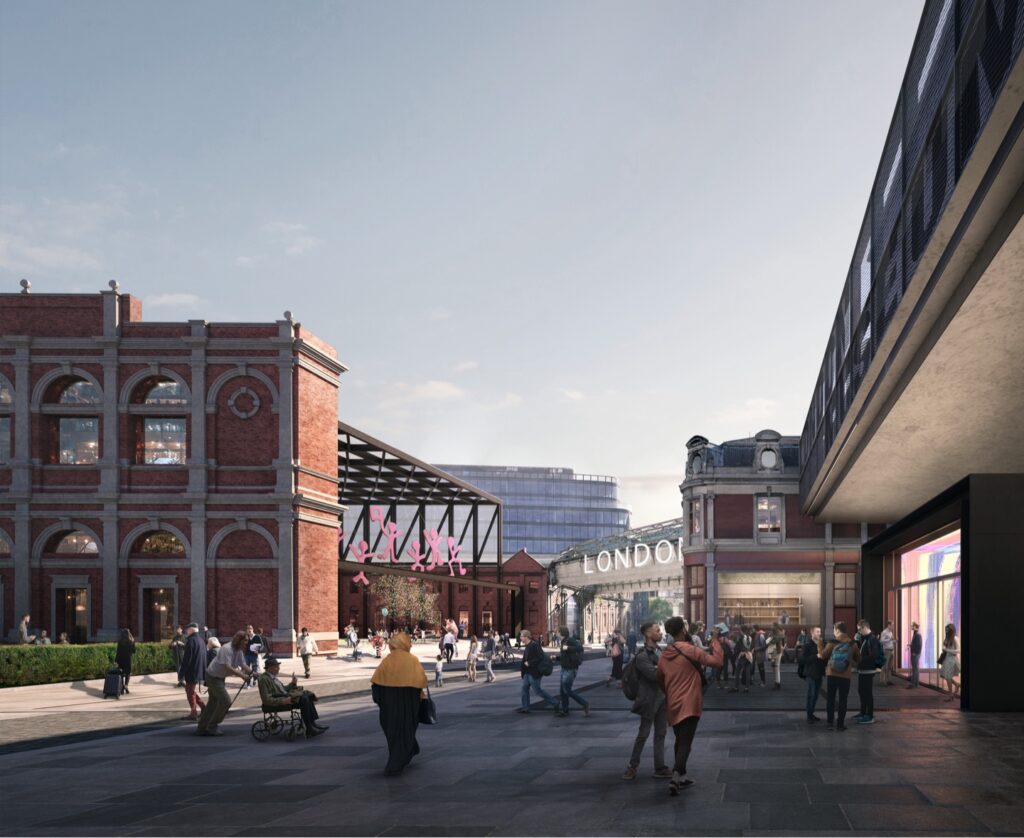
On a crisp and sunny February afternoon, a privileged group of 10 CAF members assembled at West Smithfields in anticipation of an early glimpse of the new Museum of London spaces as they begin to take shape. We were met by Museum Director Sharon Ament and Stephanie Kirkness from Museum of London and whilst booting up in PPE, Sharon shared a few slides to set out her vision for the new museum. Described as a series of interlocking exhibition galleries around a common theme of ‘Time’, allowing the visitor to time-travel through a procession of differing spaces. “Our time, past time, real time, imagined time, deep time…. “the list of galleries becomes a time traveler’s odyssey. For now these time travels are all promises for the future as the interiors, designed by Stanton Williams, Asif Khan, Julian Harrup and Atelier Bruckners, are yet to materialise. Instead, our voyage is one of architecture… pure in its naked, stripped back form revealing a hidden heritage and beautiful craftsmanship. Our journey is nonetheless a journey through time, as we are taken from the 1860’s Victorian splendor and deep vaulted brickwork basements and culminating at the 1960’s heroic space of the poultry market. It is evident that the vision of time travel will not only be a narrative to the exhibits but one of the building fabric itself. There are two principle spaces, The General Market and The Poultry Market. These are separated by a street, ‘West Poultry Avenue’, a legacy of the transportation lanes of the former market use. This street acts as buffer between the two galleries and as Sharon explains “is a fundamental part of the visitor experience”. This connecting street and indeed the surrounding streets are conceived as a shared territory, where open space and public realm merge with multiple exhibition entrances to allow the visitor unfettered access to the museum spaces, creating a permeable piece of city. We leave the West Poultry Avenue and enter The General Market, a double height Victorian hall, stripped of decades of clutter to reveal the carcass of Victorian splendor. Beautiful cast iron columns order the plan whilst old cast iron fireplaces hang precariously in what must have once been rooms on an upper floor. We are told the mezzanine floor is to be reinstated, which makes the timing of our visit all the more special as we enjoy the proportions and grandeur of the double height space. Almost Square in plan, The General Market is arranged around the central dome with its radial cast iron structure and clerestory windows. This expressed structure is a prominent focal point of the space, Sharon described how earlier designs looked to provide a spiral staircase below the dome as vertical circulation, but these ideas were rejected as they would diminish the sense of space. Instead, a new large public stair sits off centre, which takes the visitor below ground to the subterranean galleries. The walls to this stair are built with pigmented concrete, pink in hue with an uneven horizontal line, alluding to geological strata, as the visitor descends through layers into ‘past time’ galleries below. The below ground spaces are more intimate, a late discovery behind bricked up openings revealed a previously unknown world of brick vaults and buttress walls. All the brickwork had been cleaned and preserved to reveal the stoic London walls, uncomplicated and monolithic. The services are to run within floor voids to allow the brickwork vaulted ceiling to be expressed and enjoyed. There is to be a new “shop window” within the perimeter wall, which will reveal the adjacent Thameslink train line. This will allow train passengers to see into the museum as a passing vista and will become a wonderful opportunity to advertise the Museum and attract new visitors. We continued our journey, up and through more intimate spaces, timber structures and mansard roofs, until we emerge onto the roof with wonderful views across to St Paul’s, the Shard and the Old Bailey. The newly crafted bronze roof of the cupola glints in the sun. On we go, back down to ground and towards the poultry market. We rise to the first floor, through a series of compressed spaces to arrive at the big reveal. The enormity of the single span roof of the Poultry Market is extraordinary. The Victorian market had burned down in the 1950’s and a new building was completed in 1962. Its roof is claimed to be the largest concrete shell structure ever built, and the largest clear spanning dome roof in Europe. Designed by Ove Arup this feat of engineering is column-less over its 70m span and it is only 9 cm thick at its thinnest, peppered with glass lens to provide beautiful top light to the galleries below. The Main contractor only took possession in August 2023 when the traders vacated, and the space is already cleared to uncover the true potential of this space, as a crescendo to the visitor experience. Sharon described the construction journey ahead of phased completion, with the first galleries opening in 2026 and subsequent phases in 2027 and 2028. She sees this as a blessing, as an opportunity to keep up construction quality whilst providing the museum with multiple opportunities for multiple inaugurations, allowing the museum to take its place as one of London’s key cultural attractions in the heart of the City. Thank you to Andrew and Rowena for organising this privileged viewing and to Sharon Ament and Stephanie Kirkness and for their time and wonderful insight. Lee Higson, words & photos Member of City Architecture Forum
Transport for a changing Square Mile
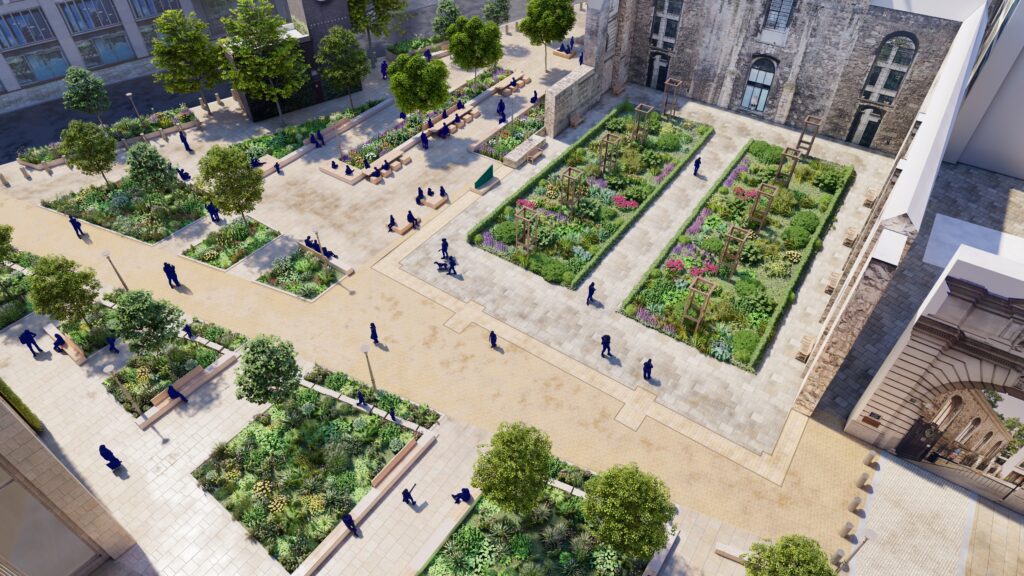
Tuesday, 12 December 2023 City Architecture Forum set up an enlightening presentation by Bruce McVean, Assistant Director, Policy & Projects, City of London Corporation and Roy McGowan, Managing Director at Momentum Transport, followed by a lively discussion with the members of CAF attending the event. Will the UK meet the government’s Decarbonising Transport objectives? Roy McGowan set off to answer the question describing the national context, and how there are as many strategic documents as transport modes. Transport is responsible for 26% of the UK greenhouse emissions, but the strategy for Decarbonising Transport, aiming to achieve Net Zero emissions by 2050, has been pushed back. Despite the encouraging 40% overall reduction since 1990, currently the carbon emissions from road transport have flatlined and the figures do not line up with the targets. Roy was clear in the importance of setting a vision, and not just measuring targets against emission levels expected in the future. The scale of investments needed to meet the electricity demand cannot be achieved with the volatile conditions of public commitments in the past years, but in the meantime the UK workers spend more time commuting than in almost all of the OECD countries. Major transport decisions are being pushed back or cancelled, whilst the health costs to society (air pollution, urban noise, obesity…) will reach £50bn a year by 2050, enough to fund two Elisabeth Lines every year. So then, how do we secure a long-term transport strategy? Well, the response is related to a long-sighted approach: a strategy for all modes of transport; early involvement of stakeholders; building independent institutions; and devolution deals to support local investment decisions. All these sounded very convincing, and Bruce McVean demonstrated how impactful local authorities can be, working with an efficient team that combines policy and delivery. How is transport in the City of London changing after Covid? Bruce described recent trends in travel and how the City is responding to them. Workers are returning to the office, with a 75% level from Tuesday to Thursday respect to the pre-Covid figures, and the GLA employment projections are in the rise. In other good news, the number of cyclists has increased fourfold since 1999, with a steep curve since 2021, whilst drivers have declined by two-thirds in the same period. Bruce defends that it is time to prepare for growth. The City of London Corporation adopted a Transport Strategy in 2019, and following the pandemic are now consulting the public on revisions to the document (open until 7th of January 2024), with a focus on inclusive policies. Some of the priorities relate to walking strategies, improving bike lanes, introducing sustainable drainage, or a smarter approach to Congestion Charge. How are changes in transport reflected in the public realm? The projects presented by Bruce were inspiring, but also an example of quiet changes that have a big impact. They demonstrate how local policymaking can reflect society trends, improving the public realm in a city where space is limited and must be negotiated between tourists and office workers, cyclists and drivers, pedestrians and amenities. From the handful of initiatives, the opportunities at Bank and St Paul concentrated most of the queries from the CAF members. All Change at Bank is a model of street space reallocation, where the pedestrian areas are widened significantly and allow new activities such as bar terraces, bike doctors, or enough space for tourist groups. By 2024 cars will not be allowed to circulate at Bank, and Threadneedle St and Queen Victoria St will become cycle only. St Paul’s Gyratory will experiment a radical transformation and become one of the largest public spaces in the City, stretching from the Museum of London roundabout to St Paul’s underground station. The evening closed with a lively Q&A session. Some CAF members were surprised by the changes in traffic restrictions, others queried about the coordination between national and local initiatives, and Peter Murray OBE questioned if the Worshipful Company of Chartered Architects would be consulted in future policies by the city of London. Gonzalo Coello de Portugal, words Member of City Architecture Forum
2023 End of Year Reflections
So as we come to the end of another year for the Forum and for the post-Covid City of London I sense a feeling of optimism and purpose in the City marred only by the inertia of our Whitehall politicians who I suspect are mindful of the Mayoral elections in May 2024 and the likelihood of another Labour London administration – to be matched by a new Government? But what of the last year for the Forum? Eight events ranging from building visits to talks on Transport Planning Policy and Designing Inclusive Public Spaces, and all culminating in a very successful Annual Dinner with fascinating speeches from our guest speakers Sharon Ament and Tom Nancollas; both beautifully illustrating the depth of our building and cultural heritage. The future of the City and its emerging skyline featured centrally in the Q&A session at the dinner, and the channels of major schemes coming through the planning system augurs well for the built environment industry as well as the City’s recovering and reshaping ecosystem which I believe will be key to the future as we need to re-establish a seven-day City post-Covid. The clever repurposing of secondary office stock for a mixture of uses on the edges of the City Core presents at once a huge challenge and a huge opportunity for all of us involved in the area. Your committee are hard at work planning a diverse programme of events for you for 2024 within which we will look to address these trends and we will let you have details early in the New Year. Something new for next year will be a Summer Drinks Party so do watch this space for further details. We are always keen to have ideas from you for new events and indeed new members and I’d be delighted to hear from you with your suggestions. Thank you once again for your continued support of the Forum in 2023. Andrew Reynolds Forum Chair
All rise for Fleet Street’s super-court
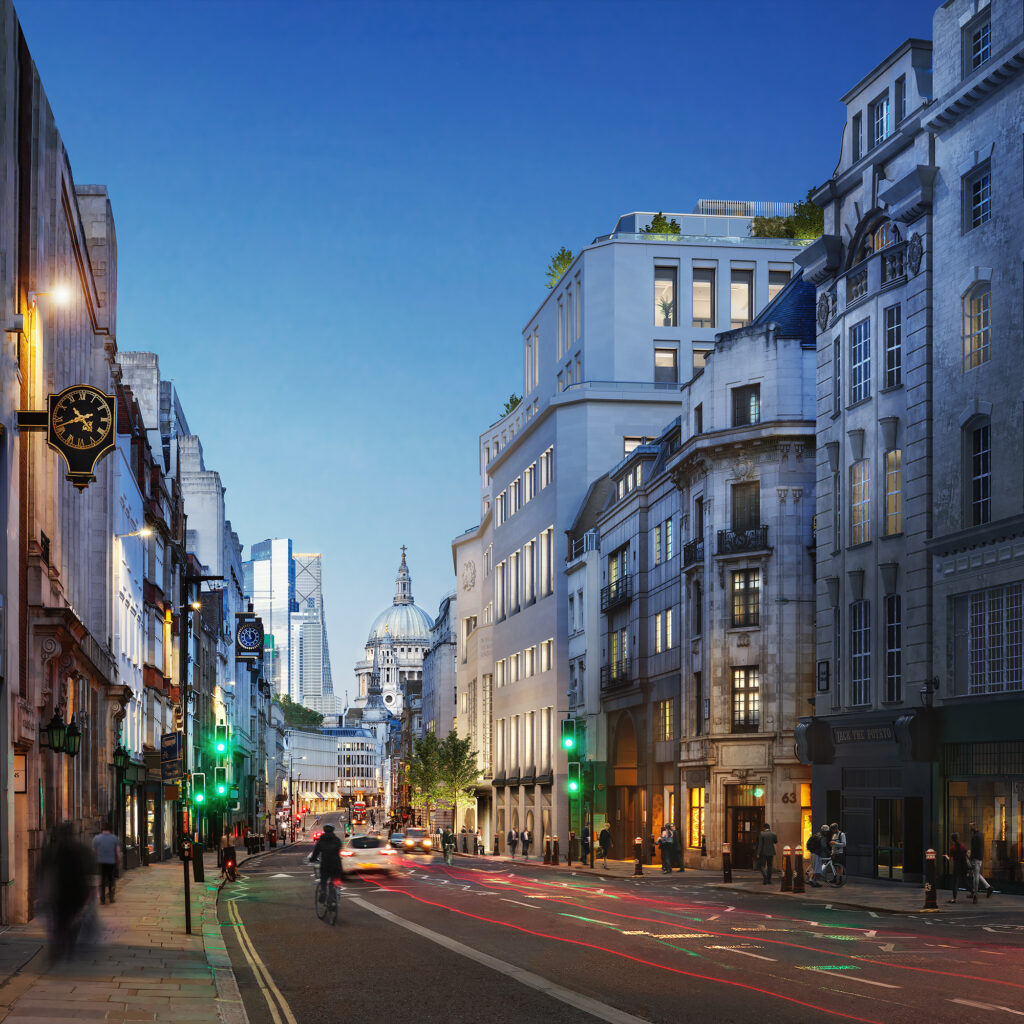
Tuesday, 12 September 2023 City Architecture Forum members were treated to a preview of the City Corporation’s new court complex at its Salisbury Square Development on Fleet Street by Lee Higson, director, Eric Parry Architects, and Tim Cutter, director, Avison Young (City of London). If you think a major city office building is complex, try combining eight crown courts, five magistrates’ courts, and five civil courts in one building, while simultaneously delivering a new linked police headquarters and a speculative office building, within a new public realm. Now under construction, this is the Corporation’s ‘gift to the nation’ a flagship ‘Court of the Future’ specialising in cyber-crime, with an innovative spatial arrangement that improves the operational efficiency of courtrooms, increasing the number of cases can be heard when compared to a traditional court. The new Court building, fronting Fleet Street, will be the frontispiece of the Salisbury Square Development, lying between the home of England’s legal professions in the Inns of Court and Royal Courts of Justice to the west and the Old Bailey to the east. It will bolster the City’s global status which rests on the UK’s rule of law and timely justice. A new City of London police will sit south on Whitefriars Street, overlooking a new Salisbury Square to the east. The City police is also the national force dealing with economic crime. It will consolidate the police estate enabling re-use of the Grade II*-listed Wood Street and Grade II-listed Snow Hill stations. Southernmost on Whitefriars is a new office development completing the city block. Existing buildings are unloved offices from earlier eras – with one exception – the Grade II-Listed 2-7 Salisbury Court, where the first edition of The Times was published in 1822, to be retained as a pub, also overlooking Salisbury Square and Salisbury Court. Eric Parry Architects’ task, said director Lee Higson presenting the scheme, was to accommodate a hierarchy of 18 new courts. These are of diminishing scale rising up through the building, threading between them circulation, a spaghetti of lifts and stairs that physically separate the various parties to all actions. Criminal defendants in custody brought up from basement cells below, civil litigants, judges, juries, lawyers and the visiting public, all must be kept apart, while meeting safety and highest level security requirements. Judges, barristers and other functionaries have suites above the courts and a nice roof garden. The three buildings will be separated by two east west walks between Whitefriars Street and Salisbury Square, continuing east to St Bride’s Church. All three buildings enclose on three sides the reimagined square, with entrances at ground level off it. Three levels of basement lie beneath, linking the police and the Court building. Durable stone facades are used for the impressive Court building and weathering steel for the police to last a minimum of 125 years, and perhaps convey something of their respective civic duties. Pale stone for the Court’s substantial Fleet Street façade adds dignity to London’s main ceremonial thoroughfare, projected by the symmetry of its two splayed outer wings and central entrance bay. Also by the classical layering and prominent judicial insignia high above a deep set portico leading to the main public entrance and three-storey lobby within. The main façade’s composition and materiality counterpoints its civic function with the neighbouring media pretensions of an earlier era – sober ex-Reuters next door and exuberant ex-Telegraph and Express buildings opposite, all listed. The office building will be clad in a rich earthy colours, composed of a ruby red terrazzo-effect polished pre-cast concrete, matt, unglazed and glazed terracotta panels and tiles, with inlaid decorative bosses. Lee Mallett words Member of City Architecture Forum
Behind the Scenes: 8 Bishopsgate

Wednesday, 10 May 2023 With less than a month until Practical Completion and with the building still a hive of finishing and commissioning activities the CAF were privileged to be given a tour of 8 Bishopsgate by Ollie Tyler of Wilkinson Eyre. Mitsubishi’s latest addition to the London skyline is at the centre of the City at the corner of Bishopsgate and Leadenhall. Began in 2013 with the acquisition of two neighbouring sites the following years saw the City continue its inexorable evolution upwards with 22 Bishopsgate by PLP consented at 62 storeys, and 40 Leadenhall by Make at 40 storeys. In response it therefore made sense to grow 8 Bishopsgate from the original consent at 40 storeys up to 50 to provide a stepped massing across the three projects. This decade long journey also permitted the evolution of several other design features. The building presents itself as an amalgam of 3 distinct forms; an 9 storey stone box, a 26 storey braced box, and rising above it at 20m wide, a slender tower topping out at 50 storeys. The staggered massing of three elements accommodates floorplates varying from 20,000 sqft and 15,000 sqft up to 8,500 sqft. as you ascend. The clever structural resolution by Arup gives rise to an elegant architectural expression in that the top 24 storeys take their bracing from the box below using just the in-situ core located on the north elevation for stability. Unusually for a core the north wall here benefits from glazed openings framing tantalising glimpses out to works by Lutyens and Rogers amongst others. The rest of the building is skilfully clad in a 200mm deep CCF [closed cavity facade] facade formed with semi-low iron glass. Tyler and his team’s efforts to keep the outer pane dead flat have paid off with incredibly crisp detailing and the flattest of flat facades. The other distinctive feature of this facade is that these units are at 3m widths giving a generous and open feel the building’s skin. Added drama comes form the 26 storey box cantilevering out to the pavement’s edge, and whose slender solar fins are cropped along the line of the bracing to accentuate the structural gymnastics at play within. Further interest is provided by a terrace for occupants at level 11. But what steals the show is the public viewing gallery at level 49. This floor plate benefits from stunning views to the panorama of the Thames beyond. The feeling on arrival is one of being amongst a series of chess pieces with the sensation that the neighbouring Cheesegrater and Walkie Talkie are within touching distance. Additional public engagement comes in the form of the double storey entrance off Bishopsgate, where flanking meeting and town hall spaces are provided at mezzanine level. The security line is pushed back to allow the public access into these areas. A facetted timber ceiling along with a glazed balcony are all detailed with the Wilkinson Eyre customary aplomb. On the main floors the fit out spec includes acoustic rafts at 2.785m above FFL. Ceilings are otherwise open with services on show making the most of the 3.850m typical floor to floor heights. The structural bays extend to 12m, but vary around the building according to how the plan responds to the site constraints. Meanwhile the potential embodied CO2 implications of these relatively long spans are offset by engineering the beam flanges to reduce according to structural requirements rather than architectural alignment. Something that can and should be done across the industry. The building is on course for BREEAM Outstanding and an A EPC rating. We all felt this was a very well thought out and crisply detailed building and with some of its best spaces directly accessible to the public, so a welcome addition to the City. As well as Wilkinson Eyre and Mitsubishi, credit must also go to Stanhope, the Development Managers, and the rest of the design and delivery team. Double height entry to 8 Bishopsgate Thanks to Ollie for hosting and a return visit in a couple of months to see see the finished building would be much appreciated by CAF! Mike Taylor words and photos Member of City Architecture Forum
Behind the Scenes: Urbanest City
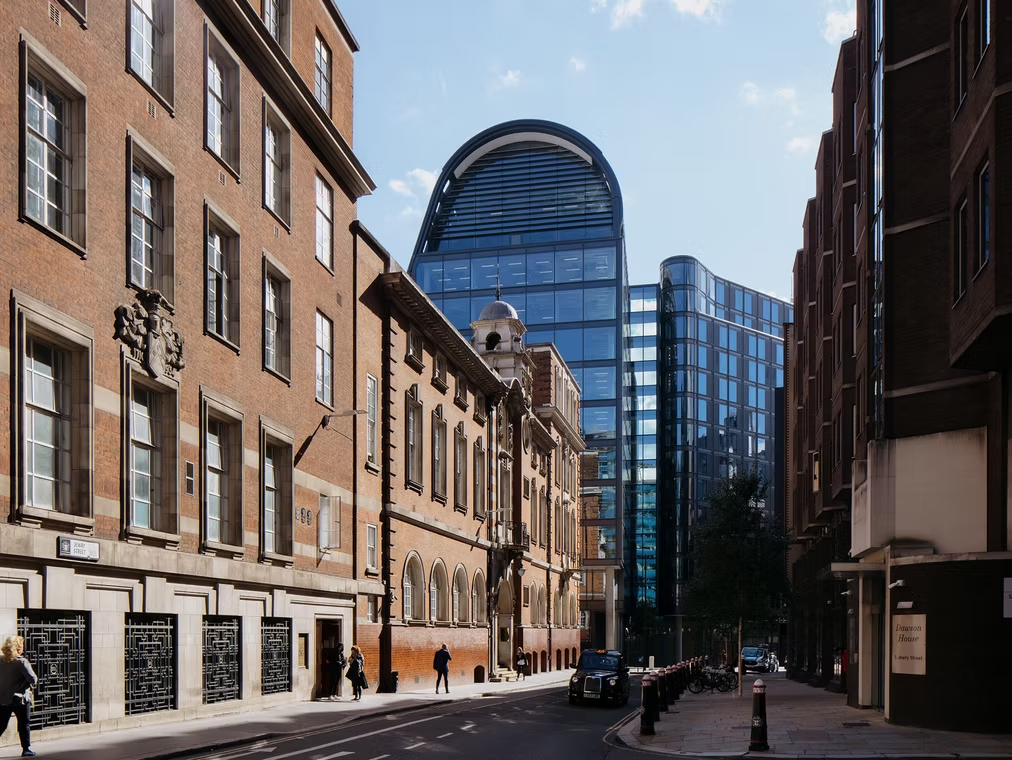
On the 28th of March 2023 I had the great pleasure of joining the CAF’s tour of Urbanest’s Emperor House development on Vine Street, in the City of London. It was a project that I was unfamiliar with, designed by a practice whose work I used to know well when I was studying but who, over the years, I had no longer found myself following. I arrived just about on time and made my way into a meeting room off the entrance lobby to the student accommodation. Here, before starting the building tour, Jim Greaves and Alex McCartney of Hopkins, who designed the scheme up to Stage 02 and Nat Lee of Apt Architects, who delivered the design through to completion, provided us with a highly informative background to the project and the considerable challenges they had overcome since its inception in 2010 through to its completion in 2022. As an overview, the development is comprised of three built forms containing its two principal uses of student accommodation and flexible office space. The main built form is a linear building that runs alongside a new piazza on Vine Street, with 11 storeys of office space occupying the northern end and 14 storeys of student accommodation to the south, arranged within the same overall height as the office by virtue of its lower floor to floor heights. The building is characterised by its louvred barrel vaulted roof that extends over both uses and slopes down its Vine Street elevation to respect the constraints of rights to light and, in so doing, cleverly belies the height of the building when viewed from the street. In addition to sharing the same roof, both uses share a material palette of metal, glass and concrete but are subtly differentiated in appearance by the extensive glazing and greater floor to floor heights of the office building. Further student accommodation is provided in two secondary built forms that employ the same material palette and architectural language, with a wing of accommodation offset and angled away from the main building to continue the line of the street frontage onto Jewry Street, whilst on Crosswall a simple infill building sits quietly but assuredly between its neighbours. The tour started by exiting out of the student accommodation entrance lobby onto the newly created piazza followed by the group looking up at the Vine Street elevation to experience how modest the building felt despite its height thanks to the previously mentioned sloping elevation whose five-storey ‘eaves’ was set at the predominant building height of its neighbours. Here we were also shown the joint-line, where the two different uses with their different storey heights meet. This could have been a difficult relationship but at lower level the change happens within a recess whilst at higher level the connection was covered by the continuity of the louvred sloping elevation. Following this, we arrived at the generously sized double height entrance space to the offices, via a well-choreographed change in level. Here the same changes in level we had experienced externally had been used to create a series of terraced informal seating and working areas that served to not only break down the space in plan but also vary the space volumetrically in what might otherwise have felt a slightly oversized and empty space. The office floors were relatively modestly sized clean rectangles of space with raised access floor and exposed services above*. So far, so normal. However, what I was struck by and found quite magical were the views out all three sides of the office space onto the close-up elevations of the three surrounding neighbouring buildings. Seen through the full height glazing and framed top and bottom by the floor and soffit, the three different ages of the architecture became a theatrical backdrop to the space and started to make me begin to appreciate what this project was doing so well. It was a growing sense that, from the outside in and from the inside out, the building was engaged in conversation with every aspect of the City’s context. *(For those interested in their office specifications, of particular note was that the height of the office the space felt generous despite the relatively low floor to floor height of 3.3m, which, thanks to some impressively well co-ordinated services, still achieved a clear height of 2.6m to the underside of the light fittings and felt more than ample for the size of the floorplate. This feeling continued as we departed the office building and followed a well-groomed landscaped planter that mediated the changes in level along Jewry Street until we reached an entrance to the next unexpected moment. Here was a glazed elevation with views down into a space that re-enshrined the significant remains of a Roman wall. Once unceremoniously hidden away in the basement of the previous office building on the site, it was now fittingly and ingeniously opened to view to the passing pedestrian by the introduction of a public cut through the building and housed in its very own independent space to allow the public to inspect the wall at close quarters and learn about its history from the accompanying exhibition. This was remarkably well done and increased my sense of the relationship the building had with its context; on this occasion its topographic and historic context as well as the contribution its permeability and accessibility gave to its urban context. The discoveries continued with the next part of the tour through the 8,000 sq.ft of University incubator space that had been accommodated in the lower levels, adding further richness to the mix of uses and life that the buildings contribute to the city. This was followed by a journey up through the student accommodation, the largest of the two uses. Here we sampled generously sized well-appointed rooms beneath the sloping roof. My observation here was that the rooms could have benefitted from more natural light and the treatment of windows and louvres felt heavy, leading to a slight […]
Revealing the City: The City – the next five years
Chris Hayward, Policy Chairman at the City of London Corporation, outlines the continuities and changes needed over the next five years for the City to remain a world-leader in the build environment.
Behind the Scenes: Leathersellers’ Hall
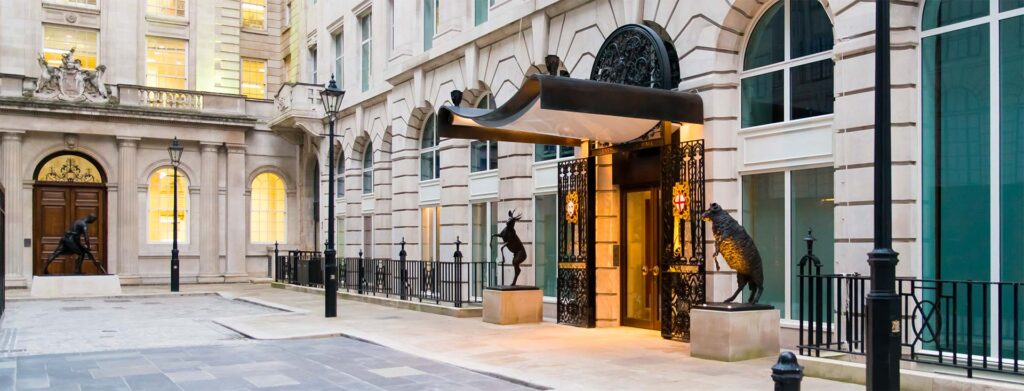
Thursday, 8 September 2022 I joined the tour of the of the Leathersellers’ Hall as a learning opportunity. I am an architect and I am always keen to visit good architecture and expand my pool of references. “The Leathersellers’ Company has occupied this site continuously since 1543. Whilst earlier halls were located within St Helen’s Place, the new 7th hall has now returned to the site of its earliest historical location.” The Leathersellers’ Company is thought to have its origins amongst the whittawyers (makers of fine white leather) and pouchmakers who congregated along London Wall in the early thirteenth century. By 1444 the Leathersellers’ were sufficiently organised and powerful to apply to Henry VI for a charter of incorporation. The house of the company has been redesigned with its rich history in mind. The entrance to this address is signalled by a draped bronze canopy and magnificent wrought-iron gates. Our visit started from the reception room – a room that orbits around a sculptural chandelier designed by the American artist Dale Chihuly. This room is about light. One of the walls is fully glazed with a curtain veiling the cathedral next door. The masonry wall of the church becomes part of the room, tainting the light of a warmer tone. The room is an essay about light and reflection, delivered using lacquered wood. Subtle colour differences varying tints of white and grey. Cracked and smooth lacquered panels make up for the envelope of this room. Walls are thick. They are hosting air handling units and all the services necessary to a functional space. The room serves the adjacent board room. A walnut room warm but still bright. Through the vision glass above the doors, you can appreciate the transition between the two worlds. Walnut panels chandeliers and soft carpet characterize this second room. Trophies on the wall such as the original statutes of incorporation. Extraordinary artefacts within bespoke niches are wonderfully crafted and very well curated to make the point about the importance of the leather trade in history. A bright generous vestibule hosts the start of the descending journey. Like a museum room, with an extraordinary self-supporting spiral staircase. Walking downstairs offers an extremely dynamic experience, the view is always comforted by an accurate selection of finishes. Calm, elegant, sound absorbing, warm textures to soften and compliment the architecture. We stepped in the bathrooms, which have been designed with elegance and good manners in mind. The final room that we visited was the actual dining hall which can seat up to 120 people at dinners. This room is also covered in American walnut panels. The main feature of this large room is the tapestry hanging along the upper part of three of its walls. It is forty metres long and contains a wealth of interesting images and allusions, all relating to the Leathersellers’ Company. Fabrizio Cazzulo words and photos City Architecture Forum member
Behind the Scenes: The Gilbert & One Lackington (City Gate House)
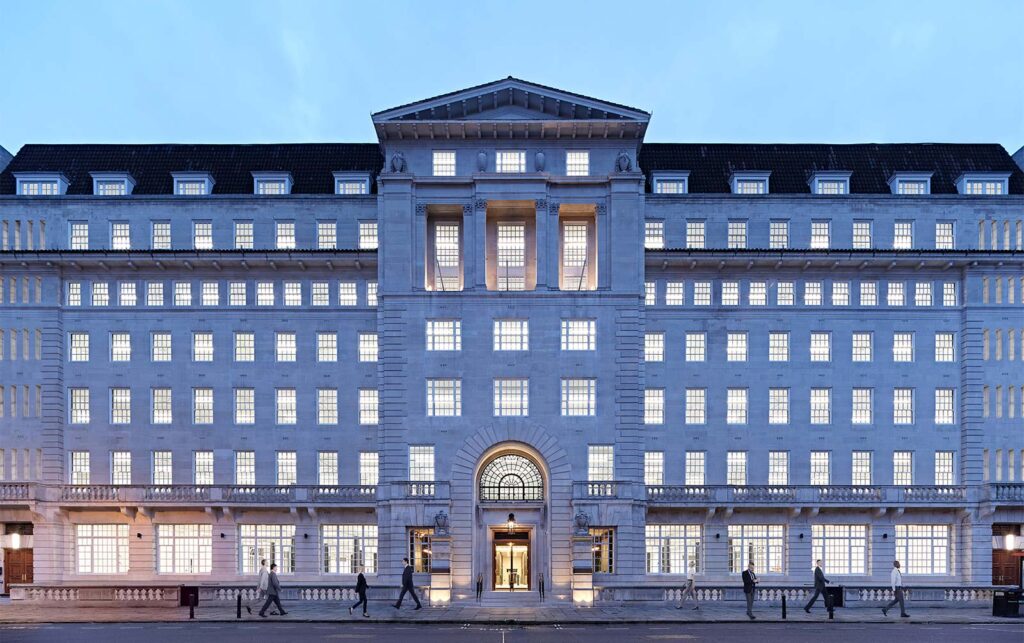
Thursday, 14 July 2022 As we seek sympathetic and practical update of our City offices and rich heritage it was refreshing to join and learn about the recent architectural revamp of The Gilbert & One Lackington (‘The Gilbert’) carried out by Brookfield Properties. The Gilbert never was intended as offices, designed by Frederick Gould and Giles Gilbert Scott originally as a Member’s Club for BP in the 1930s, so no wonder it was compromised or creatively added too, termed ‘eccentric’ by some. The history of the building is not easily attained, whether incidental or not to the original use, we understand its physical form to have been modified as the needs for the building have changed. What we experienced on touring the completed office scheme by Stiff + Trevillion (S+T) is its almost seamless transition to high quality office accommodation with a centralised new core allowing simplified circulation and unifying the historic buildings, which has only been possible through modern intervention. As with many of Giles Gilbert Scott’s creations, thinking of one of his most seminal of works – the red telephone box, they have required necessary modernisation as the needs of society and technology have evolved. So have his buildings. The robust City Gate House (as it was formerly known) is testament to this in how it has been adapted from a club to offices and more recently in this phase of office modernisation to allow more flexible workspace. We see, now more than ever, the requirement to update the office buildings of the City. What is tricky in achieving these modern updates to the City’s historic building stock is finding the balance of retaining the important historic elements whilst still delivering relevant office space with a capacity to serve the needs of new working habits. The Gilbert delivers in this regard. The numerous structural columns throughout can be viewed as a nuisance to flexible workspace but are not without their purpose. At The Gilbert the columns are unapologetic in a deep charcoal paint and strong in how they identify with other architectural features and could in fact inspire the office layout of new future tenants as sprawling open office floors becomes less in vogue. For a significant portion of The Gilbert’s lifespan, it accommodated the offices of Bloomberg who were somewhat reluctant to depart the charming City Gate House to occupy their new home at Bank, although an exceptional office redevelopment with considerable foresight and achievement in City office architecture. We gained a first-hand account from John Robertson Architects who worked on the buildings with Bloomberg, giving the tour a layered insight into the multiple lives of these buildings. An element of the S+T design approach that makes a clear and beneficial change to the internal spaces is running the air conditioning system underfloor, freeing up ceiling space and allowing greater appreciation of the surviving architectural elements, as well as improved air circulation. Future occupiers will of course want to remain cool under pressure but it would also be a crying shame not to understand the historic internal proportions or variation in fenestration to their full potential. The multiple new contemporary terraces added in the internal extensions to The Gilbert add new substance to the buildings robust character and unlock new perspectives within the buildings as well as views outwards to the varied character of the City from this historic location, elevating the user opportunity. This introduces new sensory experiences of transitioning from enclosed to open spaces across the development. Great care and resourcefulness has been taken in utilising the existing structure and architectural elements (a whopping 90% of the building is retained), incorporating the elements that make The Gilbert interesting, even celebrating the patchwork of changes, and continuing its rich history with more sustainable updates. This has been a mindful building retention project that has achieved Net Zero Carbon in Construction and improved energy performance throughout the upgraded office building which will ensure this building operates successfully for many years more. A commendable project in building retrofit. Ailish Killilea, words City Architecture Forum member Ailish Killilea and Andy Stagg (for Stiff + Trevillion), photos
Behind the Scenes: 21 Moorfields
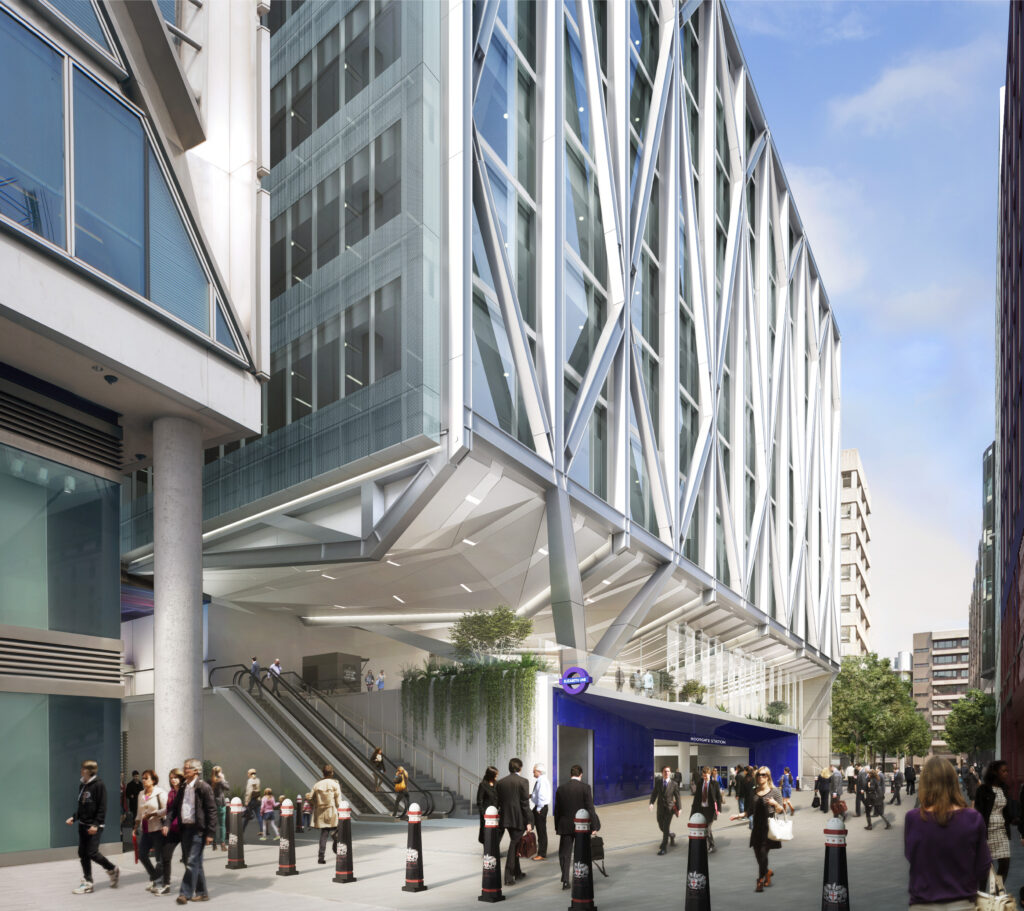
Thursday, 26 May 2022 New York was rebuilt on large plots of land, in a new grid network, with new ordinances that, for example, forbade the use of wood and encouraged tall buildings. But today, even New York is zoned into conservation areas and plots where tall buildings are allowed. Here in the City of London, we continue to see developments of varying approaches: those that exploit the envelope and those that must work within a listed building or a conservation area. Nothing is straightforward. Every decision is weighed up and evaluated carefully, so as not to upset the balance. Because we understand that one of the qualities that draws business to our great city is this fine grain, its dynamic relationship between old and new – and the sense of the future it creates, alongside respect for the past. WilkinsonEyre is responsible for three City buildings: 8 Finsbury Circus, which won the City Building of the Year Award in 2017, 8 Bishopsgate tower, and 21 Moorfields – the latter two are under construction. In each case, the context drives the design. The Moorfields site was last developed with three buildings in the early 1970’s, but had remained largely empty since Lazard’s vacated in 2003. Landsec acquired the land in January 2015 and committed to delivering a high-quality, office-led development on this most complex site. The new building rises 16 storeys above Moorgate station and provides 60,000sqm of space. The station had to remain operational and no further columns were permitted within the station box, so all structure was limited to an asymmetrical arrangement either side of the tracks. It is a contemporary solution to the modern conundrum of how to place large dealing floors and a company headquarters for Deutsche Bank in the dense heart of the city – and it does so with great panache! Giles Martin, Director at WilkinsonEyre Architects and David Seel of Robert Bird Group Engineers took us carefully around the building site. It was a rare treat to see the building in its closing stages before completion. The project will take 18 months to handover, as TP Bennett work on the interior fit-out. One cannot help thinking that it was this unique approach to the design that won the project for WEA and RBG – and it’s perhaps fortuitous that the contract was signed by the Bank before Brexit, Covid-19 and its fall-out on the global economy. With a footprint the size of a football pitch – 110 x 60 metres – it presented the opportunity to create 4 huge dealing floors for 600 people. As someone mentioned, if each trader generates profits of £1million for the bank in a year, this investment will have been worthwhile! As a young architect, working on a massive interchange in Bilbao, I recall the late, great Chris Wilkinson’s excellent book ‘Super-sheds’ analysing the great sheds of the past, just before the practice built its first big shed at Stratford in East London. Here at 21 Moorfields, we see that same big thinking applied to a major office building. Wilkinson Eyre, working alongside Robert Bird Group, has crafted a building that displays some of the most innovative new engineering in the UK – and the world. The design team has shown what is possible for other stations in the City by driving piles 65 metres into the Thanet sands to exploit the advantages of the location. These ‘super piles’ – the highest capacity strength in London, supporting 65 mega newtons – are 2.4metres in diameter and support giant trusses, which in turn support huge 7 bridging arches that are creatively integrated into he structural frame of the building, from which the floors hang. When Robert Bird Group started pile testing, it was a surprise to discover this unique development potential in the City of London – something simply not as possible elsewhere in the capital, such as Canary Wharf. Unusually, the cores in this building are non-structural and placed at the sides. They float above the station and provide all the required air treatment, toilet, and kitchen areas. WilkinsonEyre is renowned for their marriage of art and science, and this project is no different. The exposed steel frame forms the memorable entrance elevation towards Moorgate and Finsbury Circus, creates a dynamic patterned façade and shades the building from the rising sun. This makes a powerful contribution to the architecture of the street and marks the station, which had otherwise been buried under conventional-looking office buildings. In doing so, it recalls that great age of stations, which Chris Wilkinson loved so much. The building’s crown is focused on the centre line of Finsbury Circus, its sloping setback reflecting the sky. No doubt the architects’ gentle art of persuasion convinced the city planners to approve the massing. The bowstring trusses of the Piano Nobile, above station level, give the building character and form its cavernous entrance lobby. Certainly, on our visit, one could see the essence of the spaces, the voids, and its overall character. We also learnt that the building can move by +/- 100mm in any direction! This squidgy movement joint is ingeniously laced around the plant room level, which is neatly inserted under the entrance lobby and directly over the protected station box. Andy Sturgeon has designed the landscape throughout the building and often, ingeniously, within its facades, as well as in the open spaces. The planting is integrated at many levels within and around the structure, particularly at the lobby level, where it extends into a series of stepped atria gardens. An innovative long section culminates in the west at the Barbican, where a wellness suite exclusively for the use of the Bank’s employees overlooks a courtyard garden. All of this is publicly accessible via the raised walkways, which weave through the Grade-II-listed and conservation-area-protected Barbican Estate. The new building, costing several hundred million, is planned as Deutsche Bank’s London Headquarters for the next 25 years. The tour was a real treat, and as we […]
2021 End of Year Review
Sadly it looks as if the concluding headlines for 2021 will, like those for 2020, be dominated by COVID and its variants. Despite this depressing turn of events, 2021 has been a year of significant progress for the City of London and in turn for its built environment, and the Forum has followed this trend as your Committee has against the odds pleasingly been able to ‘host’ a combination of physical and virtual events. Our virtual events have shaped some great online debates which exemplify, in my mind, the diversity of the Forum and its membership whilst the essential oxygen of face-to-face encounters and building inspections which we have all craved proved hugely popular. For me the highlight of the year was to be able to hold our Annual Dinner again and for us to be blessed with two wonderful speakers in Professor Sadie Morgan OBE and Juliemma McLoughlin from the City of London Corporation.We were indeed treated to two quite contrasting speeches but significantly both of which were quite specific in setting out the challenges which the built environment faces in the coming years.The ever changing dynamics of COVID throughout the year has meant that as we focussed on keeping the Forum alive and relevant we did not get to properly celebrate the 30th anniversary of the Forum but I would hope that with luck we will during 2022 in addition to hosting a challenging programme of events also be able find time for a suitable opportunity for an anniversary party. Watch this space… Before I sign off my heartfelt thanks to you all for your continued support of the Forum in these trying times and of course my thanks to the Committee ;we truly do have a great group of people who keep coming up with great ideas – long may this last.I’m also pleased to have been able to welcome two new Committee Members this year in Dima Zogheib from Arup and JJ Sarralde from The Townscape Consultancy. With best wishes for the Festive Season and I look forward to seeing you all in the New Year.Andrew Andrew ReynoldsForum Chair
Behind the Scenes: 135 & 155 Bishopsgate
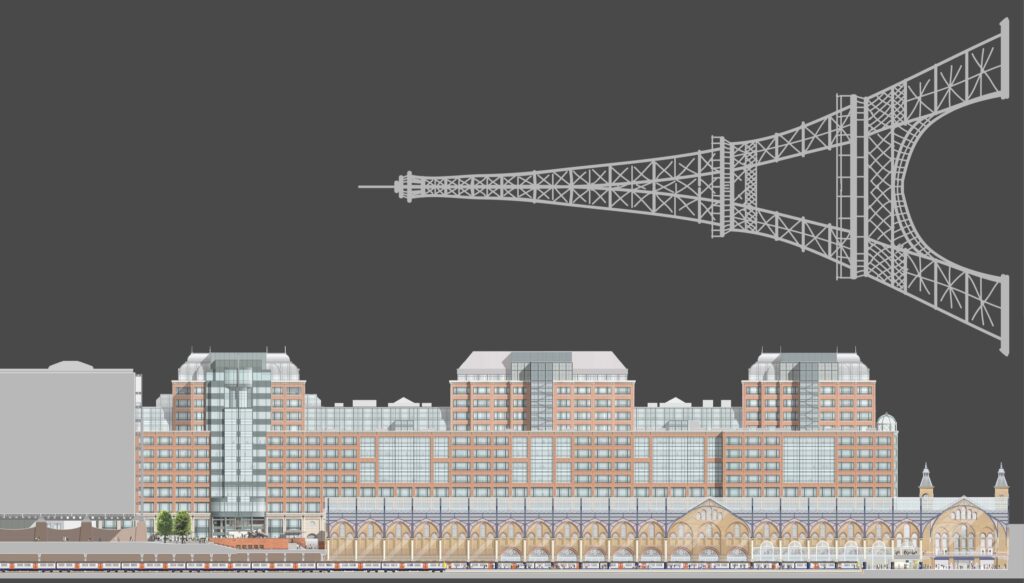
Wednesday, 3 November For those who recall the mid-80s development scene in the City the huge Broadgate redevelopment represented a step change from the dismal multitude of dull buildings provided by so-called ‘developers architects’ of that time. The wholesale demolition of historic, characterful, useable City buildings that redevelopment entailed was lamented loudly, but with limited success in turning the tide. Broadgate was something new. Albeit huge in size the vast spread of buildings were carefully designed, with public assets a major feature. Despite its size Broadgate was well received and an acknowledged success. The offices have worn well, being of composite steel frame and concrete construction. At the heart of the scheme came a unique pedestrian square encircled by a colonnade clad in marble. There might have been twinges of regret for the loss of Broad Street Station’s lively facade of 1865, but the listed Liverpool Street Station, in conjunction with Broadgate, was notably well repaired and upgraded with improved access and new through routes. New retail outlets at the station added liveliness and increased income. A broad new pedestrian route led through to Bishopsgate‘s west side, also part of Broadgate, where a raised walkway had been created lifting pedestrians away from noise and traffic fumes. This civilised gesture was much welcomed and has been retained and enlivened in the new scheme we examined. Did I hear right?? Yes I did! British Land is the developer of the west Bishopsgate scheme we visited, in their new guise as mixed-use and brownfield site developers who are also getting into regeneration – in a change of focus that is proving worthwhile. The tenants are remaining in situ at No. 155, and No. 135 is letting well. We looked into two separate buildings at 135 and 155 Bishopsgate that front the walkway, but separated by an intervening Broadgate block now being refitted by others. 155 Bishopsgate offers 160,000 sq. ft of office space. Fletcher Priest is the architectural practice appointed to refresh the buildings we focussed on. Central to their thinking was the retention of embodied carbon. The Broadgate structures were well built and have stood the test of time, but a measure of redesign and upgrading was called for to suit 2021 needs and activities. This has been the practice’s endeavour, satisfying both requirements. Partner Ed Williams, who led us round, was in charge of the scheme, blending the skills of the practice in master planning, urban design, interior design and spacial planning to produce an imaginative ,sustainable result that respects the embodied energy and quality of the existing structures. The walkway has been widened significantly, refreshed and re-imagined to provide a welcome, distinctive range of eateries in former offices on its west side, with well-lit outdoor cafe spaces and attractive landscaping on the east of the walkway. A magnificent view of Christ Church Spitalfields is available. The venues are lively, well patronised and lit at night, so catering to the burgeoning evening economy. The re-imagining of the (now setback) offices has been accomplished with flair and imagination, retaining attractive features such as marble flooring and sculpture from the earlier scheme at No. 155 and impressive classical stone arching at No. 135. Setting the offices back allowed more welcoming glazed facades to be introduced, revealing the retained travertine walling inside. There is a sense of light, air, and space throughout. Internal atria have been retained. A soft colour palette has been introduced into the offices and older installations are being retained where appropriate and feasible. Sterile spaces have been re-energised by careful lighting. Rooms for receptions are welcoming. Roof top views from high buildings in the City are usually magnificent, including at night, and there are are no exceptions here. At No.135 a rooftop outdoor garden ingeniously masks servicing installations. Carbon capture was a focus of discussion, especially as we were in the immediate aftermath of the Glasgow Climate conference and all too aware of the challenges that lie ahead. Re-imagining the potential for upgrading these buildings had significant beneficial outcomes — with the embodied carbon in both buildings calculated to be about one third of that required for new-build on the same sites. This has to be the way forward, surely? It has long been argued that re-purposing and successfully adapting existing structures is generally a kinder, more environmentally friendly, and less expensive approach. We should embrace the practice ASAP. That is the next challenge. This project maps one way . Words & Photos : Dr Jenny Freeman OBE City Architecture Forum member
Revealing the City: Thermal Comfort – a ground breaking initiative
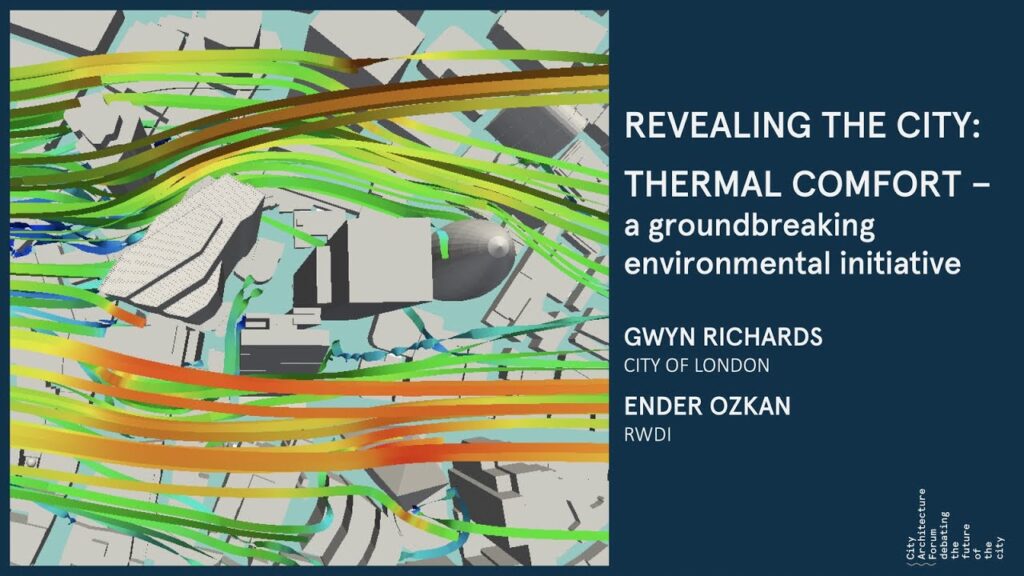
Gwyn Richards Chief Planning Officer and Development Director in the Department of the Built Environment at the City of London, and Ender Ozkan Vice President of RWDI discuss how the 2 organisations worked together to produce the new guidelines for the next generation of post COVID developments in the City where the very crafting of a more nuanced mix of new office space and outdoor amenity will be fundamental to the next generation for the City of London.
Behind the Scenes: 22 Bishopsgate
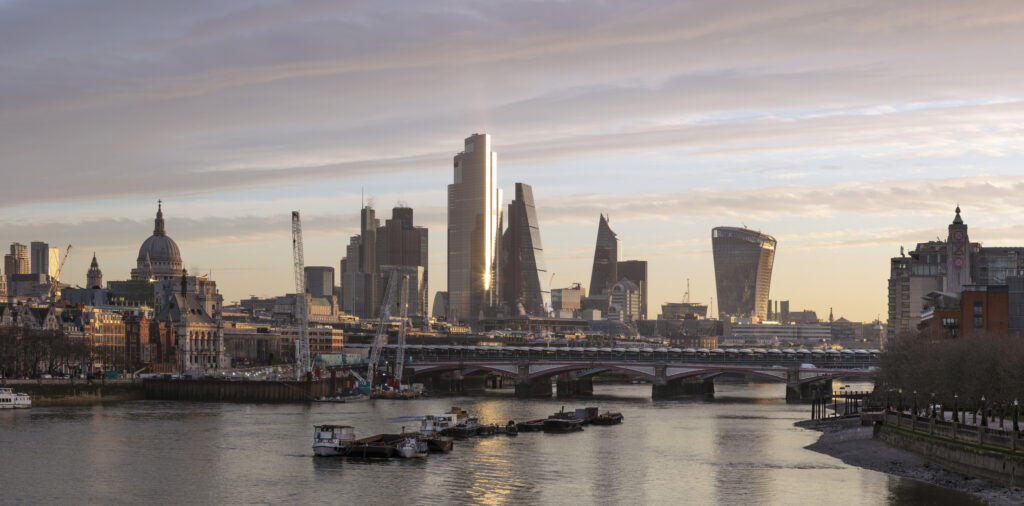
Tuesday, 12 October 2021 It is always a pleasure to experience the physical manifestation of one’s endeavours, particularly after such a long break away from being able to move around freely, let alone visit buildings, but it was even more exciting to be afforded the opportunity to tour the new 22 Bishopsgate, currently the pinnacle of the City’s famed cluster, and to be hosted by PLP Architects. ’22 Bish’ was developed by Lipton Rogers and AXA IM Real Assets and comprises 196,950 sqm of mixed use, predominantly office, space in a building of 62storeys and 278 m in height and is surrounded by established tall buildings such as The Leadenhall Building, new ones in construction (8 Bishopsgate) and others to come (1 Undershaft). We met in the main entrance off Bishopsgate in a lobby that is very human in scale given the quantum of people that will passing through when fully occupied and had the good fortune to bump into Sir Stuart Lipton and Peter Rogers en route to a publicity shoot in the public viewing gallery atop the building. We duly followed in rapid double decker lifts and were greeted with a spectacular triple height space. One can never tire of such views and to be freely available will make it a hugely successful public facility. The chance to look down and see the ‘Nat West’ tower’s branded imprint is very rare as is the reported ability to see the Channel on a clear day and, as with The Shard, one can see the Hornby scale trains and rail lines that help orientate and identify the increasingly polycentric neighbourhoods that describe London’s geography. The lift down took us to grade and the dedicated public entrance off Bishopsgate, adjacent to the main entrance, and scaled to allow for queuing, ticket and security checking. Then into the guts of the building where we were shown around the 1,699 cycle parking spaces, colour coded (Peter Rogers’ influence made obvious) and ordered at a stadium/airport scale, together with an array of storage solutions and mechanic and spray washing bays and easy access to street level. Back up again, we were able to enjoy the specially commissioned glass printed art work by Bruce McLean that line each lift car, seemingly humanising the otherwise robotic nature of movement within buildings, and entered the building’s heart; the Market Place (fitted out by Blue Crow), comprising an array of food and drink offer. It was great to see so many people enjoying a relaxing drink after work (it was by now 6.30pm) within the building itself and this area will be a huge success and a testament to the wellbeing movement. 22 Bish will undoubtedly be a huge success and the supporting functions and features make it stand out amongst its peers. With special thanks to Karen Cook and Amy Holtz from PLP Architecture, as well as Lydia Morrow from Lipton Rogers Developments for an enlightening tour. Words: Barnaby Collins City Architecture Forum member, DP9
2021 Mid Year Review
The first 6 months of this year have seen a gradual re-awakening from the long winter of the pandemic – there is cautious optimism in the air and a discernible feeling that we are on the brink of a new beginning, brimming with opportunity. The pandemic has forced many of us to reflect, re-evaluate and re-calibrate, and to revisit aspects of our work and personal lives that we have perhaps taken for granted. This is a time to innovate, to do things better, be that in terms of our health and well-being, the work that we do and the way we do it, or improving our carbon footprint. A summer of sporting events which have seen the return of spectators, and a fine showing by the England football team in the Euros, have heightened the sense that the clouds are dissipating and there are better times ahead. We, like many, had to adapt our modus operandi to the times, which prompted the launch of our online lecture series and our choice of current and thought-provoking subjects. I am pleased to report that the lectures were extremely well attended and favourably received. For those that may have missed out, you can catch up with the recordings at any time, which are available via the Blog Page. There were 6 lectures scheduled between February and April this year , offering members and guests a broad ‘menu’ of topics covering the ground breaking public realm scheme at Exchange Square presented by DSDHA and FFLO; discussions on the future ways of working and the new workplace with Fletcher Priest, Despina Katsikakis and Peter Murray; as well as presentations on 77 Coleman with Buckley Grey Yeoman and Heyne Tillet Steel; Eight Bishopsgate with Wilkinson Eyre and Arup; and One Bishopsgate Plaza with PLP – all exemplar projects which will surely contribute to attracting us back into the City. Looking to the future, we would like to continue to challenge ourselves and keep improving as an organization, to maintain our relevance and importance to you, our members. We will continue to diversify and hope to see a broader representation in the membership and at Committee level, and to engage with the best of design and thought leadership.We encourage you to nominate potential new members and help us to grow the Forum. We hope to see a return to ‘in person’ events over the next 6 months, which will be blended with the now widely accepted online events, in this our 30th Anniversary year. The anniversary is, of course, a significant milestone, which we intend to celebrate with a high-quality roster of events including tours of One Crown Place (with KPF and CBRE); 22 Bishopsgate (with Lipton Rogers and PLP); 135 Bishopsgate (with Fletcher Priest); as well as hearing from Gwyn Richards, Interim Chief Planning Officer and Development Director in the Department of the Built Environment at the City of London, and Ender Ozkan Vice President of RWDI on the ground breaking ’Thermal Comfort Guidelines’ for the next generation of post COVID developments in the City where the very crafting of a more nuanced mix of new office space and outdoor amenity will be fundamental to the next generation of our great City of London. We are also delighted to announce that the year will be rounded off with Prof. Sadie Morgan OBE as the keynote speaker at our Annual Dinner on 22 November 2021. Put the date in your diaries! As the reawakening continues, we very much hope to see the City fully active again and meeting many of you at future events and functions, not least to foster that very important sense of community that nurtures organizations like ours. David MagyarForum Hon. Secretary
Revealing the City: Eight Bishopsgate
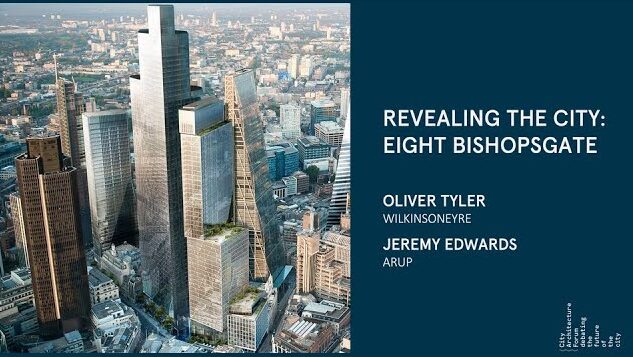
Architect Oliver Tyler (WilkinsonEyre) and engineer Jeremy Edwards (Arup) explore the development of Eight Bishopsgate – the new 51 storey tower in the City of London.
Revealing the City: The future of offices in the City of London
Despina Katsikakis, Global Head of Total Workplace at Cushman and Wakefield, Peter Murray London Mayoral Design Advocate and Chair of New London Architecture, and Andrew Reynolds City Architecture Forum Chair and advisor on a number of new City tower projects discuss the future of cities and workspace in the post-COVID world.
Revealing the City: One Bishopsgate Plaza
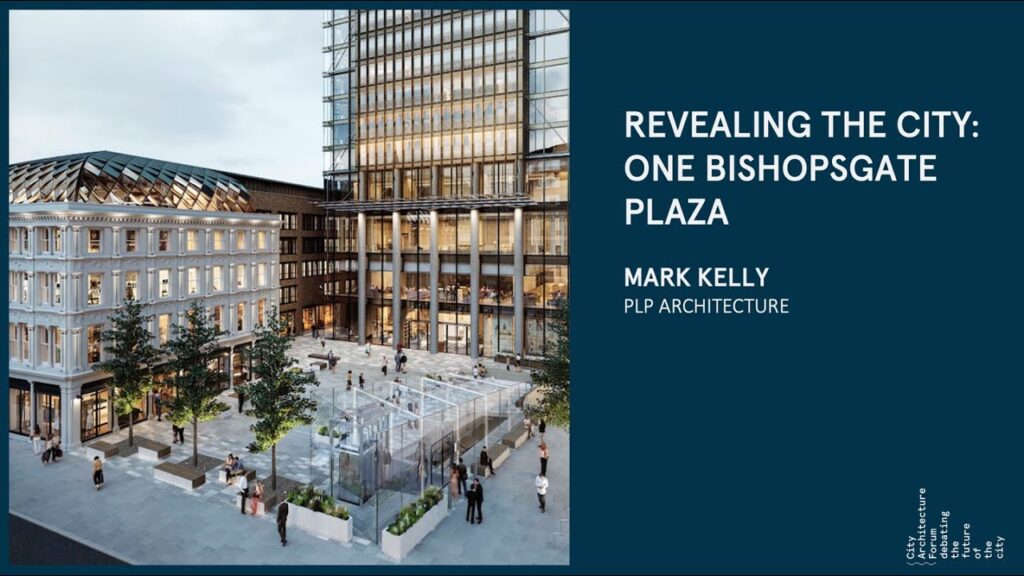
Mark Kelly, PLP Architecture explores a number of the project goals of One Bishopsgate Plaza, including the regeneration of part of the local Conservation Area.
Revealing the City: 77 Coleman
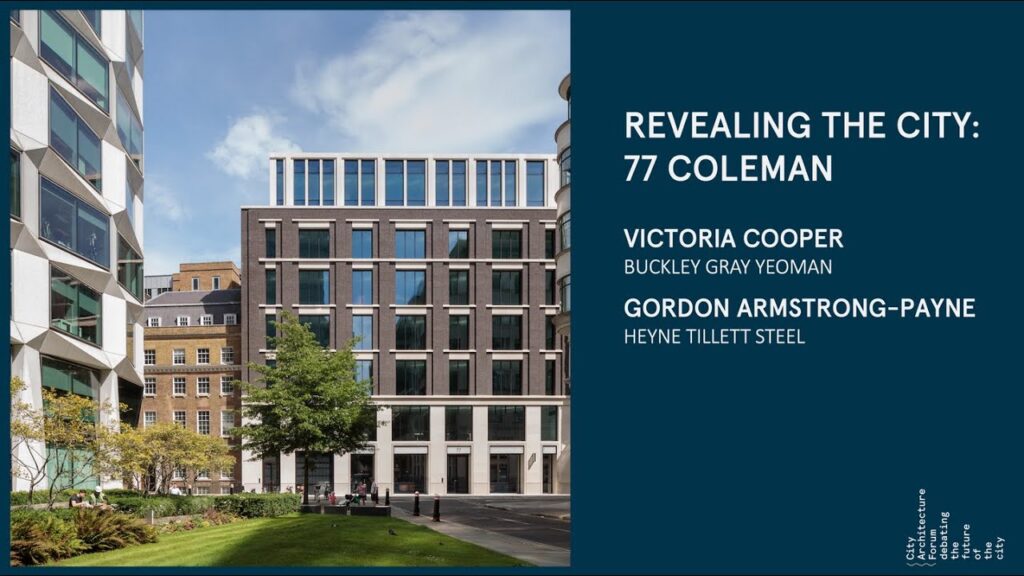
Victoria Cooper, Associate at architecture and interior design practice Buckley Gray Yeoman and Gordon Armstrong-Payne from Heyne Tillett Steel present 77 Coleman – the comprehensive redevelopment of an existing building that fronts onto two major thoroughfares within the City of London.
Revealing the City: FutureWork
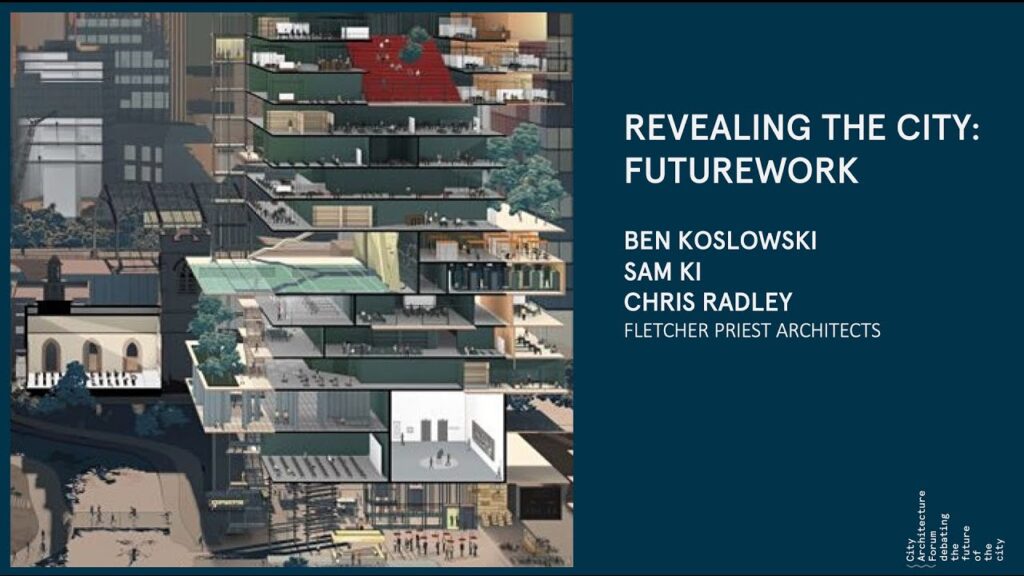
Ben Koslowski, Sam Ki and Chris Radley (Fletcher Priest) examine FutureWork which explores the evolving workplace and how and where we might work in future. While the flexibility and informality of home working was hailed as the future of work at the beginning of the Coronavirus pandemic, remote working has emphasised the value of face-to-face interaction and collaboration. Can the traditional office survive shifting work patterns, or will it become an important part of a networked workplace where choice and flexibility are the future?
Revealing the City: Exchange Square
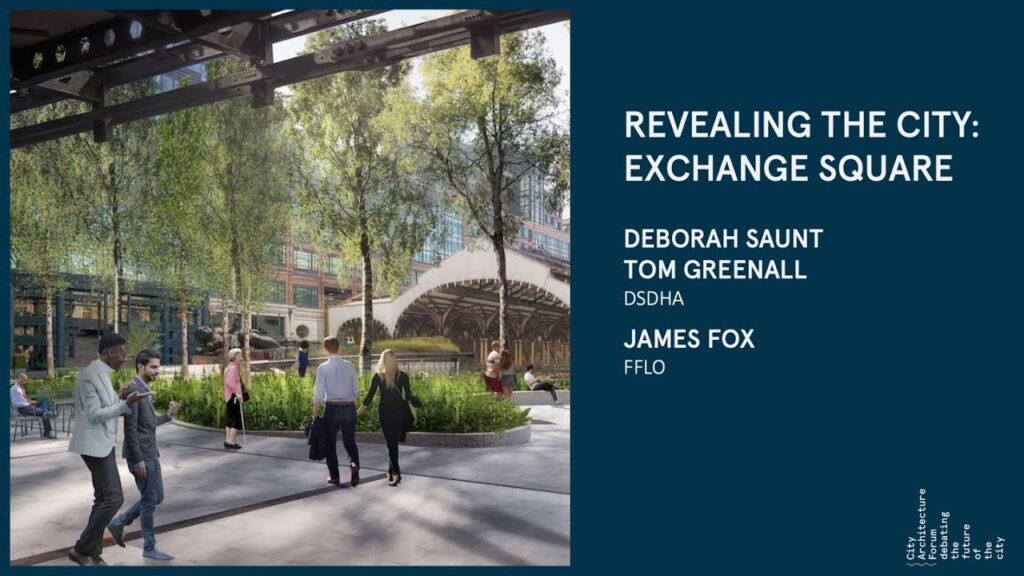
Deborah Saunt, co-founder; Tom Greenall, associate director of the architecture, urban design and spatial research studio DSDHA; and James Fox, partner of landscape architects FFLO, discuss the emerging design of Exchange Square, Broadgate in the City of London.
2020 Digital Lecture Series: 100 Liverpool Street
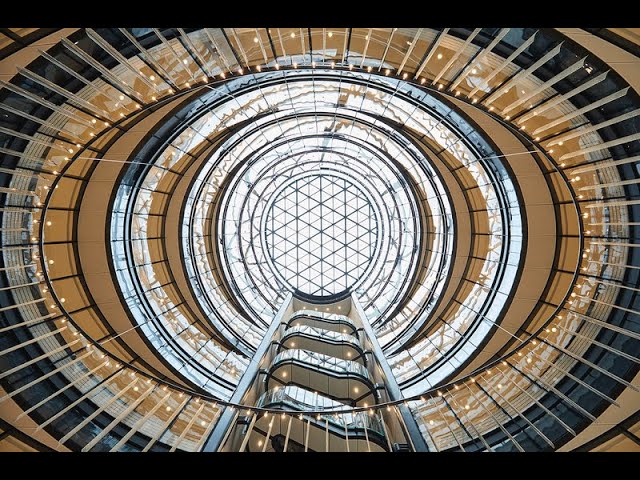
Charles Horne, Project Director of the Broadgate Campus for British Land and Mike Taylor, Principal of Hopkins Architects explore the conversion of 100 Liverpool St, from a 1980s building into a new benchmark for London offices, with a focus on technology, sustainability and wellbeing.
2020 End of Year Review
As in previous years as we come to the end of the year I wanted to write to you, our members, with a few reflections and a look ahead. So for 2020 – the year of the acronym… First, we had COVID and all the attendant horror of the pandemic, then we had WFH and the London lockdown, the likely death of the office along with the impending demise of London as everyone planned to sell up and move to country. In short WAYTW (What A Year That Was!) But throughout all this and in fact two lockdowns, social distancing, family bubbles and sadly very, very few people on the streets of the City for many months, I’m pleased to say that we did manage to keep the Forum operating and indeed growing. As we like so many organisations faced the advent of a ‘new but unknown normal’ the Forum evolved and we managed to hold 12 events; starting with a very privileged tour of the new Museum of London site with Sharon Ament and Paul Williams all the way back in February and culminating, on 24 November with a splendid session about the transformation of 100 Liverpool Street with Charlie Horne of British Land and Mike Taylor from Hopkins Architects. I have been delighted that despite all the challenges that we’ve been presented with this year your Committee has remained ever committed and enthusiastic to the cause and has therefore been able to lay on such a wide-ranging programme. The webinars or, as we have called them, lectures, have been well attended on the night and well ‘visited’ when subsequently posted on YouTube. Whilst not allowing the face to face contact and spontaneity of our traditional Forum events, your Committee rightly identified a gap in the many offerings out there in the real estate sphere alongside a perceived need for some form of personal connectedness; the lecture programme has been a testimony to the appeal of the breadth of events arranged and all the while maintaining our essential City of London connection. I offer my thanks to each and every person who has been involved in both the organising and in the individual lectures themselves. We have seen some changes to the Committee this year with Hon. Secretary Christine Wong stepping down after a period of sterling service, and former Chairman Roger Kallman has also stepped down from the Committee after many, many years of involvement. Christine and Roger, we thank you both for your commitment and enthusiasm over the years and hope to see you both at events in the New Year. David Magyar (John Robertson Architects) has stepped up to the role as Hon. Sec, and as of the beginning of November we welcomed Hala El Akl (PLP Architecture) as the newest member to the Committee.I look forward to working with both Hala and David over the coming months. As many of you may be aware, 2021 will be the 30th Anniversary of the founding of the Forum by Michael Cassidy and Tom Wilmott in the wake of the Prince of Wales’ remarks that the Luftwaffe had done less damage to the City than the developers. I am pleased to report that we have every intention once the COVID situation becomes clearer of arranging a suitable event to recognise this significant milestone for the Forum. We will also be looking to arrange a programme of new events for 2021 and the nature of these will of course depend on the emerging picture of the impact of further tiers of anti-COVID measures in London and the availability of the vaccine programme. I like many other remain very firmly of the view that there is a genuine desire for people to come back to Central London and that the City of London which has a truly rich heritage of survival – think the Great Fire, the Blitz, the IRA bombs – will recover and re-emerge as a 21st century destination. The built environment will play a huge part in this renaissance and we can be there to our part. My best wishes to you and yours; stay safe and I hope to see you all in real life in the New Year. Andrew Andrew ReynoldsForum Chair
2020 Digital Lecture Series: 21 Moorfields
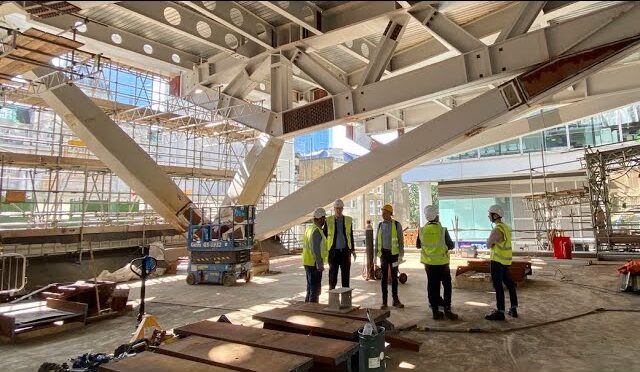
Giles Martin, Director of WilkinsonEyre and David Seel, Managing Director of Robert Bird Group join in conversation with Michael Cassidy CBE, Chairman Ebbsfleet Garden City and Advisor to the Crossrail Art Programme. Giles and David have led from inception the delivery of 21 Moorfields, an ambitious over-site development above Moorgate LUL and Crossrail stations. The scheme, for Landsec, provides more than 550,000ft² of new commercial space and will upon completion become the new London headquarters for Deutsche Bank.
2020 Digital Lecture Series: 6 Orsman Road
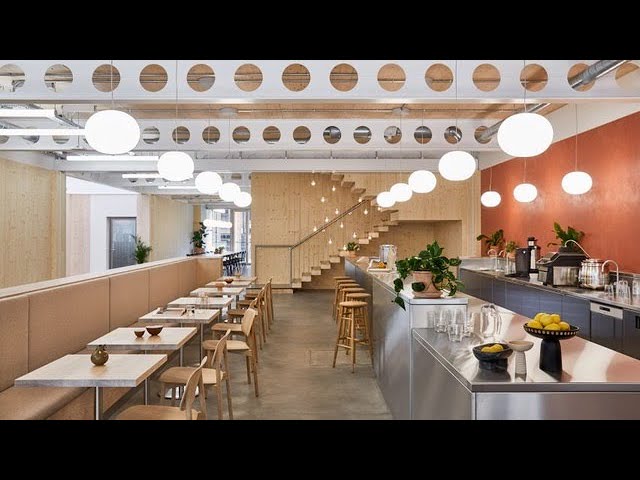
6 Orsman Road on the banks of Regent’s Canal in Haggerston is a sustainably focused office building comprising 34,000 sq. ft. by Storey, British Land’s solution to flexible private workspace. Designed by leading architectural practice Waugh Thistleton Architects, Storey’s 6 Orsman Road is championing the use of sustainable materials for flexible offices. The building’s design is aligned to the core principles of sustainability and throughout the design process there has been a focus on reducing environmental impact by reusing or recycling materials where possible. At 6 Orsman Road a cross-laminated timber (CLT) structure has been used to reduce the building’s impact on the environment, as compared to concrete and steel CLT production requires less water and energy to manufacture. CLT is also exposed internally at 6 Orsman Road, minimising the number of finishes used on the structure, and the offcuts from the building have been repurposed to make furniture within the shared spaces of the building. Andrew Waugh (Founder & Director, Waugh Thistleton Architects) and Stewart Whiting (Head of Product, Storey) discuss the design process of 6 Orsman Road.
2020 Digital Lecture Series: The role of the City’s public realm in today’s changing context

Public spaces are the essential foundation for healthy and enjoyable city life in dense urban environments. As the current health crisis evolves, the ability to engage safely in welcoming outdoor / publicly-accessible indoor green environments is becoming essential for the re-activation of the economy in urban environments. Ken Shuttleworth founder of Make Architects and Dima Zogheib, Associate at ARUP’s Cities Division, discuss how stakeholders can help facilitate a resilient post-COVID city life in dense urban centres and support the re-activation of the City.
2020 Digital Lecture Series: Engineering New Architecture – 100 Leadenhall
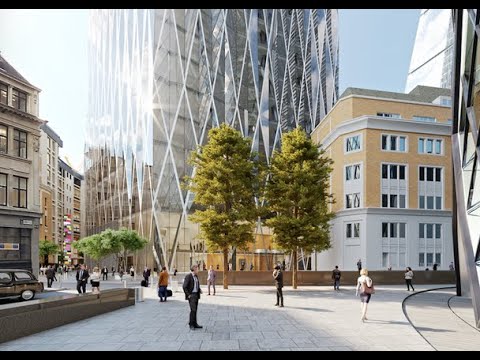
SOM Design Partner Kent Jackson, and Dmitri Jajich, Structural Engineering Director explore SOM’s history of inventive design, and SOM’s proposal for 100 Leadenhall Street, an elegant and intricate tower created by an integrated team of expert engineers and architects, slated to reshape the City’s Eastern Cluster in the years to come. Kent Jackson: is the Design Partner at Skidmore, Owings & Merrill in London. Since joining in 1999, Jackson has worked in SOM’s Chicago and London offices. Under his leadership the office has won a number of significant projects including the renovation of the United Nations Office at Geneva, Karlatornet, Scandinavia’s tallest building, in Gothenburg; and The Stratford, an iconic 42-story residential tower located in East London. Jackson’s work has been published in various international publications including Wallpaper, DETAIL, Interior Design, and SOM Journal. He has also lectured at a number of conferences and architectural schools around the world including TED Talks in 2015. Dmitri Jajich: As a Director of Structural Engineering in the London office, Jajich leads the delivery of innovative structural engineering solutions to realize ambitious building designs. Since joining in 2000, Dmitri Jajich has worked on projects ranging in scale from the World’s Tallest Building to a single-storey residence, and has also collaborated with numerous renowned artists. His recent projects include Karlatornet tower in Gothenburg, Sweden, and The Stratford, which features an ambitious notched, double-cantilevered construction. Jajich is an active chartered member of the Institution of Structural Engineers in the UK, and a licensed Structural and Civil Engineer in both Illinois and New York.
2020 Digital Lecture Series: 20 Ropemaker Street
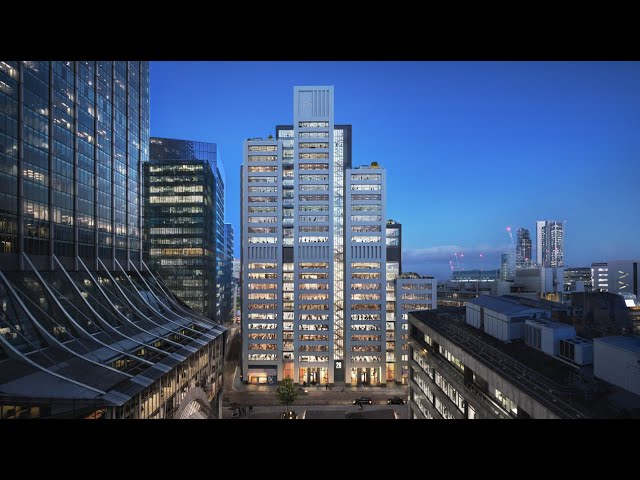
This new 27-storey commercial office building, on the City Fringe has now started on site, and when complete in 2023, will bookend the emerging cluster of towers around CityPoint Square. The design evolution of this new City icon, dealing with a transition in the townscape, features an articulated natural stone façade, a stepping form, and an innovative and challenging structure that creates the opportunity for varied floorplates with no centre core, and multiple roof terraces. In dialogue with principal architect and the client, the design approach looked to create a next generation of workspace that promotes wellbeing in a creative and collaborative environment, successfully leading to the biggest letting of 2020.
2020 Digital Lecture Series: Dan Burr – Citicape House
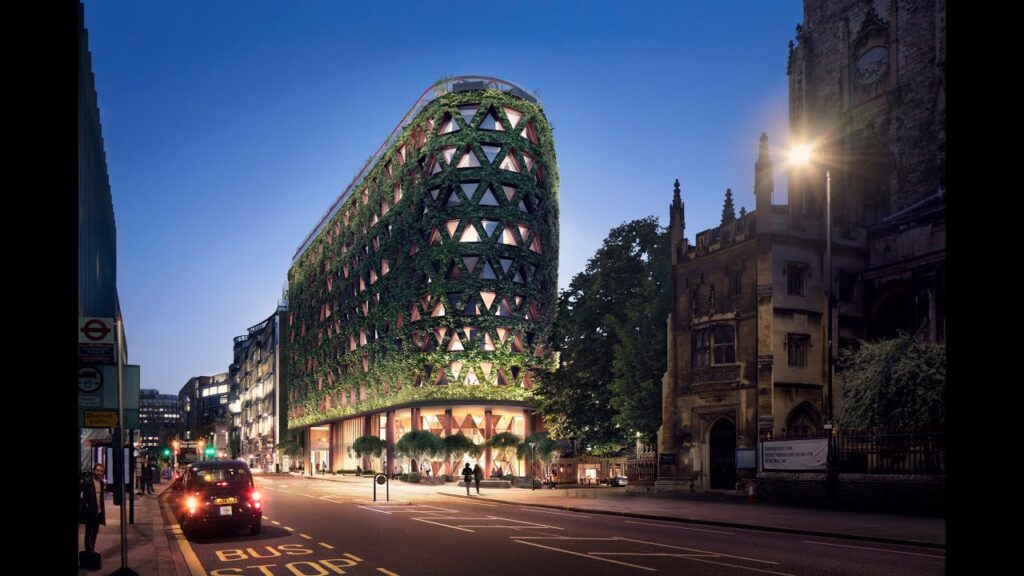
Citicape House, a hospitality-led, mixed-use project, is characterised by the largest green wall in Europe, creating a distinctive architectural addition to a gateway City of London site, while absorbing eight tonnes of pollution annually and setting the standard for urban greening in London. Dan Burr (Sheppard Robson) takes us through how the building can address pertinent issues such as air quality, climate change and air pollution.
2020 Digital Lecture Series: 81 Newgate Street
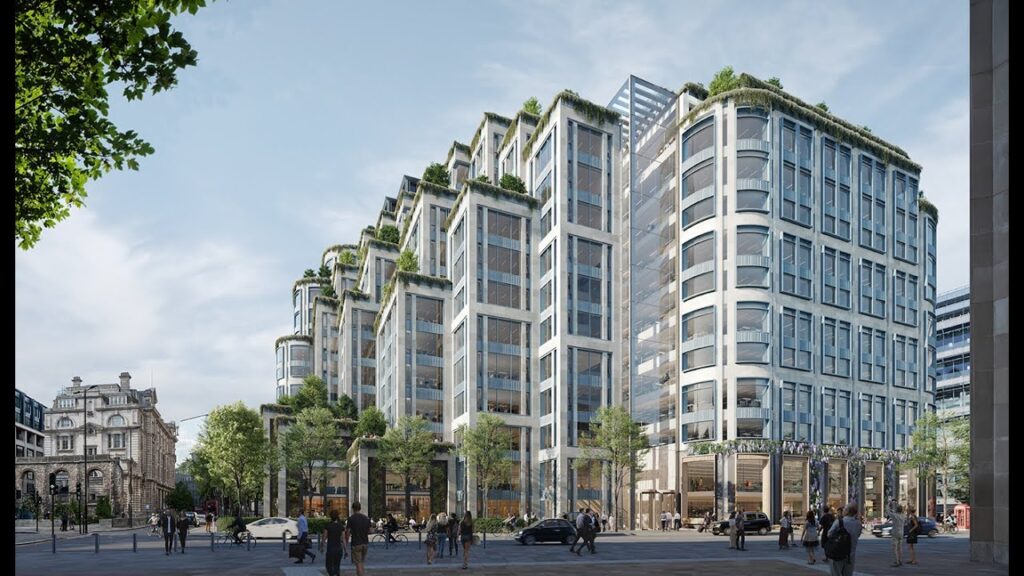
81 Newgate Street, the former BT Headquarters, is an exciting transformation project in the heart of the City. John Bushell (Kohn Pedersen Fox Associates) discusses the scheme, which will transform a monolithic 1980’s office block into a sustainable, mixed-use building that is embedded in the wider public life of the City as a new gateway destination into London’s ‘Culture Mile’.
2020 Digital Lecture Series: Changing Transport and Public Realm in the City
Bruce McVean, Acting Assistant Director, City Transportation, City of London Corporation and Roy McGowan of Momentum Transport consultancy discuss “City Streets – the Transportation response to support the City’s recovery from Covid -19”. The City of London Corporation has begun to deliver its transport recovery plan, designed to ensure the safety of workers, residents and visitors as people return to the Square Mile. The scheme is primarily focused on providing the space needed to maintain social distancing on our streets and to enable safe walking, cycling and the managed use of public transport. Have your say: complete the City of London survey to let them know what you think about the changes. www.cityoflondon.gov.uk/covid19citystreets
2020 Digital Lecture Series: Great Arthur House
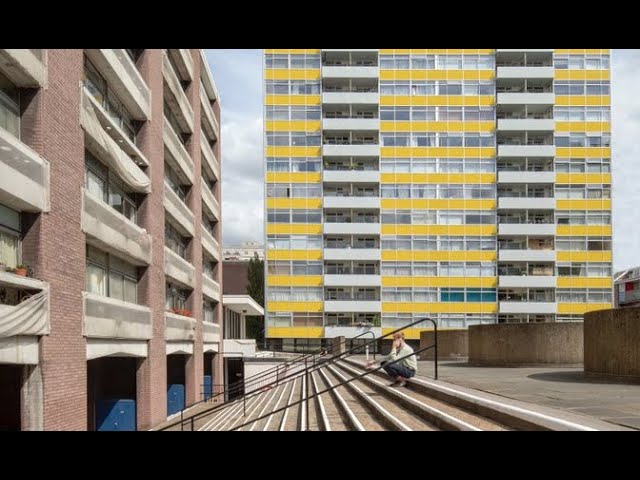
Originally designed in 1956 as part of the Golden Lane Estate by Chamberlin Powell and Bon for the City of London Corporation, this iconic Grade II Listed Building was a hugely influential post-war housing development, with unusual views into The Barbican, their best known work. John Robertson (John Robertson Architects) explores the sympathetic refurbishment of one of the City’s exemplary residential developments which took extensive consultation with leaseholders and tenants, Historic England, The 20th Century Society and the City Planners.
2020 Digital Lecture Series: 50 Fenchurch Street
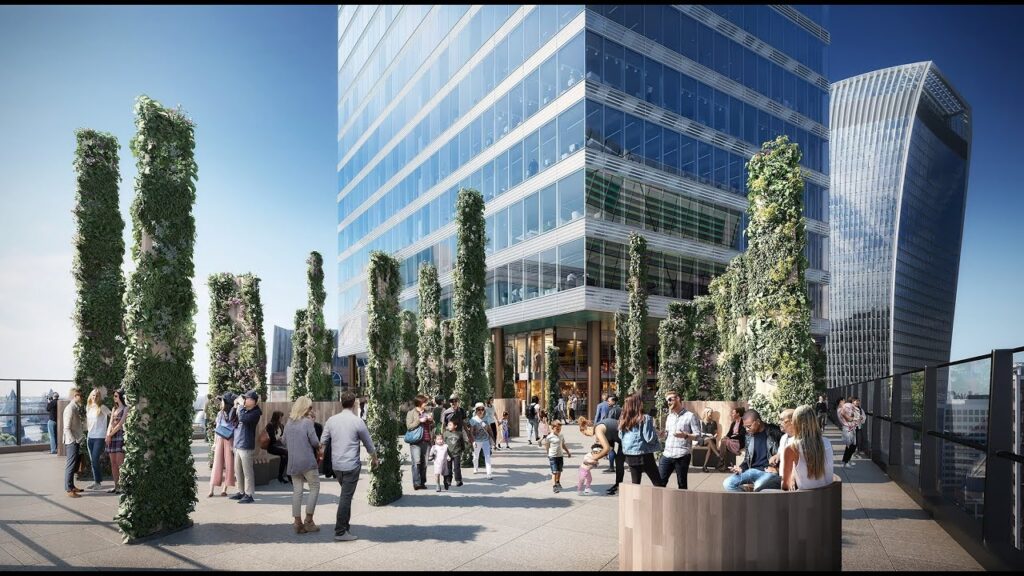
Eric Parry RA – 50 Fenchurch Street Tuesday, 16 June 2020 50 Fenchurch Street is an exciting new City of London development proposed by The Clothworkers’ Company. Eric Parry RA (Eric Parry Architects) discuss’ the scheme, which includes a new office building, Livery Hall for The Clothworkers’ Company, public roof garden, and winter garden and a significant new public realm situated around a restored Grade I Tower of All Hallows Staining.