


A New Museum for London pt I
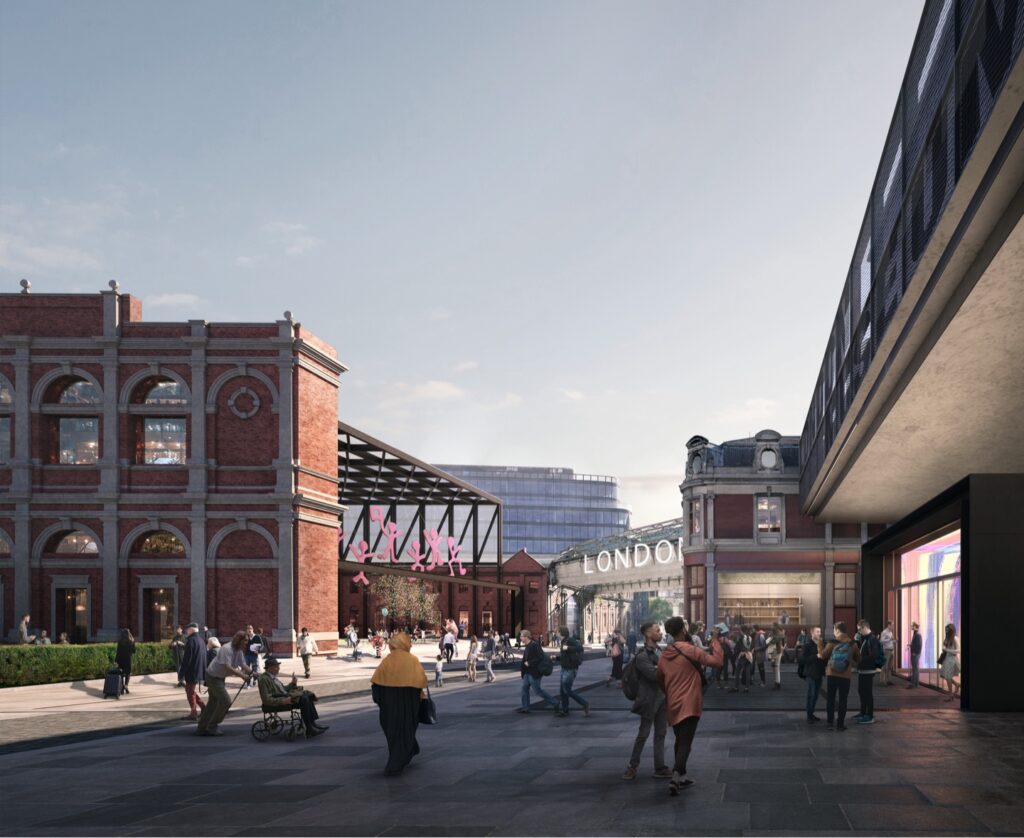
Friday, 7th February 2020 On Friday, a group of City Architecture Forum (CAF) Members were fortunate enough to tour the Museum of London’s new home at the historic West Smithfield. A planning application to support the relocation from the Museum’s current site at London Wall was submitted during December 2019 led by Stanton Williams Architects. Sharon Ament, the Director of the Museum of London (MoL) introduced her vision for the proposals from her appointment in September 2012 and how she had shared her passion for a new location with improved access for all. Paul Williams of Stanton Williams, the lead architects and designers of the MoL then explained how the design proposals evolved and how the project expanded into the Poultry Market. The application site itself comprises four buildings; the General Market, the Poultry Market, the Annexe and Engine House located within the northern section of the City of London (CoL) within Smithfield Market. The site itself is bound by Farringdon Road to the west, Charterhouse Street to the north, and West Smithfield to the south. To the east of the site lies the Smithfield Central Market which is made up of the East and West Markets. The Annexe is the collective name for the Fish Market, Iron Mountain and Red House buildings, separated from the Engine House by Smithfield Street. The Annexe and Engine House buildings are a CoL Corporation development and will be a mixture of retail (A1-A4), office (B1) and cultural/leisure uses (D1-D2). Whilst the General Market and Annexe and Engine House have been largely derelict since 1999 and 1983 respectively, a small number of traders are still seen to operate within the Poultry Market. Sales of meat, poultry, oils and cheese operates from 02:00-08:00 on weekdays within the East and West Markets. The development proposals for the General and Poultry Market are museum-led (D1) land uses, supported with ancillary café and restaurant (A3) and back of house office (B1) uses. West Poultry Avenue lies between the two market buildings, and will form the main entrance for the new Museum. This forms the destination entrance, connecting visitors from street level and presents a “Real Time” environment where visitors are immersed into the Museum from the living, breathing city streets outside. During the tour, CAF members learnt of how the General Market ground floor will represent the period “Our Time” encapsulating London from 1945 to today; where history becomes living memory. This large open space will be occupied by programming events as well with visitor attractions such as restaurants and cafes. Beneath this at basement level the General Market basement “Past Time” exhibitions will focus around purposeful permanent galleries, illustrating London’s story from the beginning until around 1945. Within the Poultry Market at basement level, visitors drop into “Deep Time”; this open and active London collection is held for research. The Poultry Market ground floor will be occupied by the contemporary “Show Time” where 2-3 temporary exhibition galleries will be displayed a year. Above this lies “Imagined Time” on the first floor encompassing London’s influence worldwide for example through the works of JK Rowling and Charles Dickens. The development proposals for the General and Poultry Market are museum-led (D1) land uses, supported with ancillary café and restaurant (A3) and back of house office (B1) uses. From the project’s conception, the Museum’s desires were to provide a permeable and connective space for users. The MoL offices at the new site are designed to open straight onto the public area, providing a unique opportunity to dissolve the barriers between visitors and Museum staff. As a result, there is no staff entrance proposed; staff and visitors alike will come in through West Poultry Avenue, reflective of how different groups are already interacting on the streets of London around the site. Within the outer ‘crust’ of the General Market, individual units referred to as the Houses will provide a range of flexible uses; A1-A4, B1 and D1-D2. A coach drop-off space will be provided on East Poultry Avenue in line with key aspirations of the Museum to increase school visits to the new site as an active learning destination. The Museum’s relocation to West Smithfield can be seen as a catalyst for renewal with significant public realm improvements planned for the Smithfield area. The Culture Mile proposals are a joint initiative through the City of London Corporation, Museum of London, London Symphony Orchestra, Guildhall School of Music and Drama and the Barbican looks to provide “an unrivalled visitor experience” through significant public realm improvements such as greening, wayfinding and public art from Farringdon to Moorgate. Furthermore, introduction of Crossrail services at Farringdon station will further increase pedestrian footfall around the site. “If we can get MoL to be more like London it will be the best Museum in London as it will connect with all people” said Sharon Ament and her passion for the vision and delivery of this world-class development was clear for us all to see. Words & Images: Roy McGowan City Architecture Forum member, Momentum Transport Consultancy
Behind the Scenes: Bracken House
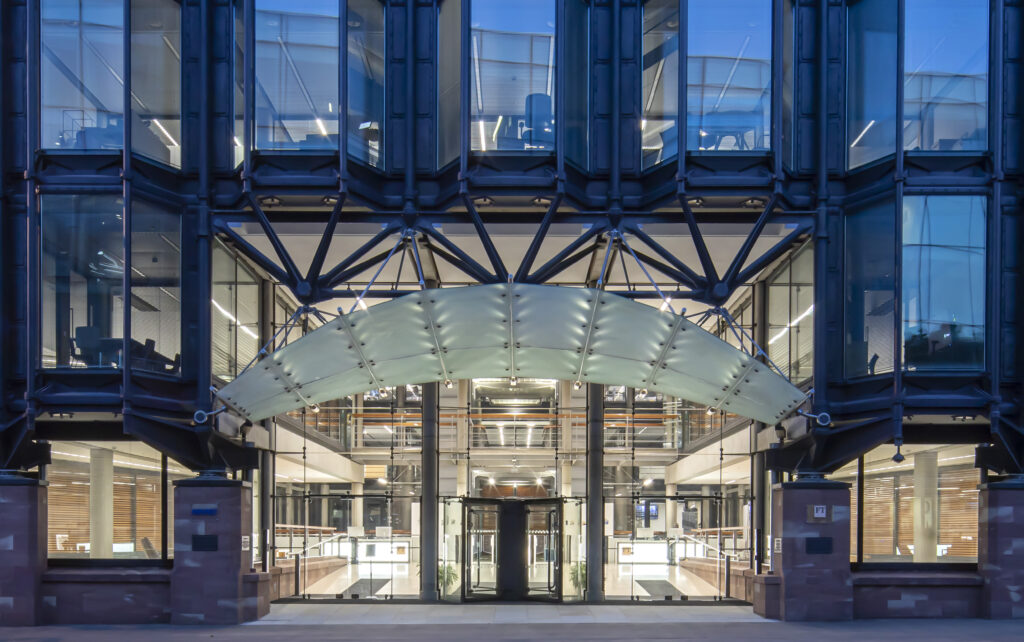
Thursday, 24 October 2019 A select group of City Architecture Forum Members were privileged to have an insightful visit around the newly refurbished Bracken House. The building sees the return of The Financial Times to its historic headquarters and their Global Facilities Director, Darren Long, welcomed us to their new home. The tour was conducted by John Robertson Architects Director, David Magyar and Project Director, Zemien Lee. It was fascinating to see the building brought back to life as a contemporary state of the art headquarters for the FT and lovely to see them return to their iconic home so close to St Paul’s. Bracken House was first designed by Sir Albert Richardson in 1959 and then significantly redeveloped in 1988 by Sir Michael Hopkins, replacing the central printing works between two brick and pink sandstone wings (reflecting the colour of the FT) with new, large post ‘Big Bang’ open office floors. The building is Grade II Listed and within the constraints of the St Paul’s Heights Grid, so the team has done a wonderfully sympathetic refurbishment, which enhances the iconic architecture of two great knighted architects to bring the building up to the most contemporary standards and expectations. On arrival, the entrance has been doubled in size, with two single storey areas either side of the double height existing entrance lobby, to provide generous waiting lounges. This allows the reception desks to be moved off axis to open up the magnificent central view of the atrium and lifts. The distinctive lift bank sitting at the centre of the atrium is constructed of exposed concrete, gunmetal painted steelwork and glass blocks to floors and roof. The architects have sensitively replaced the central section of roof with full glass panels flooding the otherwise faithfully maintained area with natural light. The two wings, being from an earlier era, have different floor heights and much smaller floor plates. They have been very cleverly connected into the large central office floors by new light wells that replace old solid cores of WCs and risers. These have stairs and bridges, are flooded with light and transform the connections of the building wings. Materials are faithful to the modernity of the 1980s building with glass, steel and concrete panels, and a clever use of oak floors and wall panels providing warmth and contrast to an otherwise neutral palette. The side wings now provide appealing, bright, intimate office spaces as a contrast to the large open plan floors, and a choice of work places for the FT team who are all working flexibly with a fully agile office designed by interior architects Perkins + Will. Another transformation is the new ceiling and lighting, providing bright working areas. Old 1980s fittings are replaced with the latest contemporary, seamless, linear LED fittings. These are now running towards the perimeter, rather than parallel to the facades, helping to better express the radial geometry of the Hopkins office floors. Sensitive contemporary circular fittings have been used for the wings, similar to the original arrangements. We visited the old Bracken House boardroom with its magnificent picture window facing St Paul’s, where Churchill often met his long-term political friend and colleague, and FT Editor, Viscount Bracken. This is now a contemporarily designed dining and meeting room. Perhaps the most stunning improvement is the new accessible roof terrace. With severe planning restrictions allowing no interventions breaching St Paul’s heights the landscape is cleverly integrated to provide an amazing amenity for the FT staff with stunning 360 degree views. A beautifully curved planter of external quality polished Corian forms benches and planters and sits alongside radial paving. This is inspired by the dome of Palazzo Carignano’s Baroque masterpiece that had originally influenced the design of Hopkins’ Bracken House. The whole team is to be congratulated on improving what was already an inspired building. Words: Richard Beastall City Architecture Forum member, tp bennett Images: © John Robertson Architects
What if we were to use circular economy as a business strategy?
The circular economy seeks to decouple economic growth from resource consumption by creating value in new ways. This directly address’ issues of resource scarcity, productivity and climate footprint through new business models and customer experiences. Organisations such as the World Economic Forum, OECD and the EU have recognised the importance of a circular economy to achieving global economic and environmental goals. The principles of a circular economy can help projects tackle even the hardest-to-mitigate aspects of their climate footprint. Below is a summary of findings from each of the tables at the CAF/ARUP Knowledge Cafe that was held in October 2019. Economics and Policy Table Discussion – Incentive for developers to design for re-use or a life of 200 years, or – Short lifecycle but hyper-reusable therefore super flexible – Think about the cost and the risk (material costs rising, would this change sell back or lease costs)? – Would this make the asset decrease or increase in value in a different way? – Who would be liable for issues with the material ie a leak? – This doesn’t really happen yet – A key question is how to build a community so people can share – Smaller flats with more communal space – like the new student housing model – A sacrifice is required somewhere in the system – How would actually adjusting pricing impact different people in society? Refurbishment Table Discussion – Raised floor tiles and external façade sent to be refurbished – Historically, contractors can add value from a job by reusing or recycling materials – For example, the demolition of a railway shed at Kings Cross went out to tender. Tender submitted for job at zero cost as they had realised the rail sleepers were lined with platinum – We need to be better at understanding value in materials – By 2050, 87% of existing buildings will still be in use – Reuse is often faster and cheaper – Changes in planning, for example height regulation, means you could have more floor space – Are we building space for the sake of building space or do we actually need it? – Could use a timber frame to expand, and therefore not demolish whole buil – Cost would have to be managed so as not to drop market – Poor financing model as loans had very high interest rates – Damaged sustainability agenda – For example, cars show emissions of car but do not show the emissions during its manufacturing – Long term and flexible material passport could help future proof costs of refurbishment – Digital boom will help – Service history informs risk therefore people know how to manage the building and retain the value – This could feed int BIM and use of AI in construction management – At 1 Triton Square, Arup refit previous facades after reusing and cleaning them – Brief specified BREAM excellent which then became to outstanding using marginal gains – Cultural shift in own thinking required Materials Passport Table Discussion – When was it poured? – What was in the mix? – Each slab can be tagged and catalogued – Makes it easier to track value of resource – Contrast between American and European views – Europe is more accepting of reused assets – The idea of leasing steel is a great way to buy into this – Could include consideration of this as an extra design stage (RIBA and GRIP) – Digital Object Identifiers are a potential way to meet this need – A counterpoint is that further opportunities are also needed to be able to purposefully use the information gathered – Clients as well as contractors should be aiming to lead in offering useful opportunities – Need to make it worthwhile to collect the information – Answer from group: Value comes from knowing and ensuring materials are used in the most efficient way possible (cost and sustainability benefit) – Also need to ensure information gathered is concise and accessible enough to be useful, as too much information will deter use – This however requires a good information management system – Need to also educate clients that value exists intrinsically locked within assets Planning Table Discussion – If we look at number of rooms in London and directly compare to number of residents, seems like London doesn’t have a housing problem – Shows the need for a change in the planning of our housing and breakdown in the housing market’s mechanisms – This will likely face opposition from the public – Does council tax cover this? – Potentially an incentive on those sharing spare space is a more effective solution – Is there a need to bring in extra capital gains tax for foreign purchasers and sellers? – Will require fundamental change in how new infrastructure is designed and planned – Rather than making mixed use of an area, facilitate multiple used of the same exact space (e.g. school buildings being used as educational centres during the day and community centres, polling booths in the evenings/holidays) – Need a way to test for willingness of occupiers to share space – Build this into stages of construction – AirBnB is a good existing commercial example of this – Should we address this issue first? – Group member introduced concept of site guardians – Normal room in ‘undesirable’ spaces – Can change according to requirements e.g. couples’ room – Great value for money – No ownership is possible however – Nordic countries have accepted shared ownership/ long-term renting as the norm – do we need to change our mindset? – Does Nordic model have an over reliance on the housing system though? – Good idea but is it scalable? General floor discussion – Space – why do we have to build more when so much is vacant? – We have a housing problem, but we have enough room. It is a matter of consumption. We leave offices empty, so could we use AI to match floor spaces which are vacant […]
Behind the Scenes: One Fen Court

Monday, 30 September 2019 One Fen Court is a new building located in the heart of the City of London designed by Eric Parry Architect (EPA) and owned by Generali. You’ve probably already seen its colourful iridescent top the peaking put atop the City’s winding streets. We had the rare opportunity to hear from most of the project team, in addition to EPA and Generali, occupier and end user, M&G Investments and Interior Designers, tp bennett presented. The presentations were followed by a tour of M&G’s office spaces. Philip Vaughan, Director of Development noted that M&G, occupier since November 2018, wanted to create a destination for their business and were attracted by the prime location and opportunity to occupy a landmark building. They have a dedicated entrance at 10 Fenchurch Street which brings visitors into a grand entrance lobby leading to the lifts and up to the company’s auditorium, where the evening’s presentation was hosted. Interior designers, tp bennett were able to translate the company’s ambitious vision into reality, providing an agile workplace supplemented with a variety of support spaces to suit the diversity of departments within the business. Tina Palliet, Head of Projects Development at Generali, spoke of the challenges that the team faced which started with the complexity of 7 different land ownerships on the site and an extensive archaeological excavation. The project offers a net lettable office area of 38,000sm over 13 floors and has six retail units. The project’s crowning glory is the City’s largest public roof garden with a 360 degree view. The restaurant on the 14th floor should be open by the end of the year, so keep it on your radar! The project had received numerous accolades even before completion and was awarded BREEAM Excellent. The focal point of the public passage through the building is a large LED screen, also signifying entry to the roof garden. Currently on display is ‘Botanic’ by Jennifer Steinkamp, part of Sculpture in the City, a flowing digital floral composition. Eric Parry, Founder and Principal at EPA, described the building design process and aspirations for the project. From the onset of the project the planners wanted the building to be a city block building, not a tower. EPA created porosity through the block with a public passage. In elevation the building is organised in a tripartite manner with a base, middle and top. The loggia at its base, signifies entry and retail, the centre is the main office space, which creates a neutral backdrop to the Crown, a sculptural form lined with dichroic film, the site of which can brighten even the darkest of days! The office space is column-free with the structure integrated in the perimeter façade. Richard Beastall, Principal Director at tp bennett, described how they embraced M&G’s aspirations within their design. They tied together a flexible working environment, a staff restaurant, a signature double height arrival space and executive floor, by using a central organising circulation spine throughout the fitout. This spine is well-used and creates a buzz, one of the many spaces which encourages staff interaction. The primary neutral palette uses rich materials which can be seen in the main reception, so take a peek! In contrast the variety of meeting and touchdown spaces have been thoughtfully curated and using exciting furniture selection and an array of colours throughout, creating a variety of collaborative workspaces. The success of the project is a credit to the collaboration of a talented and progressive team, and a brave client! Words and images: Etain Fitzpatrick City Architecture Forum member, John Robertson Architects
Frederick’s Place in the world

Frederick’s Place Wednesday, 10 July 2019 I think Robert Adam would be very pleased with fellow architect and Scotsman John Robertson for not only extending the life several of his buildings, but also for respecting his original work that survived bomb damage during the Second World War. 7/8 Frederick’s Place which sits off Old Jewry a few yards from Cheapside, the busiest shopping street in the City, and forms part of a group of buildings all owned by The Mercers’ Company. The Company asked Robertson and his team at JRA to work on a masterplan for the buildings in this small street, that in its time was home to Sir John Frederick (Lord Mayor 1661), Prime Minister Benjamin Disraeli (1821-1824) and the offices of what was to become accountants Price Waterhouse. Simon Taylor, The Mercers’ Company Property Director, asset managed the street to vacant possession to enable the whole to come together and allow regeneration to take place under a JRA master plan. This has seen the Livery Company secure a new entrance into its Hall through No.6 Frederick’s Place, Nos. 7/8 refurbished while Nos. 1/3 will complete their upgrade in November this year. Planning consent for other buildings has been or is in the process of being obtained. Nos. 6/7 offer contemporary and functional office in a very good location only 200 yards from Bank which has seen all the offices fully leased only a short time after completion, while a ground floor café operation is expected to be signed shortly. Excellent rents have also been achieved underlining that the Mercers have produced the right product at the right time given the changing market due to the impact of Serviced Office operators. Throughout the building a mixture of brickwork has been left exposed – some original, some Victorian and some post war – while two Adam fireplaces, an original ceiling and staircase have all been restored. Each floor has been opened up so that small office suites could be offered if required, although each floor has subsequently been let to single tenants attracted by interesting, yet functional space with modern kitchen and toilet facilities all served by a new lift and a VRF cooling system. The tall ceilings allow in plenty of light while a covered lightwell brings a brightness into the café area. Other spaces have a contemporary white cladding to the walls, which does not reach full height leaving exposed brickwork above, with uplighting carefully hidden behind the cladding. Steel beams are also on show giving an almost industrial feel in places. The City Corporation is currently resurfacing Frederick’s Place, paid for by the Mercers which will create a pedestrianised approach to the buildings. All the office space in Nos. 1/3 is currently under offer, so I feel sure Robert Adam would be very grateful to the Mercers’ for respecting his original buildings and admire the creative design of JRA in bringing these buildings back to life in a sensitive yet also profitable way. I can’t wait to return later in the year to see the completed project. Words and images: Simon O’Donnell City Architecture Forum member Priority Real Estate
Green Pleasure

33 King William Street Tuesday, 11 June 2019 On Tuesday 11thJune, we had the pleasure to join John Robertson, Director at John Robertson Architects, to explore 33 King William Street, a new landmark designed and delivered by his team for the international property developer HB Reavis, the latter’s first major development in the UK. The development is located in a privileged spot in the City of London, where King William Street meets London Bridge. A combination of a very popular area with continuous heavy traffic. The site context was a key driver behind the design of the building. From the outset the building was conceived as a complimentary backdrop to Grade 1 listed Fishmonger’s Hall, which sits in front of it, and Art Deco Adelaide House, opposite. The elevation on Arthur Street is generated by its surroundings. Its design has been inspired by the colours and tones of the buildings it faces. The result is a promenade of reflected light and earthy brick tones that marries this contemporary new building with its historical surroundings. 33 King William Street building perfectly captures this role, as it raises a green landscaped roof that compensates for the tough, dense and polluted location catalogued as the most contaminated point in London. The purpose of the visit was to admire the building from the deck and the facade and enjoy its meeting and enjoyment green space. The combination of the urban environment with the roof’s landscaping is impressive. Access to the roof is designed so that everyone enjoys the green space, the views and the environment specially designed between NE, SE and W directions. The project is totally defined or limited by the visuals between Greenwich and Saint Paul’s Cathedral, so that all elements of the roof have had to limit their height. This has led to the sinking of the building’s facilities and losing part of the free height of the last floor, but leaving an impeccable roof. The gondola’s route is very well integrated with the walking path that runs along the perimeter. The work done by Townshend Landscape Architects is impeccable in the selection of the different species, the colour of the flowers, the smells that emerge and the overall arrangement. The drawing of the floor plan is very expressive of the intentions being sought. It is worth highlighting the installation of photovoltaic panels on the roof that achieve 4% of the total capacity of the building, achieving greater parameters when not working at maximum capacity. Words and images: Xavier Aguiló City Architecture Forum member BAC-evolve consulting engineers
Feeling Uplifted
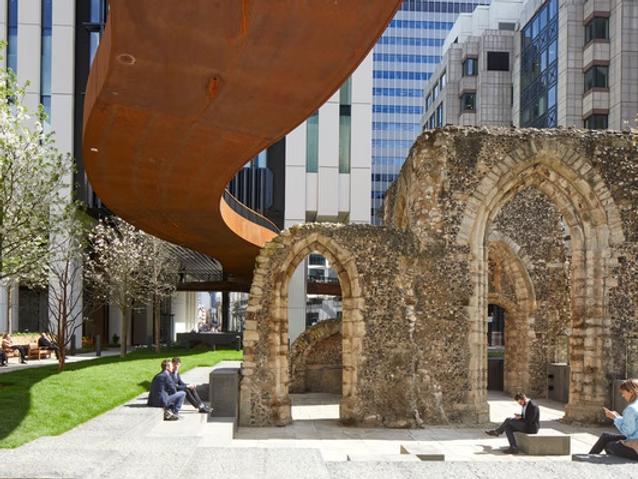
London Wall Place 29 April 2019 Brookfield and Oxford Properties have made a bold move to knock down a large stretch of London Wall; the 1950’s version, that is. The impermeable podium building that once spanned the full length of the site is gone, and through close collaboration with many stakeholders, two new office buildings designed by Make have been elevated above the site, creating a significant new piece of public realm layered with pedestrian paths, intimate pockets of gardens and seating, elevated walkways, and retail space; much appreciated by the City dwellers. As the project architect Chris Jones described the development of their concept following a successful competition bid in 2008, the importance of understanding the history of the site was clearly paramount since its inception. Chris explained their objective of adding a new layer rather than wiping the slate clean. However as we explored the site, it became clear that the new development does more than adding a layer; it respectfully reveals and enhances many more layers of history. The pavement along London Wall now widens and steps down to reveal the remains of St Alphage Church, and a new tiered garden seamlessly extends the existing garden of the Salters Institute bound by a section of the original London Wall. A new paved route dissects the site at street level, whilst sweeping walkways above the site reinstate existing connections to the Museum of London as well as bridging the road of London Wall. The use of consistent materials throughout the landscape provides clarity, and distinguishes the public spaces and routes from the new buildings on the site; for example corten steel is used as a robust maintenance-free finish to the planters, public stairs, railings, and bridges. The layers at street level continue upwards breaking down the scale of both buildings by creating stepped elevations with a vertical emphasis, in contrast to the horizontality of the previous podium building. The use of distinctly contrasting facade materials also emphasises the layers of the facades. The chalk-white GRC panels are split by the intricately curved iridescent panels of blue-black glazed terracotta, reminiscent of the flint used in the Roman remains. Care has been taken to wrap the facade materials under the soffits of the elevated buildings, and where the expansive use of dark terracotta may seem counter-intuitive, the highly glazed finish responds to the changing daylight and reflects many colours from the surrounding landscape. The buildings provide the quality of modern office space we expect in the City; 580,000sqft of flexible floor plates designed to accommodate multiple tenants at an occupancy density of 1 person per 8m2; 1.5m spaceplanning grid; floor to ceiling glazing; landscaped terraces; and BREEAM Excellent. What makes this project unique is the opportunities that have been realised by working closely with the stakeholders, in particular the freeholder, the City of London. The importance of this collaboration has enhanced connectivity across an acre of new landscaping at street level, balanced by the successful negotiation of extensive cantilevers on both buildings along London Wall, coordinated with the City’s traffic calming measures – a reduction in the number of the traffic lanes and widening of the pavements. As Carlin Fier from Brookfield explained, the project reflects their ambition to reinvest in, and activate public spaces within their developments, with a programme of events already underway including a free concert by the London Symphony Orchestra in June. Brookfield Oxford’s approach not only offers quality space, but a new sense of place for the wider community in the City. Words and Images: Liam O’Grady City Architecture Forum member Hutchinson & Partners, Associate
Republic at East India Dock
Forum members and their guests joined Robert Wolstenholme, Founder of Trilogy Real Estate to discover the vision behind Republic, the next-gen office campus redefining the workplace in East London. The project is a dramatic reimagining of a tired post-modern office campus, the newly launched Import Building is a 270,000 sq ft refurbishment on a 600,000 sq ft campus delivering affordable rents and a lifestyle offer aimed at creative businesses priced-out of Central London and Shoreditch. Reimagined and refurbished by architect Studio RHE, the project reflects Trilogy’s approach to creative places and features collaborations with artist Scott King, graphic designer Tom Hingston, retailer MagCulture and workspace operator Trampery. The building launched with a collaboration with Courier, the start-up culture magazine, whose first ever festival took place at the campus in September and is accompanied by Clipper, a magazine which celebrates culture in the area. On-site lifestyle benefits include a dedicated Community Management and Wellness team who provide personal training, classes, events and advisory services to tenants; a health and fitness centre operated by PureGym; a Gentlemen Baristas coffee shop.