
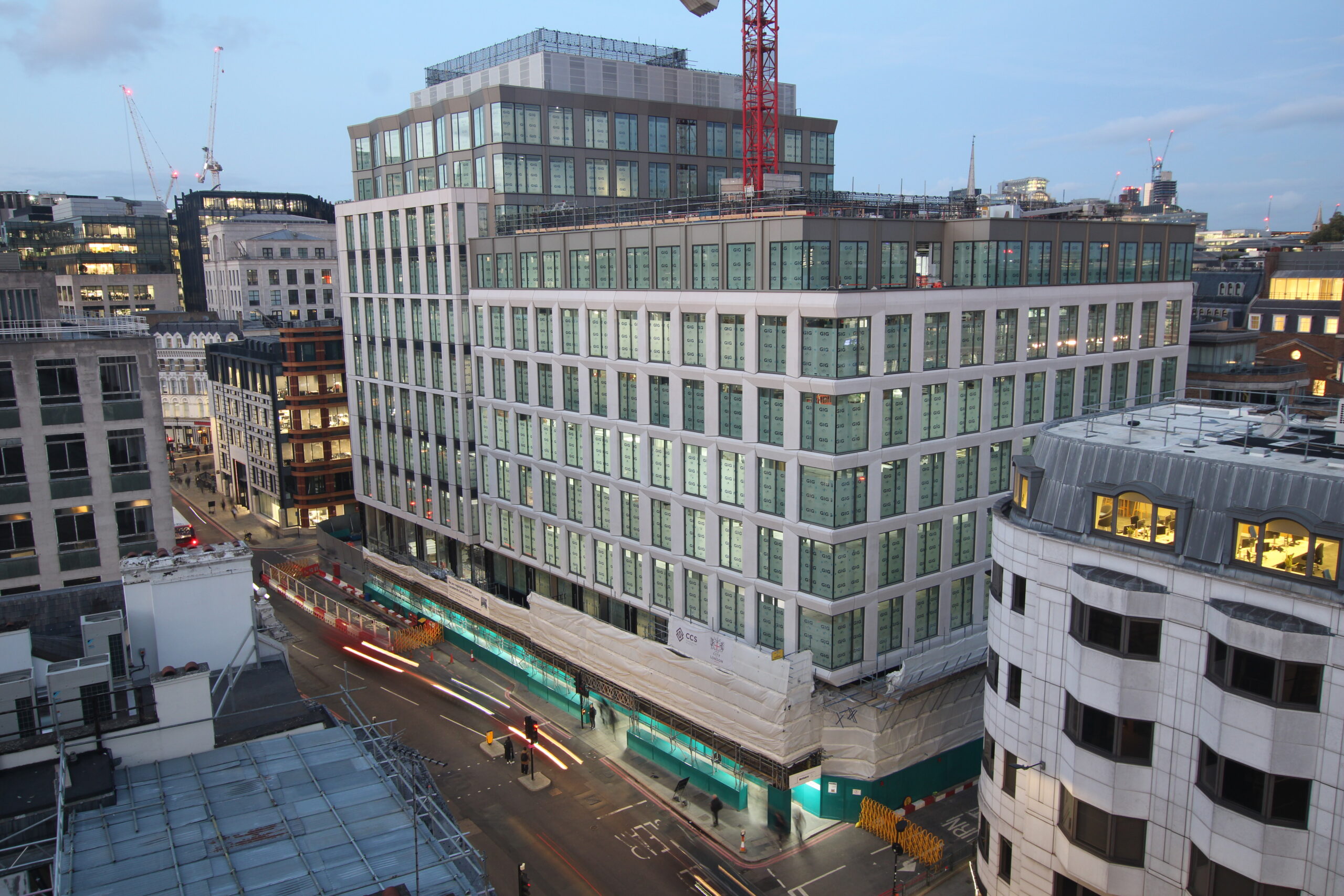
CAF members visited the soon-to-be-completed project at 100 New Bridge Street, a retrofit project of an existing building (completed in 1992) to renew the life of the building to meet current tenant requirements and environmental standards.
Developed by Helical and Orion, with architects Gensler and main contractor Mace, the project is nearing completion with final finishes and landscaping works underway.
Gensler and Mace presented key aspects of the building, including a synopsis of the existing building, described as typical for its era, with good floor-to-ceiling heights, and structural frame, but with the entrance in the wrong place and an uninspiring façade.
The building sits over the City Thameslink rail line, so to combat structure-borne vibration it was constructed with spring dampeners at the basement level which isolate the building above. One of the key aspects of the project brief was to not touch the basement or foundation levels.
Primary changes to the existing design comprise two additional floors of offices at levels 9 and 10, floor plate extensions to the entire western façade, infilling of previously set-back corners, with additional massing created to the east, and the infill of the existing atrium.
These alterations have provided 30,000sqft NIA additional floorspace whilst maintaining compliance with LVMF protected views of St Paul’s.
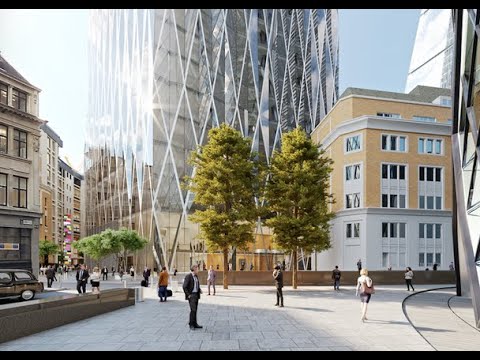
The entrance, formerly in the centre of the main façade, has been repositioned at the north east corner to face towards Ludgate Circus. A garden terrace has been added to provide tenant outdoor amenity space, and the ground floor has been opened up to provide more visual transparency to New Bridge Street and a better arrival experience.
Key Aspects of the Project
- 200,000 sq ft total area
- Retained 90% of existing structure
- Building sits on springs for acoustic isolation from train tunnel below
- Key architectural moves
- Relocated entrance from mid-building to corner (Ludgate Circus)
- Extended building 1m onto New Bridge Street (this only happens from level 2 and above oversailing the highway)
- Added +30,000 sq ft through extensions and infill
- Removed low canopy, lifted ground floor datum
Sustainability & Carbon Performance
- Carbon target achievement
- Target: 350 kg CO2/m²
- Actual: Just over 400 kg CO2/m² (still strong performance for existing building)
- Subject to planning condition for whole life cycle carbon assessment
- Material reuse initiatives
- 30 tons steel reused (same amount out/in due to program constraints)
- Granite cladding reused in reception areas
- Extensive donation program via St Mungo’s, London National Park City
- 1,100+ books donated through site letterbox initiative
- Green features
- 5 new accessible terraces added
- Greened every possible roof area
- Enhanced thermal envelope (original had 30mm roof insulation)
- 115 PV panels at roof level
Construction, innovation and prefabrication Prefab’ strategy expansion
- 15 prefab’ elements vs seven on previous project
- Riser modules: 46 units installed in just 24 hours
- Cat A prefab’: 1,670 ceiling modules (two-step vs traditional eight-step process)
- Three-story ductwork modules replaced ten-story blockwork shafts
- Mock-up program
- Full 12m x 9m structural Cat A mock-up
- All mock-ups built in same location for comparison
- Successful testing led to suspended ceiling choice over exposed services
- End-of-journey facilities
- 334 cycle spaces (two-level arrangement)
- 154 showers (high-end hospitality-grade provision)
- Gender-neutral Super-loo arrangement
Project delivery and outcomes
- Long PCSA period enabled extensive optimisation
- Building forward-sold to State Street during construction
- Full letting achieved during topping out
- Completion: April, tenant fit-out September/October
- Accreditation targets all achieved (BREEAM Outstanding, WELL enabled, Nabers 5*)
- Team continuity across multiple Helical projects (33 Charter Street → 100 Ludgate Hill → Paddington)